Mountain Review: Mountain Creek
MOUNTAIN SCORE

CATEGORY BREAKDOWN
See our criteriaGOOD TO KNOW
1-Day Ticket: $90-$120
Pass Affiliation: Snow Pass
On-site Lodging: Yes
Après-Ski: Limited
Nearest Cities: New York (1.25 hrs), Philadelphia (3 hrs)
Recommended Ability Level:

+ Pros
Standout freestyle terrain across all of South Peak
Night skiing on every pod, open until 9 PM daily
High-speed lifts serving both major bases
Easy day trip from New York City
– Cons
Very little natural snow, so conditions depend on snowmaking
Heavy weekend crowds and congested slopes
Odd lift setup, including the slow Sojourn Double connector
Commercialized feel with ongoing etiquette problems
MOUNTAIN STATS
Skiable Footprint: 167 acres
Total Footprint: 398 acres
Lift-Serviced Terrain: 100%
Top Elevation: 1,461 ft
Vertical Drop: 1,001 ft
Lifts: 11
Trails: 44
Beginner: 37%
Intermediate: 48%
Advanced/Expert: 15%
Mountain Review
Looking to go skiing, but stuck in New Jersey? Mountain Creek, the state’s only outdoor ski resort, may be your default choice. The mountain has long been infamous for its history as both a ski hill and a summer amusement park, with the latter earning the nickname “Class Action Park” after decades of unsafe rides causing injuries and even fatalities.
But the Mountain Creek of today actually doesn’t look half bad on paper. The resort offers multiple high-speed lifts, a substantial collection of freestyle features, and night skiing most days of the week. But can a New Jersey ski resort really provide the snow and terrain quality to compete with destinations elsewhere in the Northeast? And is its infrastructure actually equipped to handle the demand that comes with its location?
In this piece, we’ll go through the overall Mountain Creek experience, and then we’ll see how the resort stacks up in our overall rankings. Let’s jump right into it.
Size and Terrain Layout
One of the most surprising things about Mountain Creek when you first arrive is just how sprawling the resort is. Despite its New Jersey location, the mountain stretches across a surprisingly large footprint, and it feels much broader and more substantial than you might expect going in.
Mountain Creek is essentially spread across three main skiing pods grouped into two broader complexes. Vernon Peak and Granite Peak make up the resort’s northern side, with Vernon serving as the primary base area and Granite offering another distinct zone of more conventional ski terrain. Much farther south, South Peak and neighboring Bear Peak form a separate southern complex with its own base area, with South in particular serving as the resort’s main freestyle hub. The Vernon and South base areas are roughly two miles apart, and while the two sides are connected on snow, the distance is significant enough that South can almost feel like a separate ski area once you make your way over there.
Mountain Creek’s 1,000-foot vertical drop is nothing to write home about compared to the bigger ski areas farther north. But for New Jersey, the statistic is frankly better than you might expect, especially on the South Peak side, which is slightly taller than the northern pods. While still well short of many Catskills resorts, Mountain Creek’s vertical is right in line with some of the biggest mountains in Pennsylvania and actually exceeds many of the other major ski areas in that state. And while plenty of Mountain Creek’s individual trails are still fairly short, there are some runs here that provide reasonably substantial laps—which, for skiing in New Jersey, some people might find frankly amazing.
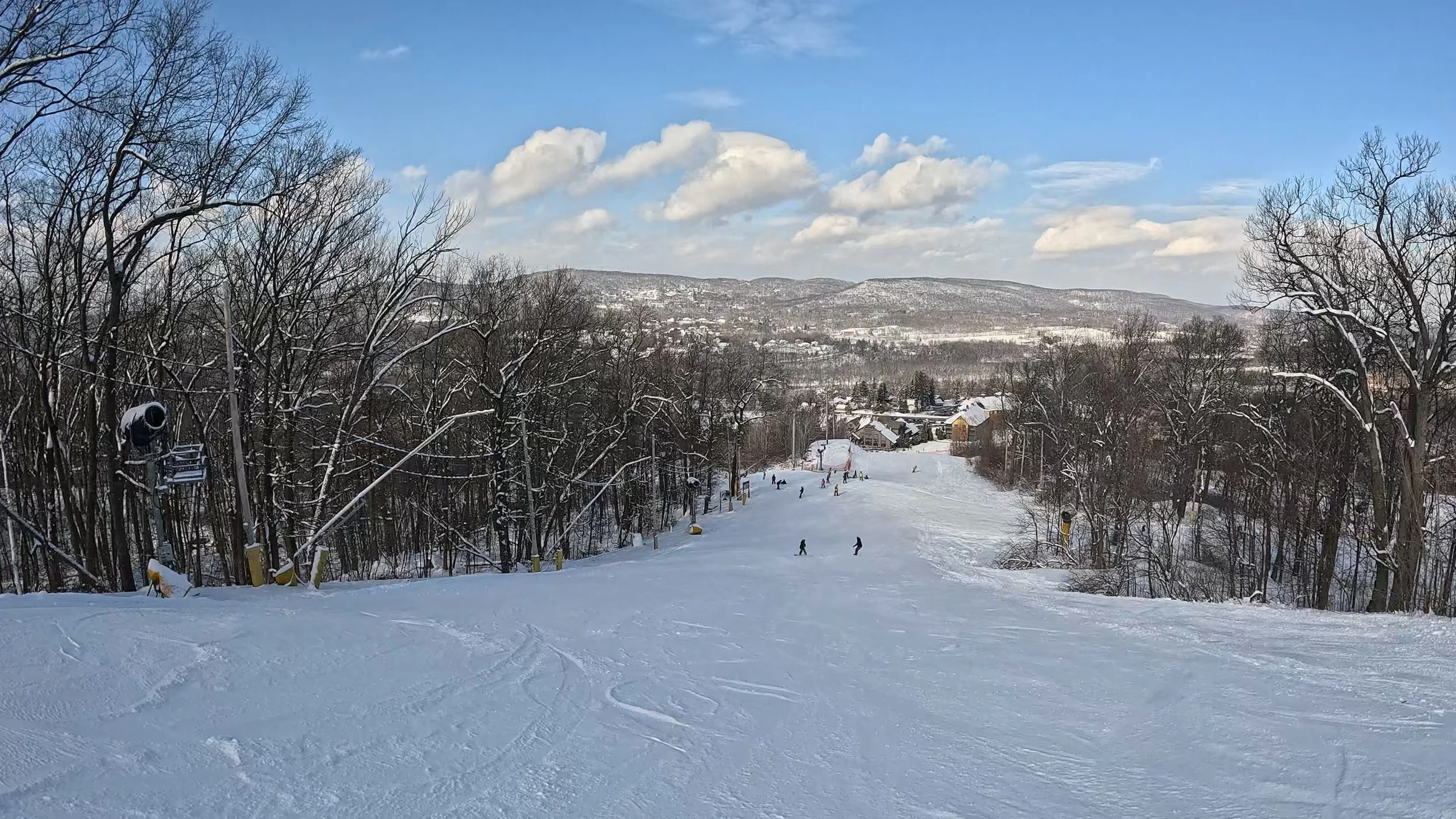
Vernon Peak is Mountain Creek’s primary base area and one of three main skiing pods spread across the resort.
Beginner Terrain
As one of the closest ski areas to New York City and many of its suburbs, Mountain Creek reliably attracts a huge number of less experienced skiers and riders, including plenty of people who are just learning. If you’re a beginner, you’ll probably spend most of your time at Vernon Peak, which is home to the overwhelming majority of Mountain Creek’s green terrain. True first-timers will generally start on the Terrain-Based Learning carpet areas. The next obvious progression is the Sugar Quad, but its slope is surprisingly steep for a true beginner, creating a fairly abrupt jump in difficulty once you graduate from the carpets.
There is also a green trail running down from the top of Vernon Peak, although calling the experience relaxing would be a stretch. Dense concentrations of inexperienced skiers and riders are commonplace here, many of whom take up huge portions of the slope while making unpredictable turns. If you want to witness one of the more impressive displays of concentrated beginner chaos you’ll find on a ski slope, this is probably the place to do it.
But perhaps surprisingly for a resort that attracts so many first-timers, large portions of Mountain Creek are not particularly beginner-friendly. South Peak is entirely devoid of green terrain, and there are no green trails leading down into the Granite Peak pod either, although there is a green route that allows beginners to ski out of it. As a result, less experienced guests are much more geographically constrained than Mountain Creek’s overall size might initially suggest.
Intermediate Terrain
Stepping up to Mountain Creek’s blue runs will put you on, at least relatively speaking, intermediate terrain. Reaching this ability level unlocks essentially every remaining area of the resort, although on Vernon and Granite Peaks especially, it can still be difficult to completely escape the green terrain—and the beginner traffic that comes with it.
Bear Peak offers one of the better options for intermediates looking to get away from the crowds, with the Bunk’s Bank/Haley’s Comet route providing what is probably one of the least congested blue runs most guests will want to take at the resort. Another notable run is Southern Sojourn, which is the longest trail at Mountain Creek and provides an on-snow route from Granite Peak over toward South Peak. But the run has some notably flat sections, along with another glaring issue that we’ll get into later in the infrastructure section.
Terrain Parks
But the most unusual intermediate terrain at Mountain Creek is found once you reach South Peak. Every blue trail descending from the top of this pod is designated as freestyle terrain, meaning that rather than simply providing conventional groomed runs, these trails are built around terrain-park features. This wholly freestyle terrain pod area actually gives Mountain Creek a surprisingly standout terrain feature despite its otherwise unremarkable footprint.
Rather than hitting a handful of features on one short dedicated park trail, you can string together boxes, rails, jumps, and other features throughout a substantial top-to-bottom run—or, in some cases, swap between trails to hit different features midway down. Most of what exists typically falls into the small-to-medium range, although larger jumps and rails can exist. On the other hand, not every one of these trails is always completely built up with freestyle features and your mileage may vary depending on when you visit. There is also one short freestyle blue run off Vernon Peak with beginner-level features, as well as a walking park at the bottom of South Peak.
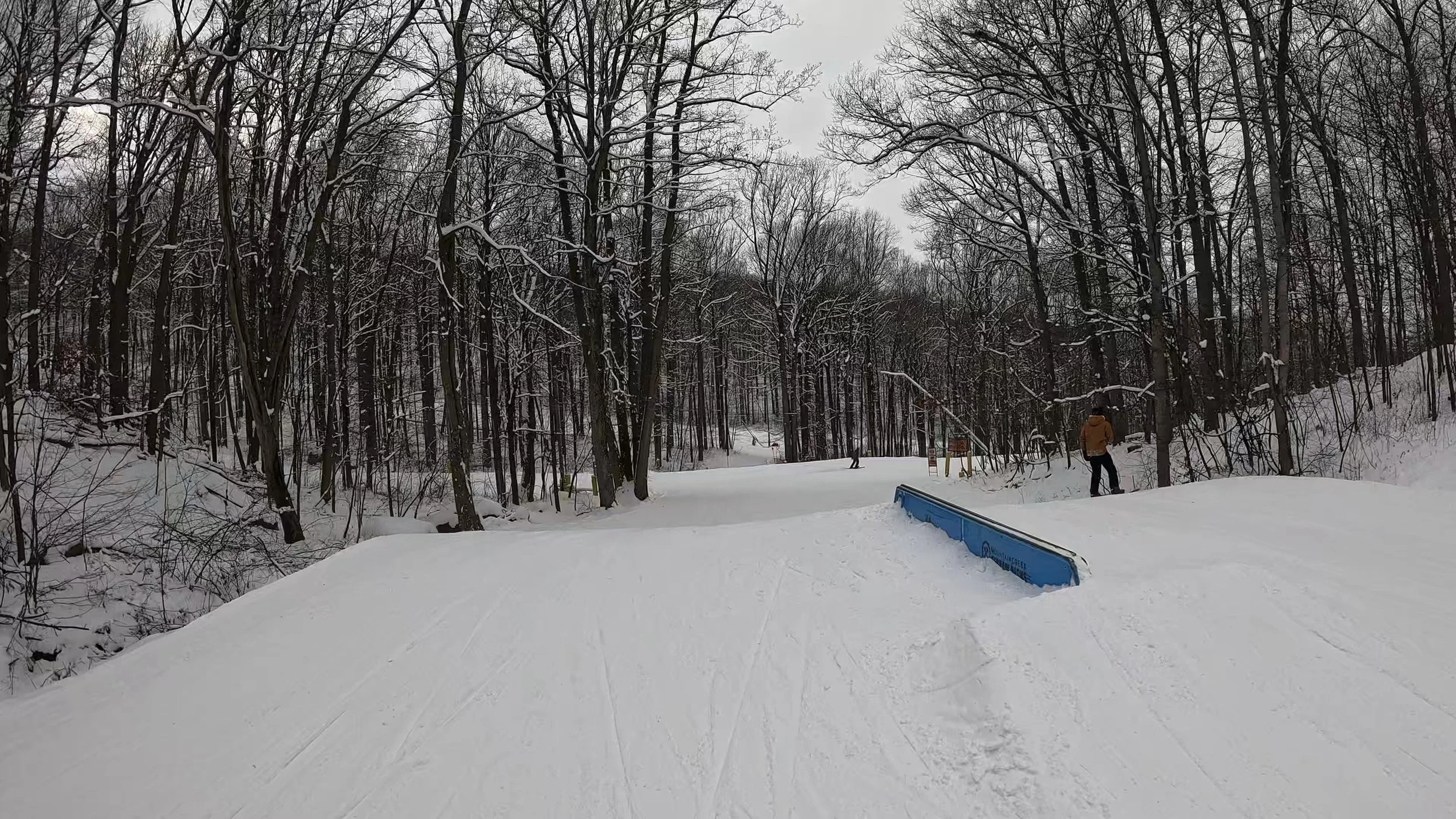
Every blue trail descending from the top of South Peak is designated as freestyle terrain.
Advanced and Expert Terrain
With its family-oriented layout and almost exactly 1,000 feet of vertical, nobody is going to mistake Mountain Creek for a resort designed around advanced and expert skiers and riders. Still, there are a decent number of black-diamond-rated trails spread across the resort’s footprint.
Most of these runs are groomed, and by broader Northeast standards, many would be manageable for a confident intermediate. That said, there are a few modestly steep pitches scattered around the mountain that provide at least some challenge and variety beyond the resort’s blue terrain.
Perhaps the best thing about Mountain Creek’s black runs, though, is simply that they tend to scare off the resort’s large beginner population. As a result, they are reliably among the least congested trails on the mountain, making them some of the better places to actually open things up and get a clean lap.
There is also a single gladed run on Vernon Peak, at least on paper, but it’s a stretch to call it open even rarely.
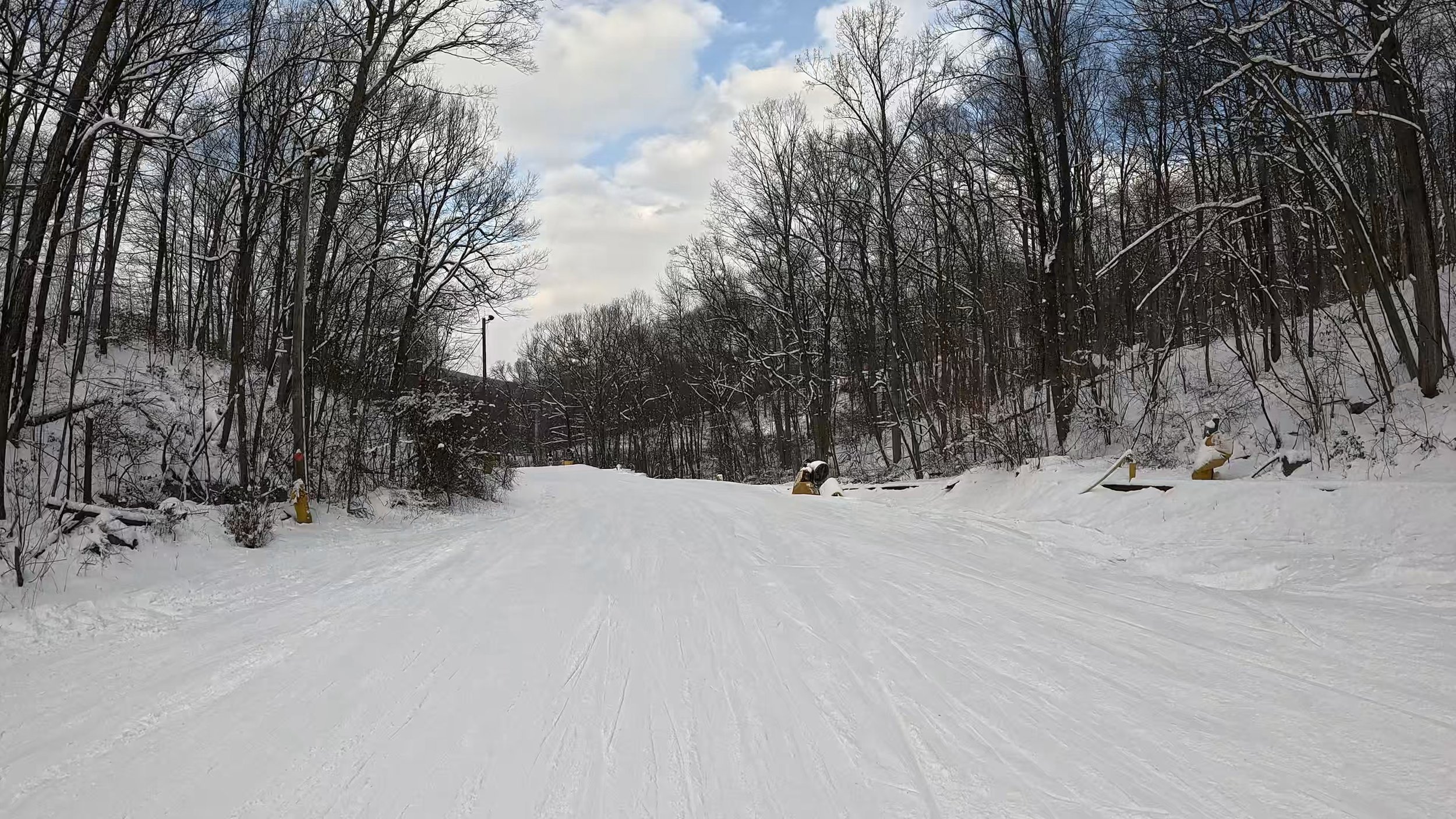
Mountain Creek’s black runs are reliably among the least congested trails on the mountain.
Snow Quality and Resiliency
Mountain Creek’s biggest natural disadvantage is exactly what you would expect from skiing in New Jersey: it simply does not get very much natural snow. The resort advertises an average of 65 inches per year, but recent independent reporting has generally come in much lower than that, with several seasons producing well under half of that.
Perhaps a bit surprisingly, Mountain Creek’s snowfall is not actually that far out of line with many ski areas in the Poconos of eastern Pennsylvania. The difference becomes much more pronounced once you head farther north, with the major Catskills resorts typically receiving substantially more natural snow.
As a result, Mountain Creek’s ski season is overwhelmingly dependent on snowmaking. The resort has snowmaking coverage across essentially its entire developed trail network, and it’s a good thing it does, because without that infrastructure, operating consistently in this climate would be extremely difficult.
But even artificial snow isn’t always foolproof. Freeze-thaw cycles and even outright rain are common occurrences during the core winter season. Anyone who has skied or ridden Mountain Creek before won’t be surprised to encounter “white ribbon” conditions, where the snowmaking areas are surrounded by completely bare ground. And because many of Mountain Creek’s lift lines do not follow official ski trails, don’t be surprised to find yourself riding above completely bare slopes on the way up the mountain, even while the runs themselves remain covered.
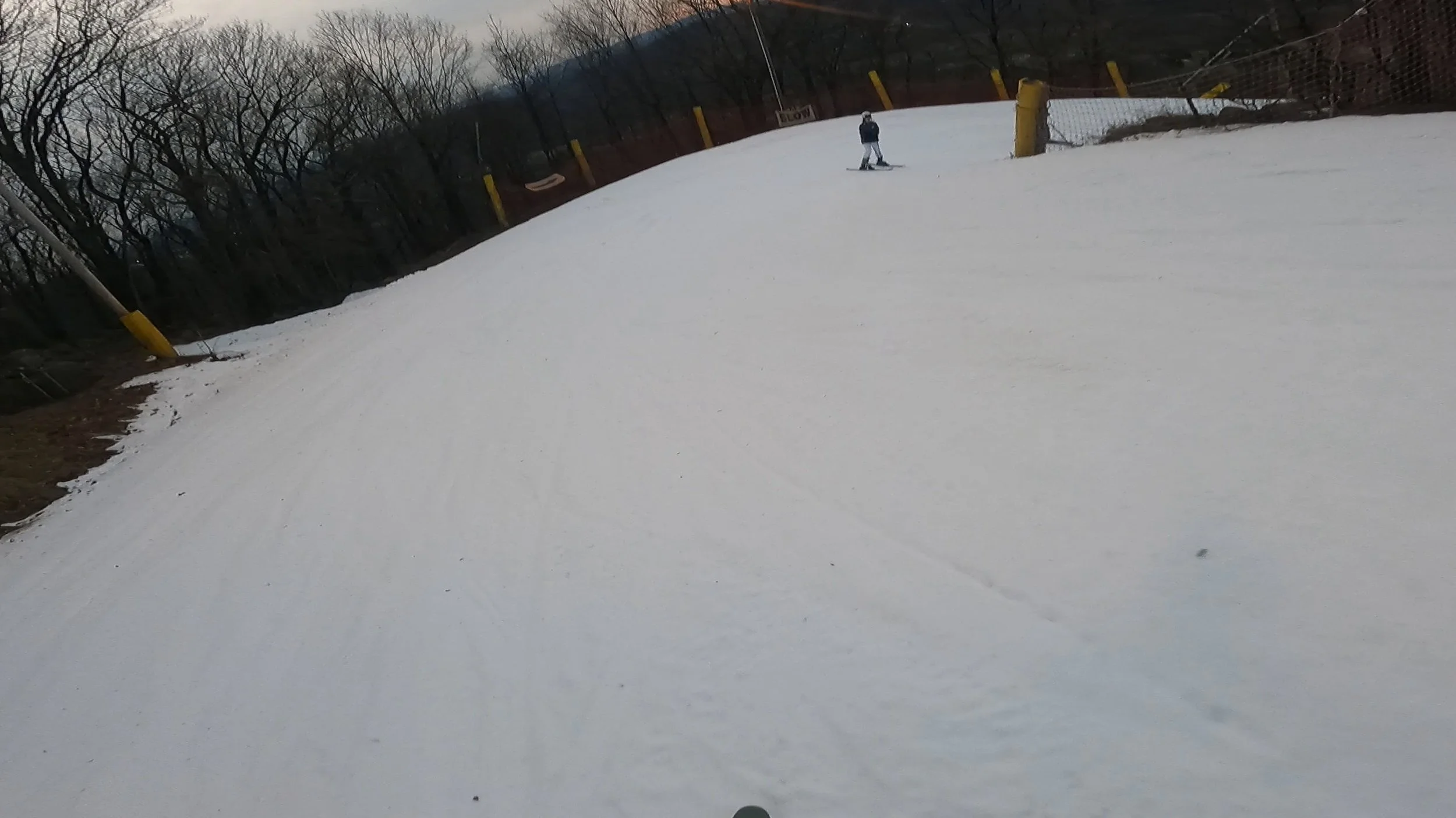
“White ribbon” conditions, with bare ground on either side of the snowmaking-covered trails, are common at Mountain Creek.
Lifts
Speaking of lifts, Mountain Creek’s lift system actually looks pretty modern at first glance. Both of the resort’s major base areas have high-speed lift service, with the Cabriolet providing primary access out of Vernon and the South Peak Express serving the southern complex. But the more you look at Mountain Creek’s lift setup, the weirder it gets.
The Cabriolet is the most obvious example. Rather than a conventional chairlift or enclosed gondola, this is an open-air, stand-up lift with eight-passenger cabins. It’s an extremely unusual choice for a lift that many guests will repeatedly lap throughout the day: you have to take your skis or snowboard off every time you ride it, only to stand for the entire trip uphill. You also don’t get the benefit of the isolation from the elements that’s typical of gondola lifts.
Things only get weirder once you move away from the main bases. Granite Peak is served by a slow fixed-grip quad, despite one sign at the bottom rather amusingly referring to it as an “Express” quad.
But the strangest lift in the entire system may be the Sojourn Double. Because of Mountain Creek’s sprawling layout, getting from the South Peak side back toward Granite and Vernon requires riding a chairlift rather than simply skiing between the two areas. That chair is Sojourn, an exceptionally long fixed-grip double that feels almost comically slow for what is essentially an inter-mountain connector.
There’s also very little warning before boarding about just how long you’re about to spend on it. And things get even stranger at night: Sojourn operates during night skiing, but because much of the chairline does not run directly above a lit ski trail, substantial portions of the ride can be almost completely dark. Mountain Creek historically ran shuttle buses between its two base areas, giving guests a way to avoid this awful on-snow connection, but that service is no longer regularly operated today.
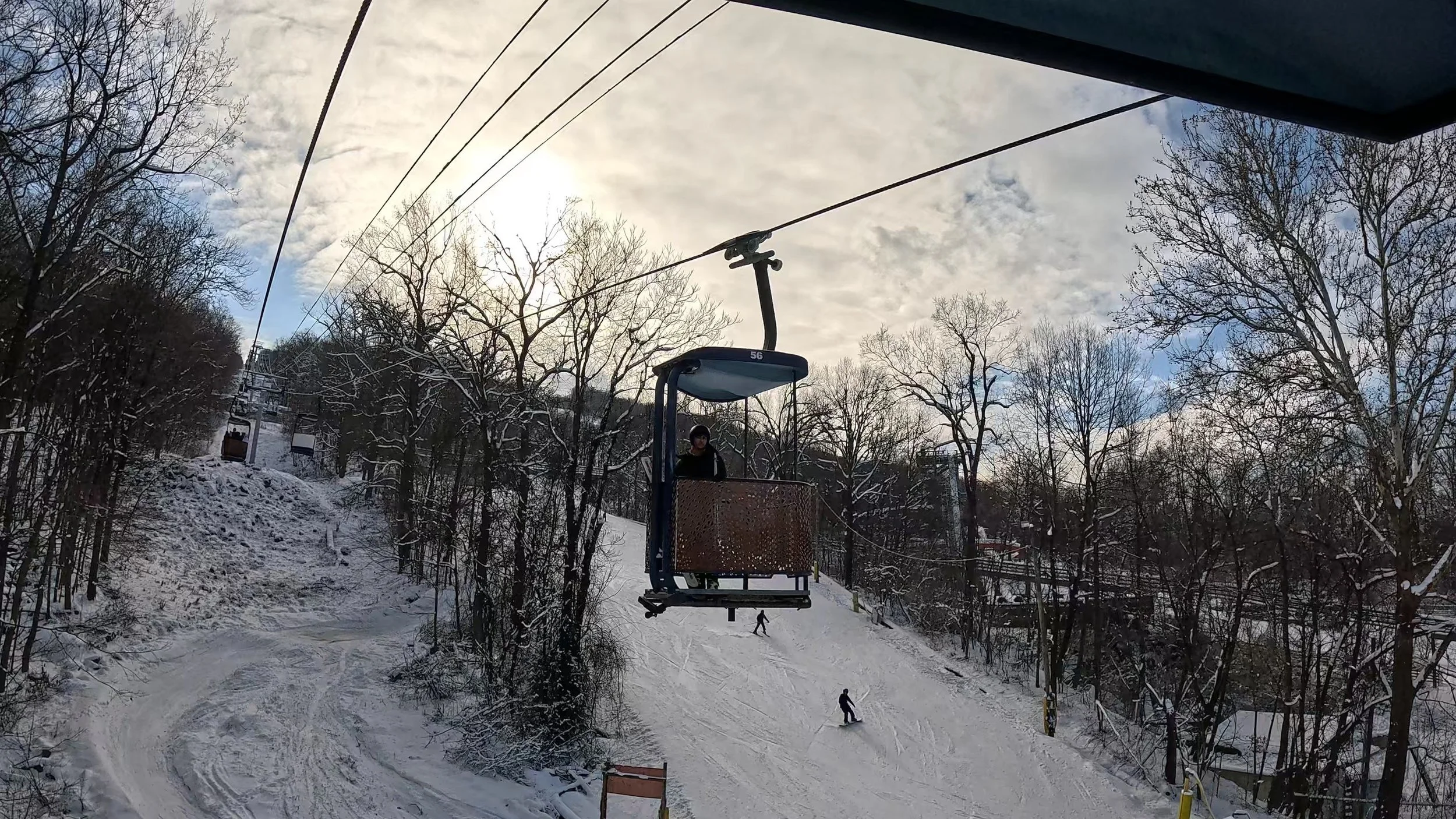
The Cabriolet is an open-air, stand-up lift with eight-passenger cabins.
Crowd Flow
As one of the closest ski areas to New York City and its surrounding suburbs, Mountain Creek can get absolutely slammed on weekends. Waits of 30 to 45 minutes are common at the busiest lifts, particularly the Cabriolet at Vernon Peak and the South Peak Express.
Ironically, while the Cabriolet is a pretty strange lift for repeatedly lapping ski terrain, its design does give it one major advantage: capacity. The open-air, eight-passenger lift is rated for around 3,000 people per hour, putting it well above the capacity of a typical high-speed quad and roughly in line with many modern six-packs. It also tends to suffer fewer misloads than some of Mountain Creek’s chairlifts, which helps it keep moving more consistently. That combination allows the Cabriolet to chew through a surprising number of guests when operations are running smoothly.
And to give the resort some credit, Vernon Peak also has the Vernon Triple as redundant uphill capacity. That chair can develop a line of its own, but waits are generally less severe than at the Cabriolet, making it a useful alternative on especially crowded days. However, the triple doesn’t always operate, which can put additional pressure on the Cabriolet.
Crowds can also vary considerably depending on where you are on the mountain. The Bear Peak Express typically does not see the same level of congestion as the South Peak Express, largely given its less desirable terrain, while Granite Peak tends to be somewhat less busy as well. And one lift where you probably do not need to worry much about a line is the dreadful Sojourn Double.
But Mountain Creek does not always make the most of the lift capacity it has. South Peak Express has a singles line, but it only begins partway through the queue maze, and attendants do not consistently fill every chair. In the case of Granite Peak, the lift has no singles line at all, and chairs can still leave the terminal with empty seats. On a mountain capable of drawing such enormous crowds, these feel like pretty significant missed opportunities.
And as we mentioned earlier, the crowding isn’t limited to the lift lines. Some of Mountain Creek’s most popular slopes can become packed with skiers and riders of dramatically different ability levels, making traffic itself a meaningful part of the experience. Perhaps fittingly, Mountain Creek’s trail map even marks dedicated locations where guests can report incidents on the mountain—something we don’t recall seeing called out quite so prominently at any other ski resort.
And those incident-report stations start to feel a lot less surprising once you experience some of the basic etiquette problems that can be prevalent at Mountain Creek. There’s a general disregard for some of the unwritten rules that experienced skiers and riders tend to take for granted, including (but not limited to) being generally polite to others, littering on the mountain, and not appropriately watching out for those on the slope in front of you. Equipment theft is unfortunately more common than it should be at Mountain Creek, and we’d strongly recommend locking up your skis or snowboard—or using the resort’s equipment check—if you plan to leave them unattended.
Perhaps the clearest indication of just how much crowding Mountain Creek has dealt with, though, is one of the wildest crowd-control setups we’ve seen at any ski resort. To access the Vernon Triple, you can’t simply ski down to the lift. Mountain Creek ropes off the trail leading to it and checks your pass before you’re even allowed onto the access run, creating what is effectively a separate ticket-checking line at the top of the trail. Only after getting through that checkpoint can you ski down to the actual chairlift below. We’ve never encountered a setup quite like this anywhere else, and you have to imagine Mountain Creek has dealt with some pretty extraordinary situations over the years to decide something like this was necessary.
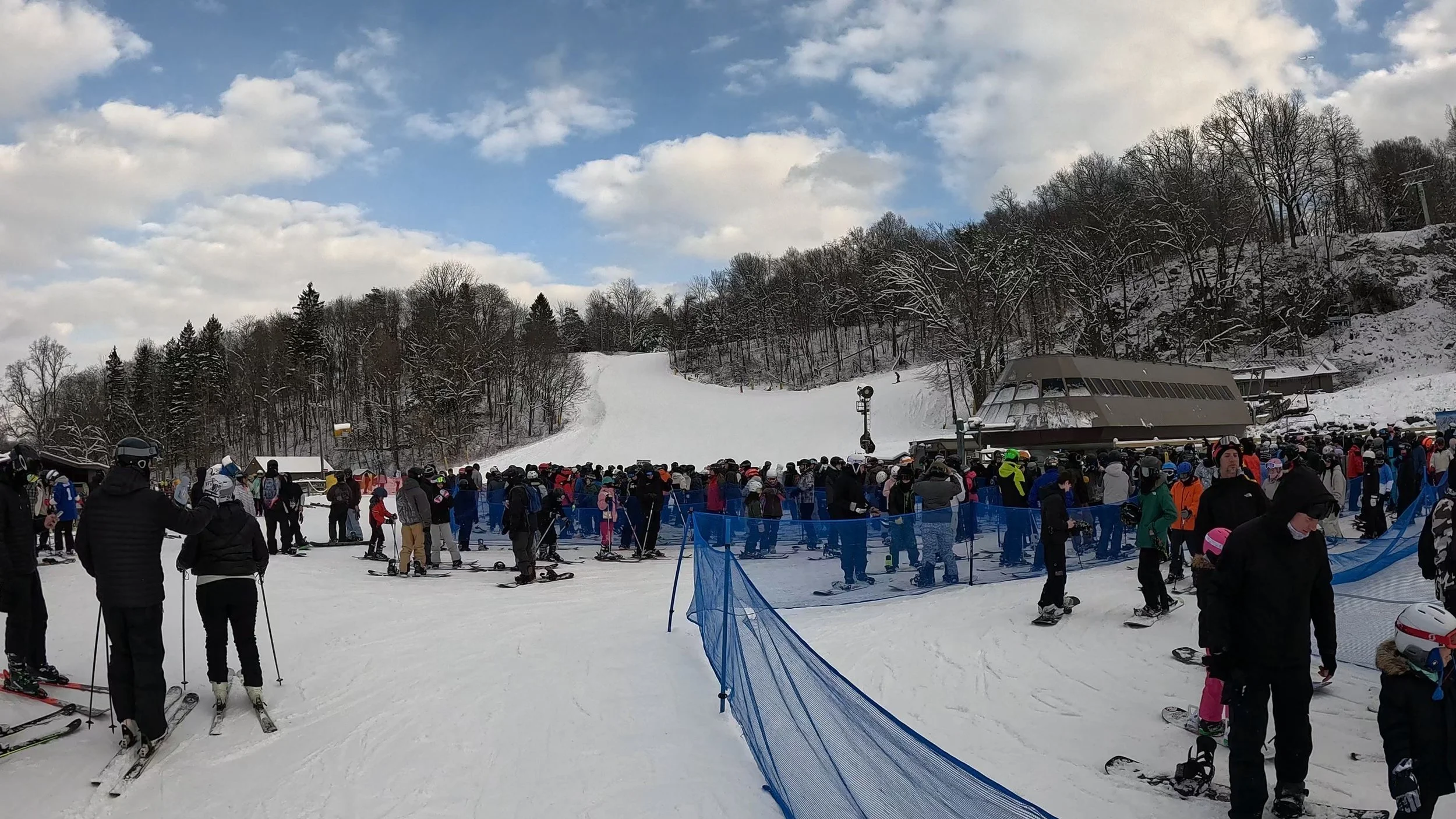
Waits of 30 to 45 minutes are common at Mountain Creek’s busiest lifts on weekends.
On-Mountain Facilities
As one might expect from a mountain this small, all of Mountain Creek’s options to stop in for a break are located at the bases rather than somewhere higher up on the mountain.
Vernon Peak has the resort’s most substantial base lodge, with a primary grab-and-go cafeteria-style option, as well as a sit-down bar upstairs and a café downstairs. There's also a beer garden adjacent to the lodge. The Appalachian Hotel at the base, right next to the bunny hill lift, has grab-and-go food and drinks as well. South Peak's base lodge also has cafeteria-style food and a sit-down bar. As one might expect from such a commercial resort, food is fairly expensive and among the most underwhelming we've tried. Seating can be difficult to come by during peak hours.
Mountain Aesthetic
Mountain Creek probably isn’t going to win many awards for its overall aesthetic. This is a heavily developed ski area in one of the most populated parts of the country, and combined with the often-snowless surroundings and lift lines, plus the high density on the slopes, the experience feels incredibly commercialized—and, absent a fantastic snow year, artificial.
There are also some rough-looking parts of the resort from a development standpoint. Over at Granite Peak, there are several trails that appear to have been cut out at some point but never fully developed, with vegetation growing back into them and what appear to be abandoned snowmaking guns still sitting around. Mountain Creek’s summer waterpark also leaves a fair amount of permanent ride infrastructure around the Vernon side of the resort, which makes the skiing feel like a secondary priority in some ways. That said, it’s far from the truly appalling, footprint-wide buildup found at some resorts in the Poconos.
That said, Mountain Creek’s wide footprint does at least give the resort more of a sense of scale than you might expect from skiing in New Jersey, and the resort does have a sprawling multi-pod feel that not all small local hills have.
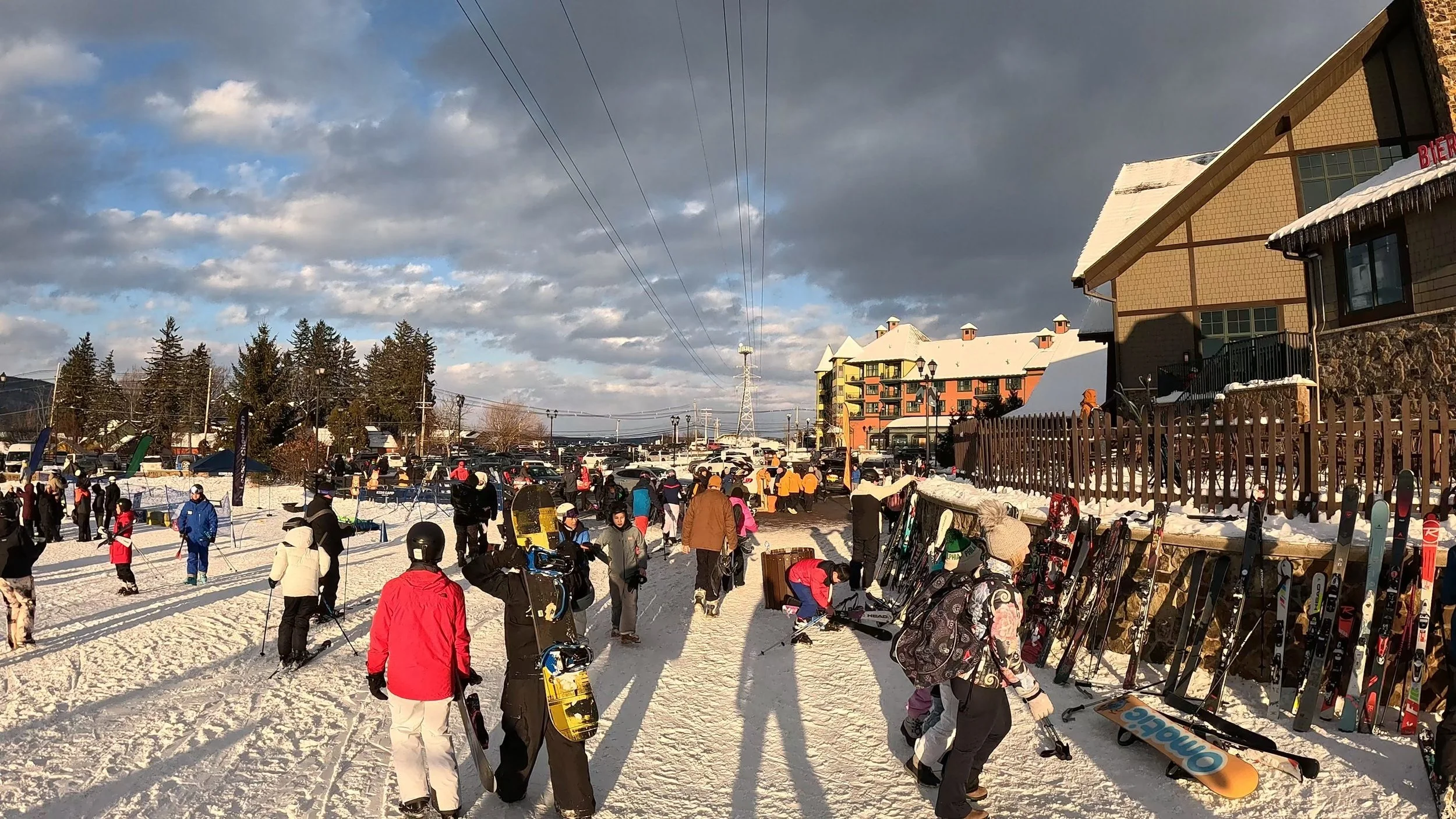
Mountain Creek is a heavily developed ski area in one of the most populated parts of the country.
Night Skiing
Arguably Mountain Creek’s biggest attraction for many skiers and riders in the area is its night skiing. The resort offers night operations across all of its terrain pods, with essentially the entire developed trail network lit after dark. During the core winter season, Mountain Creek typically stays open until 9 PM seven days a week, leaving plenty of time to grab some laps after work or school.
That said, because night skiing is so popular here, don’t necessarily expect the mountain to be quiet after dark. Crowds can be comparable to weekends, especially on the less beginner-oriented, terrain-park-heavy South Peak side.
Pass Partnerships
Mountain Creek isn’t part of one of the major destination-oriented ski pass networks, and given how crowded it already is, that's probably a good thing. But there are still a few ways to access it through broader partnerships.
The resort is a founding member of the new Snow Pass, a product that provides two days each at Mountain Creek and about a dozen other partners, mostly based in the Northeast. Mountain Creek is also a member of the Snow Triple Play, which provides three total ski days to use across its broader network, albeit no more than two visits at any one resort. Mountain Creek has no blackout dates on either product.
Getting There and Parking
For the overwhelming majority of people who choose to visit, Mountain Creek’s single biggest advantage is simply where it is. The resort sits only about 47 miles from New York City, putting it within easy day-trip range of the city, northern New Jersey, and a huge portion of the surrounding suburbs. For millions of people, there really isn’t another outdoor ski area of comparable size that’s nearly as convenient.
General parking is available across the street from both the Vernon and South Peak base areas, with a short walk required to get to the slopes. On the Vernon side, Mountain Creek also sells preferred parking closer to the base lodge for those willing to pay to cut down on the walk. But on busy days, these lots do fill up, so make sure to arrive before 11am on a weekend or come back later in the afternoon.
Lodging
If you do decide you’d prefer to stay on site rather than day trip it, Mountain Creek does offer true slopeside lodging, although the options are fairly limited compared to larger destination resorts.
The flagship on-site option is The Appalachian, a condo-style hotel located directly at the base of Vernon Peak. The complex has options ranging from studio to two-bedroom, and it’s complete with an outdoor pool and hot tub. There are additional condos around the resort area, along with a handful of hotels, motels, and vacation rentals elsewhere around Vernon.
Après-Ski
If you’re looking for après, Mountain Creek does have a reasonably decent base-area scene for what it is. Both base areas have live music on certain weekends, and the bars stay open through night operations. But for most people, the most appealing option will probably be to get in their cars and drive home.
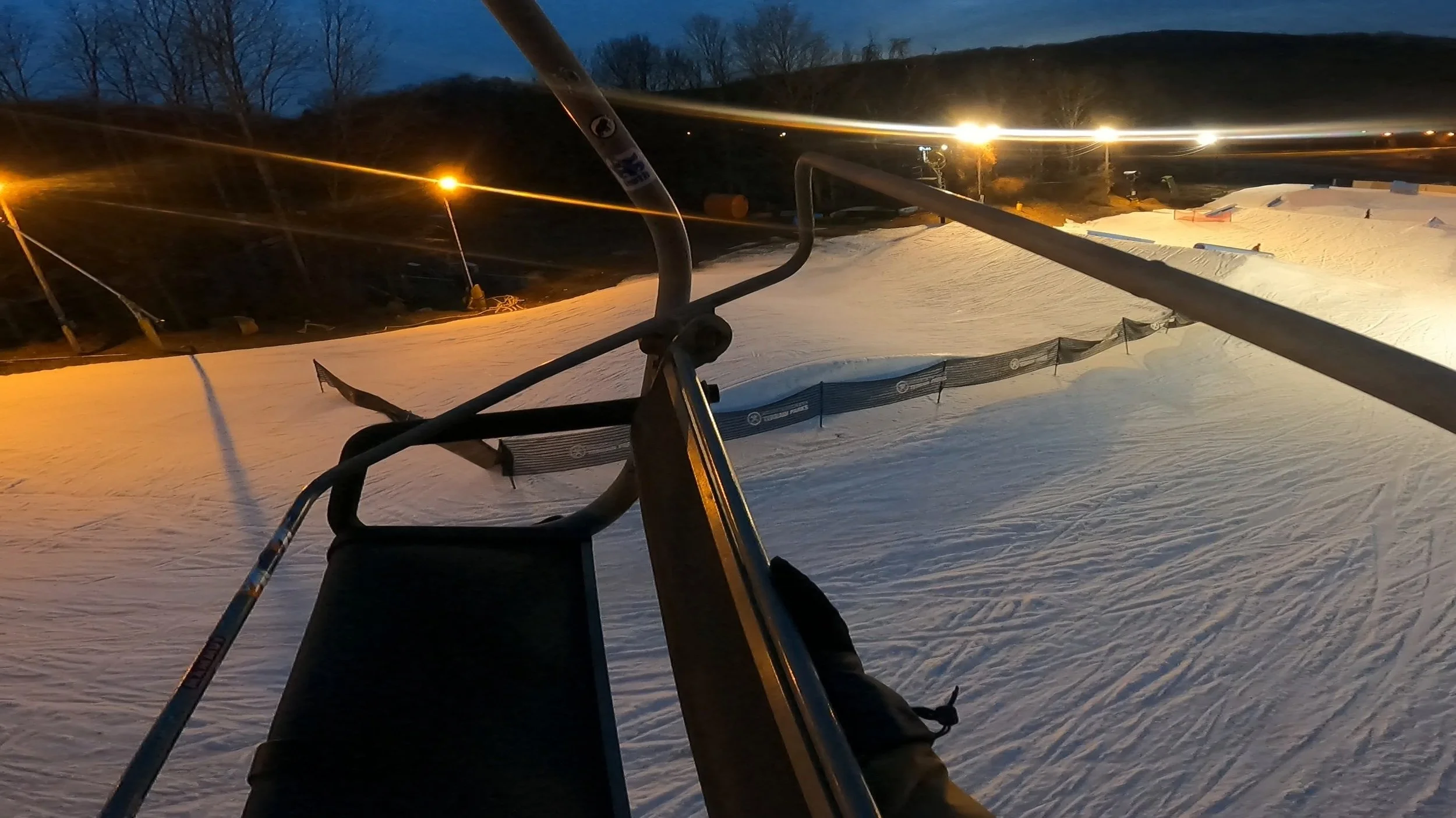
Nearly all of Mountain Creek’s trail network is lit for night skiing, typically until 9 PM.
Verdict
So Mountain Creek offers some genuine surprises for where it is, including a notably spread-out set of mountain peaks and legitimately standout freestyle terrain. But you also get many of the drawbacks that come with a resort this close to the country’s largest city, including an extremely commercial and sometimes unwelcoming atmosphere, limited natural snow, significant crowding, and not much in the way of interesting natural terrain.
Pricing
And Mountain Creek isn’t necessarily cheap for what you’re getting. During the 2025-26 season, full-day tickets were around $90 on weekdays and $120 on weekends, putting a busy Saturday here firmly into triple-digit territory. At least when you have to go and grab that ticket, Mountain Creek employees walk around with handheld terminals that allow you to do so without going through the traditional ticket-window process.
Ultimately, there’s no doubt that Mountain Creek is extraordinarily easy to get to, and for someone who lives nearby—or wants to grab a few laps after work—that convenience may be impossible to beat. But if you have the time to make a longer trip, many skiers and riders will find the extra drive to Vermont—or even the Catskills—especially worth it.