MOUNTAIN SCORES
CATEGORY BREAKDOWN
See our criteriaMountain Score by Area
GOOD TO KNOW
1-Day Ticket: €72–€89 ($81–$100 USD)
Pass Affiliation: Ikon Pass
On-site Lodging: Yes
Après-Ski: Moderate
Nearest Cities: Venice (2 hrs), Innsbruck (3 hrs), Verona (3.5 hrs)
Recommended Ability Level:

+ Pros
Jaw-dropping Dolomite scenery, with ski runs right up against towering rock faces
Iconic runs like Armentarola, Lagazuoi and Rio Gere
Outstanding mountain restaurants, including the Ra Valle and Lagazuoi huts
Excellent, sweeping intermediate cruising on Tofana and Faloria
Strong off-piste potential at Faloria with little traffic
– Cons
Two disconnected ski areas, linked only by a free shuttle bus
Unreliable lower-mountain snow, especially on south and east-facing slopes
Limited advanced terrain compared with the big Alpine mega-resorts
Confusing navigation between Ra Valles and the rest of the mountain
Few terrain park features
MOUNTAIN STATS
Skiable Footprint: 495–2,512 acres per area (3,007 combined)
Ski Areas: 4
Marked Pistes: 113 km
Top Elevation: 10,335 ft
Vertical Drop: 5,597–6,319 ft per area
Lifts: 37
Trails: 160
Beginner: 40%
Intermediate: 50%
Advanced/Expert: 10%
VIDEO
Mountain Review
Cortina d’Ampezzo has been in the spotlight more than almost any other European ski resort recently, thanks in large part to its role as a co-host of the 2026 Winter Olympics, with a substantial number of alpine events held on site. The resort is known for its towering rock-formed footprint, sense of scale across several valleys, and character-filled town. But what makes Cortina such an Olympic-worthy ski venue, and how does it compare to other major European mountains? Here is a look at everything Cortina has to offer.
Size and Terrain Layout
As part of the larger Dolomiti Superski network, which parts of the resort count as Cortina is open to some interpretation. For this review, Cortina is made up of two distinct regions that are each continuously lift-served but not connected to one another: Tofana and Faloria. Together they offer roughly 3,000 acres of skiable terrain across a disjointed layout.
Tofana is the main side, and it is divided into multiple terrain pods with something for just about every ability level. Groomed cruisers are concentrated on the lower and mid-mountain, while the upper sections have steeper pitches and spectacular views. The top section, known as Ra Valles, sits above a dramatic rock face and is largely isolated from the rest of the resort. When conditions allow, skiers and riders can descend more than 5,000 feet from the top of this area into town. Tofana also has a far-flung back side: a 15-minute Skyline Gondola ride leads to the Cinque Torri and Falzarego-Lagazuoi zones. These outlying areas feel quieter and more remote than those closer to town, and they offer sweeping views of distant parts of the Dolomites. Together, this continuous lift-served area makes up about 84% of Cortina’s terrain.
Faloria, across town, has a more technical, big-mountain character, although it is nowhere near as large or tall as Tofana. From town, the only way up is a two-stage cable car in a pulse setup, where the upper car reaches the mid-station at the same time the lower car arrives. Runs then descend the full vertical to the other side of the valley, which means the slopes of Faloria are not visible from town at all. Skiers and riders also need to take the cable car back down at the end of the day unless they use a shuttle bus. Despite the shorter overall vertical, Faloria’s runs are longer and more sustained in pitch than at much of Tofana, with a rugged feel and some excellent off-piste lines. Faloria also has its own back side, Cristallo, which is reached by skiing down to the road, crossing it on foot, and taking another set of lifts.
A free shuttle bus is the only way to move between Tofana and Faloria, so plan your day accordingly if you want to ski both, especially if you also want to include the back sides. With multiple days in the region, though, it is easy to cover most of the terrain.
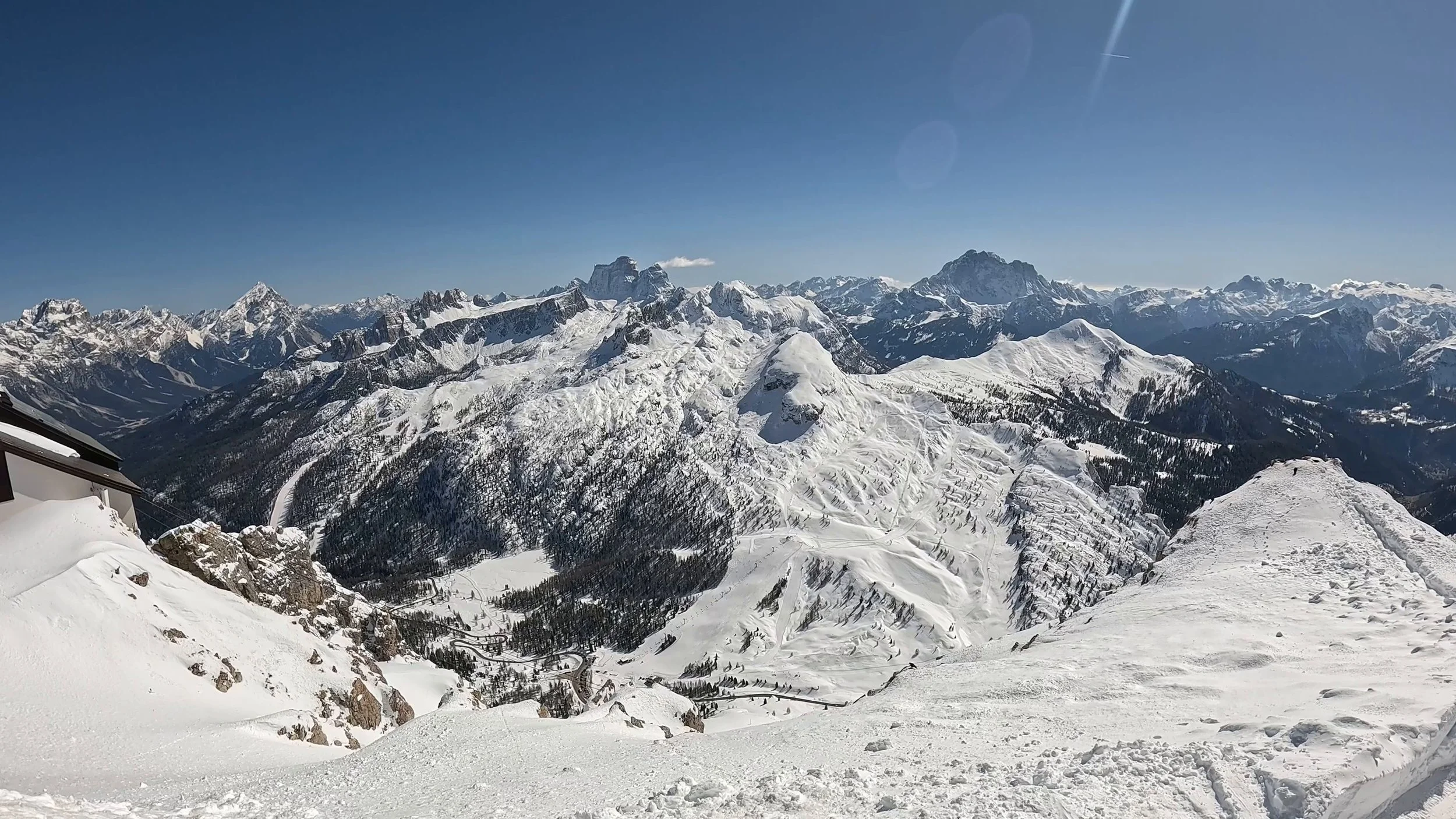
The view from the top of Tofana shows how large and rugged the Cortina area is.
Snow Quality and Resiliency
Cortina’s upper-mountain snow is among the best in the Dolomites. The region doesn’t typically get the snowfall of the western Alps, but higher elevations and northern aspects in key areas help preserve quality snow when other Dolomiti Superski areas begin to soften. The resort also has extensive snowmaking to keep slopes in good shape when natural snow is lacking.
However, that natural snow preservation doesn’t extend to all slopes. The bulk of the Tofana front side faces east, and lower-mountain snow retention is unreliable. Cinque Torri and front-side Faloria slopes mostly face north, which helps in those areas, but the main slope on the Cristallo side of Faloria faces directly south, and in a poor snow year it is common to see bare ground right next to the run. Lower-mountain pistes are often closed for lack of snow cover, and skiers may need to take a lift down to exit the resort when that wouldn’t normally be necessary. As with most Italian resorts, anyone whose priority is a reliably snow-sure trip, especially one with off-piste or fully skiable valley runs, may be better served elsewhere.
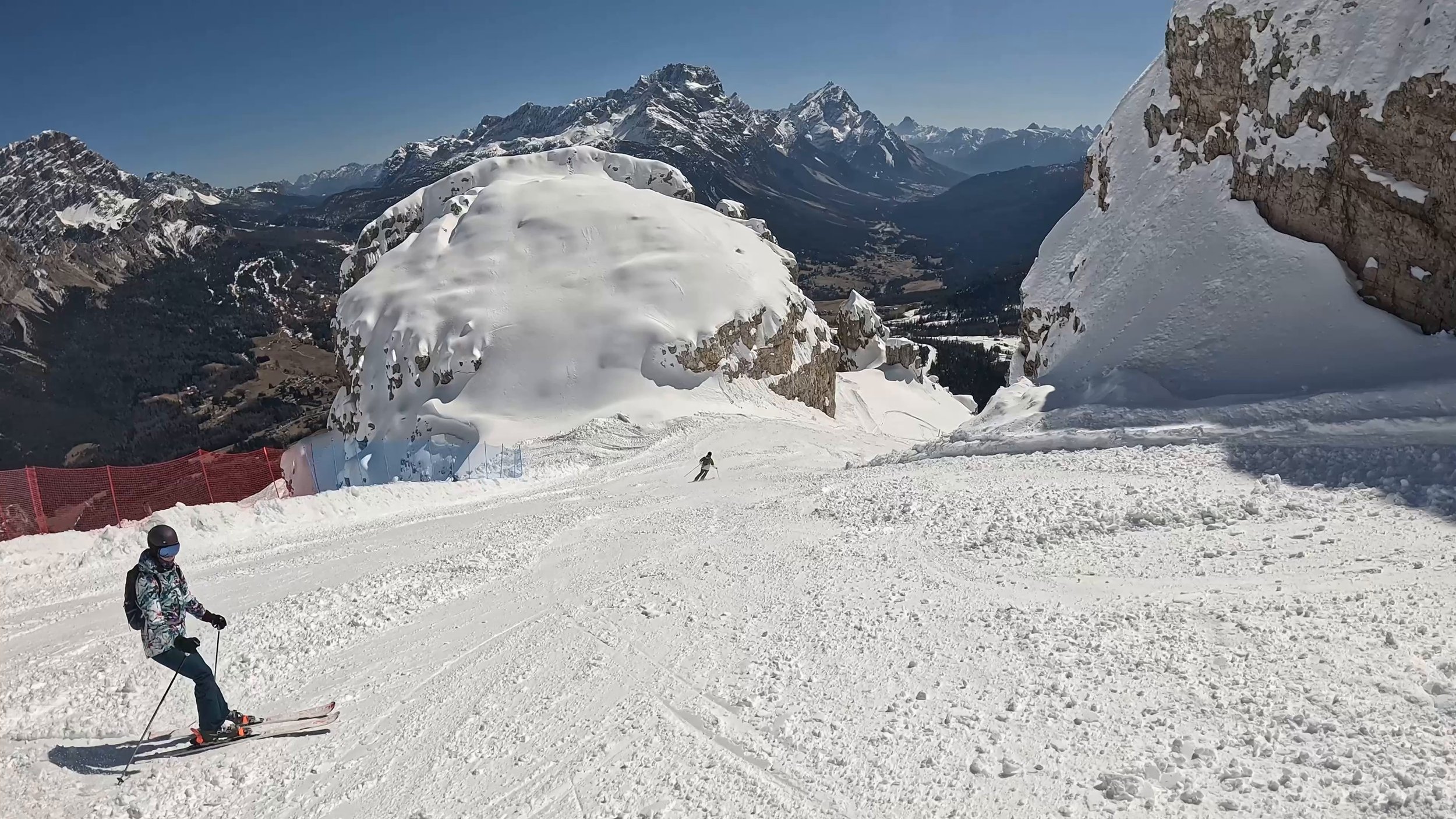
Upper-mountain snow in the Dolomites holds up better than the lower slopes, where coverage can be thin.
Beginner
Beginner options exist at Cortina, but as you would expect from an Olympic-caliber mountain, they aren’t the main draw. The steep, dramatic landscape limits truly mellow runs in many parts of the resort, and first-timers may find it tricky to move between areas without tackling at least some intermediate terrain. Less experienced skiers and riders should stick to the Tofana side, which has strong beginner-level blue pistes at lower elevations, and the isolated Cinque Torri area has some nice higher-elevation blues as well. The Ra Valles area has a couple of blue trails too, which makes this stunning zone accessible to beginners, but they are limited and not reachable from the top of the main lift. Blue trails on the Faloria side are substantially more limited. For true first-timers, there is a bunny hill near the Socrepes base on the Tofana side.
Intermediate
Intermediates have access to the bulk of Cortina’s terrain. The modestly steep mid-mountain on the Tofana side is home to some great red cruisers, and the Pomedes area and the entire Faloria side have plenty of runs at this level. These runs are well suited to big, sweeping turns and are a big reason Cortina has a reputation for world-class carving terrain. The reds on the Faloria side are a bit steeper than those on Tofana, so anyone progressing from blues to reds should test their comfort on the Tofana side first.
The red rating is also where skiers and riders get access to some of Cortina’s most iconic runs, especially in the most remote areas. The Cristallo side has the Rio Gere trail, which passes beneath several prominent rock walls and offers direct views of the Faloria front side, while the Croda Negra, Lagazuoi and Armentarola pistes at Cinque Torri and Lagazuoi have astonishing views of the surrounding Dolomites and are boxed in by even more pronounced rock faces. The Armentarola trail ends well away from any lift in the Cortina complex, so getting back requires a bus or taxi, or a 4 euro horse-drawn ride over to Alta Badia. Even so, it may be the most beautiful run in all of Cortina. The latter three of these signature runs are part of an official ski tour route called Super8, which links them in an 8-shaped loop, and they are among the longest runs in Italy, so be prepared for a long descent.
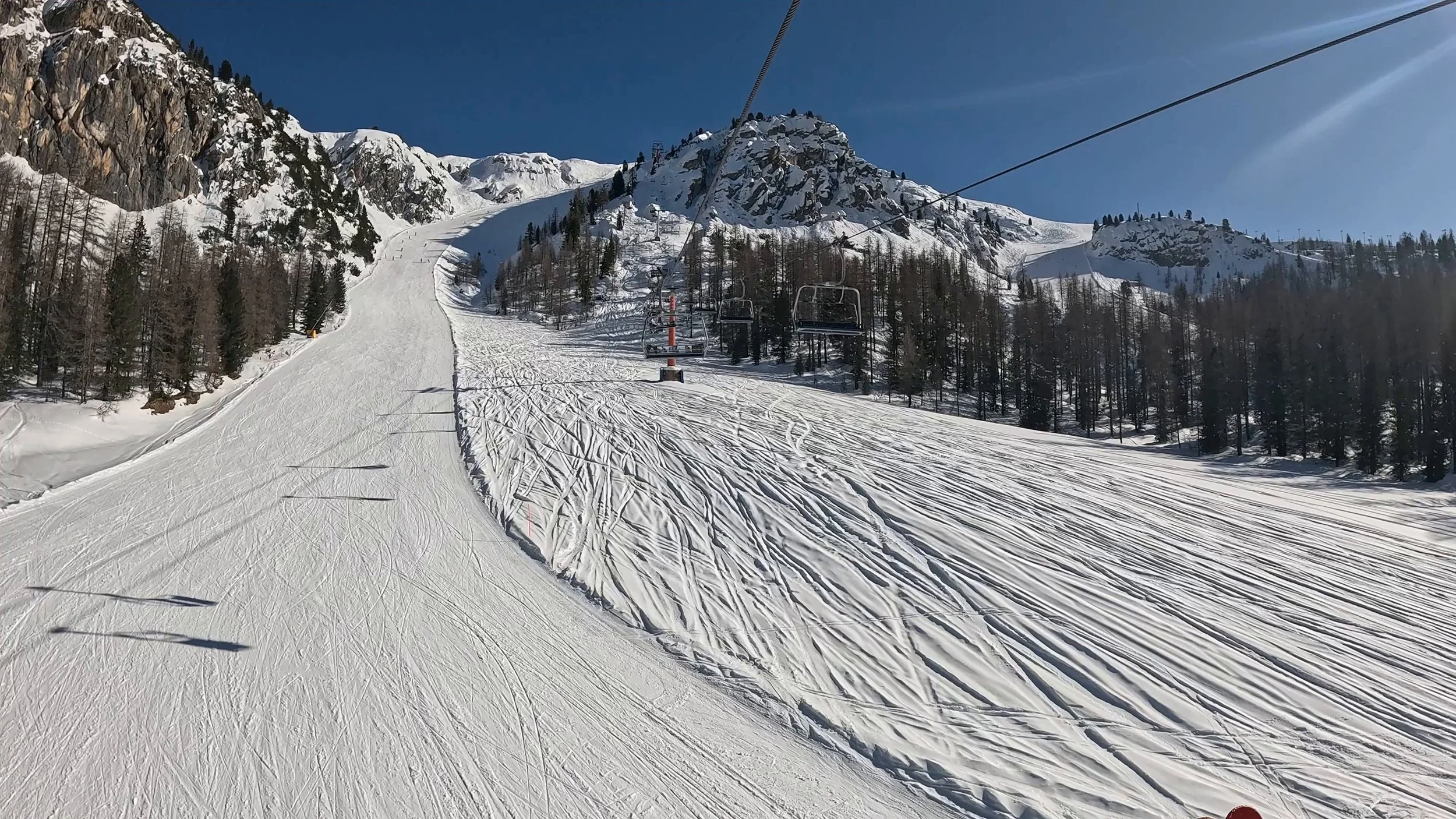
Wide, groomed runs like this one on Tofana are well suited to carving.
Terrain Parks
Despite its Olympic credentials, freestyle skiers and riders won’t find much at Cortina. Park features are minimal and not a priority, so those looking for jumps and rails should look elsewhere in the Dolomiti Superski network, or in the greater European Alps.
Advanced and Expert
Cortina has some truly incredible advanced and expert on-piste terrain, even if it isn’t as extensive as the resort’s reds. Both Tofana and Faloria have black-rated pistes only on their front sides, but they are notably sustained. Most of these trails are longer than those at many other Dolomiti Superski areas, and the fall lines are consistent.
Most of the blacks are on the Faloria side, but experienced visitors shouldn’t leave without skiing Black #51 Forcella Rossa, a steep gem of a trail that descends the face of the massif. It is the only way down from the Ra Valles area without downloading the tram, and once you see how steep the rock wall you are skiing across is, you’ll understand why.
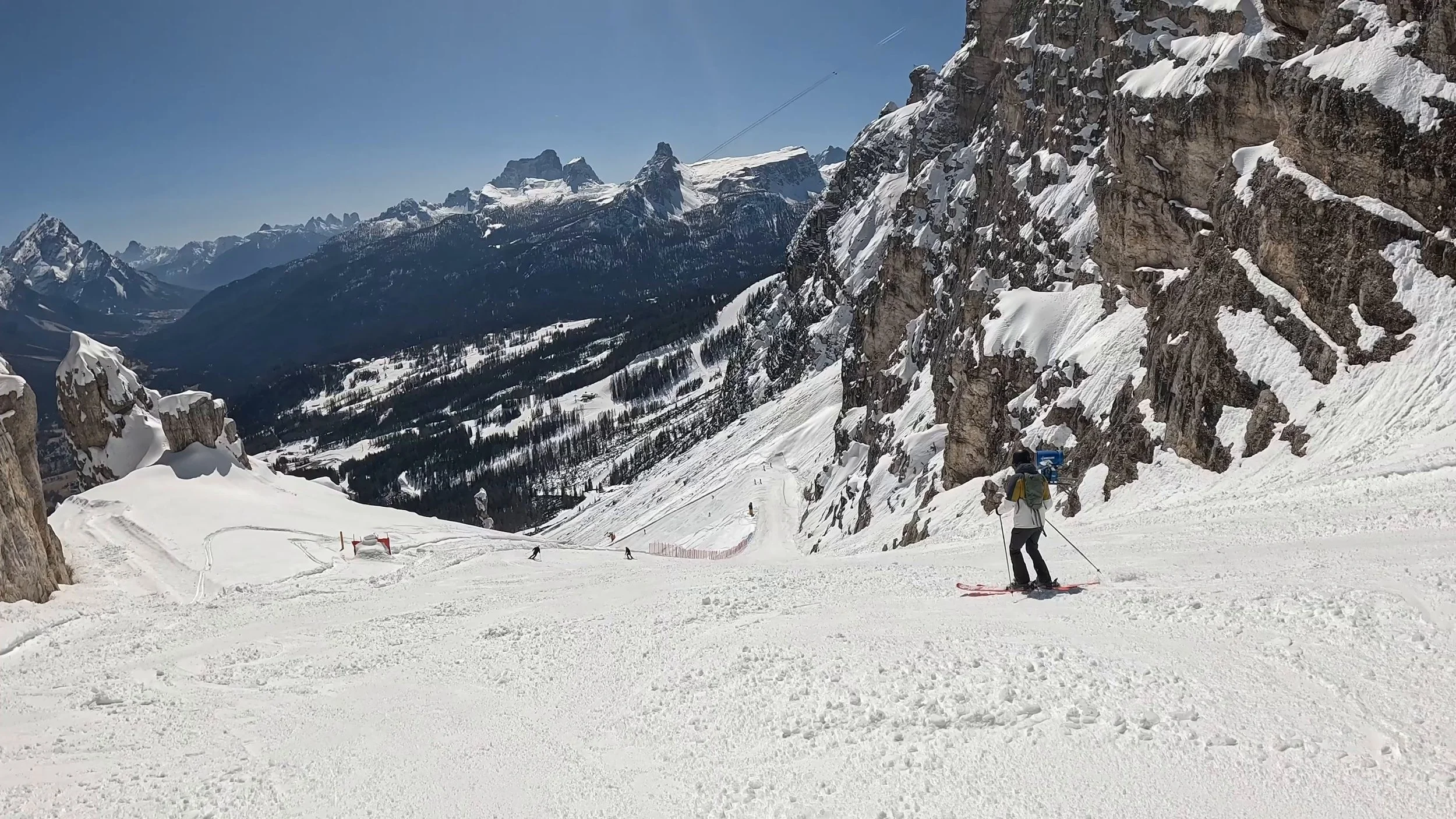
Cortina’s black pistes are fewer in number but notably sustained.
NOTE: We may receive a small affiliate commission if you click on the below links. All products listed below are unisex.

Recommended all-mountain ski

Recommended carving ski

Recommended glade ski

Recommended expert/touring ski
Off-Piste
Cortina has excellent lift-served off-piste opportunities when conditions allow. On the Tofana side there are several areas to leave the marked runs for ungroomed slopes, with chutes, cliffs and other technical features most common in Ra Valles and Cinque Torri. These features are not marked and should be scouted carefully before attempting. Cinque Torri also has interesting off-piste skiing through rock gardens. Faloria is the best place for off-piste, though. Several chutes and natural lines start right off the lifts, and the sidecountry has a technical, big-mountain feel normally found in far more remote terrain.
Despite the terrain, Cortina is not popular for off-piste, and snow often stays untracked for days even without a recent storm. Even just outside the boundary of a nearby slope, the off-piste is true backcountry terrain with no avalanche control or other hazard management, so you are on your own in assessing conditions. We strongly recommend carrying a beacon, shovel and probe, and hiring a guide if you aren’t familiar with the region.
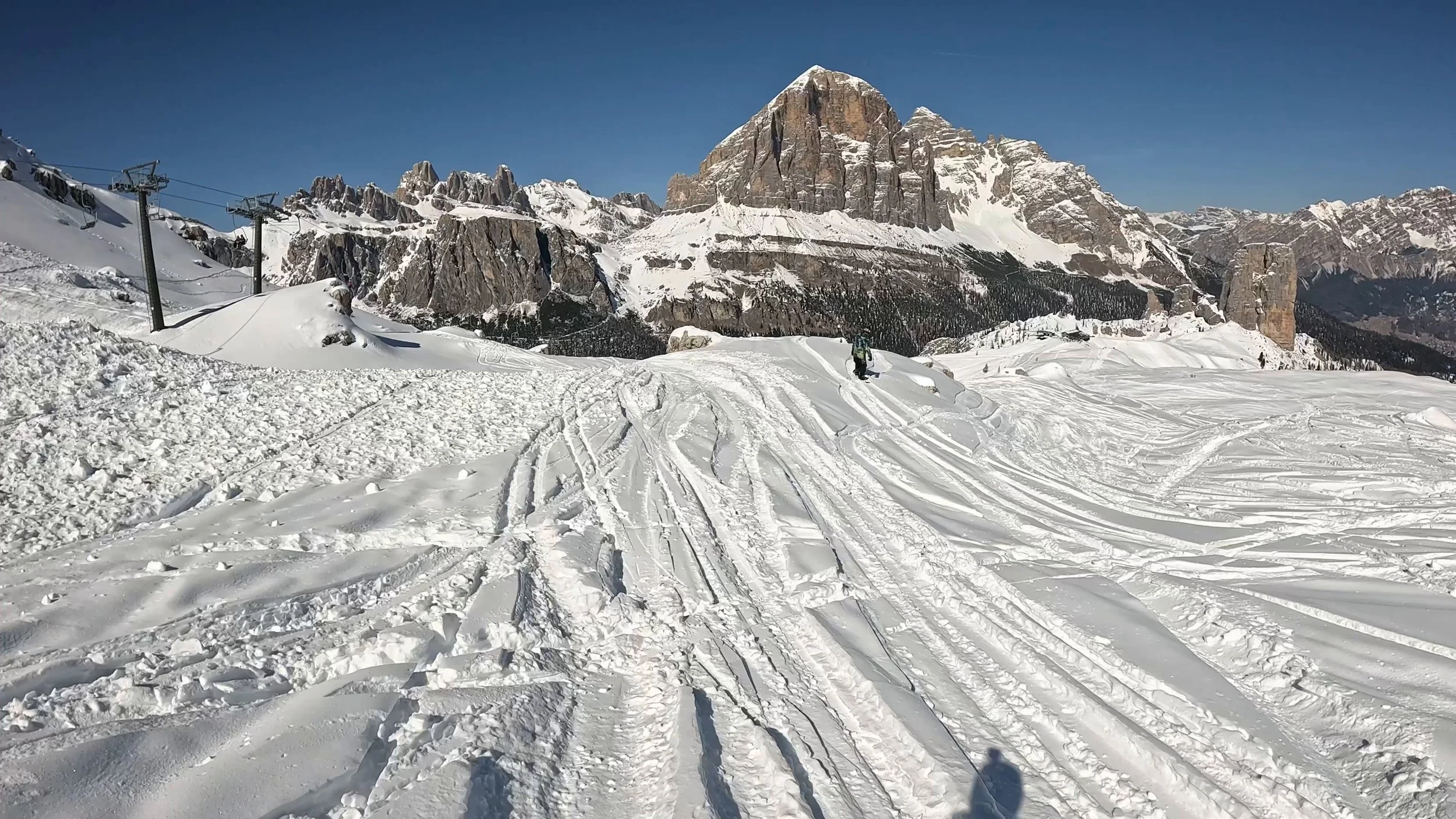
Off-piste snow at Cortina often stays untracked for days, even without a recent storm.
Lifts
Cortina’s lift network is modern and generally efficient, with a few quirks. In the areas closest to town the lifts are high-speed, and state-of-the-art ten-passenger gondolas serve both Tofana front side bases. On the Cristallo side, the main chair is one of the most interesting lifts we’ve seen, with bubbles that resemble spaceship pods. Some lifts in less prominent areas, especially on the Cinque Torri side, are slow, fixed-grip doubles and triples. The lifts over the most dramatic rock faces, specifically Lagazuoi, the second leg to Ra Valles, and the Faloria ridge, are low-capacity cable cars. Two lifts in the complex are out of service: the Cima Tofana tram, a third stage from the Ra Valles tram that only operates in summer, and the Forcella Staunies lift at Cristallo, which historically served some of the resort’s best expert terrain and closed about a decade ago with no replacement.
RFID gates can be finicky at some lift entrances, especially for Ikon Pass holders. This is a known issue, so wave down a resort worker if you have trouble.
Navigation
Cortina’s disjointed, rock-tower-filled layout makes navigation interesting. Within a single terrain pod it isn’t too difficult thanks to straightforward signage with clear lift directions in most places, but moving between areas introduces problems.
One of the biggest annoyances is getting to the Skyline Gondola, the lengthy lift that connects the Tofana front side to Cinque Torri. The resort deserves credit for it: when it opened in 2021, it was the first lift-served link between Cinque Torri and Tofana and eliminated a lengthy bus ride, linking Cortina more coherently with the broader Dolomiti Superski footprint. But the loading area is out of the way, and from most of the resort you have to ski or ride all the way down to the Socrepes base to reach it. The Socrepes Gondola, which replaced two quad chairs, is a bit farther from this loading area than the lift it replaced.
If you can’t ski black runs, getting from Ra Valles to the rest of the mountain can also be tricky. The signage isn’t clear, but the only way out without a very steep run is to download the tram to the lower mountain. The black #51 trail is hard to find, since it sits over the side of a ridge and is far less prominent than the quad lift, which looks like the intuitive way to reach the base but doesn’t allow you to ski out. A trail indicator sign for this piste appears right after the tram, but there is no directional signage at the intersection where it diverges from the #49 blue that returns to the quad. Many people likely assume the run isn’t there or isn’t open and download the tram instead, which is a shame given how iconic the run is.
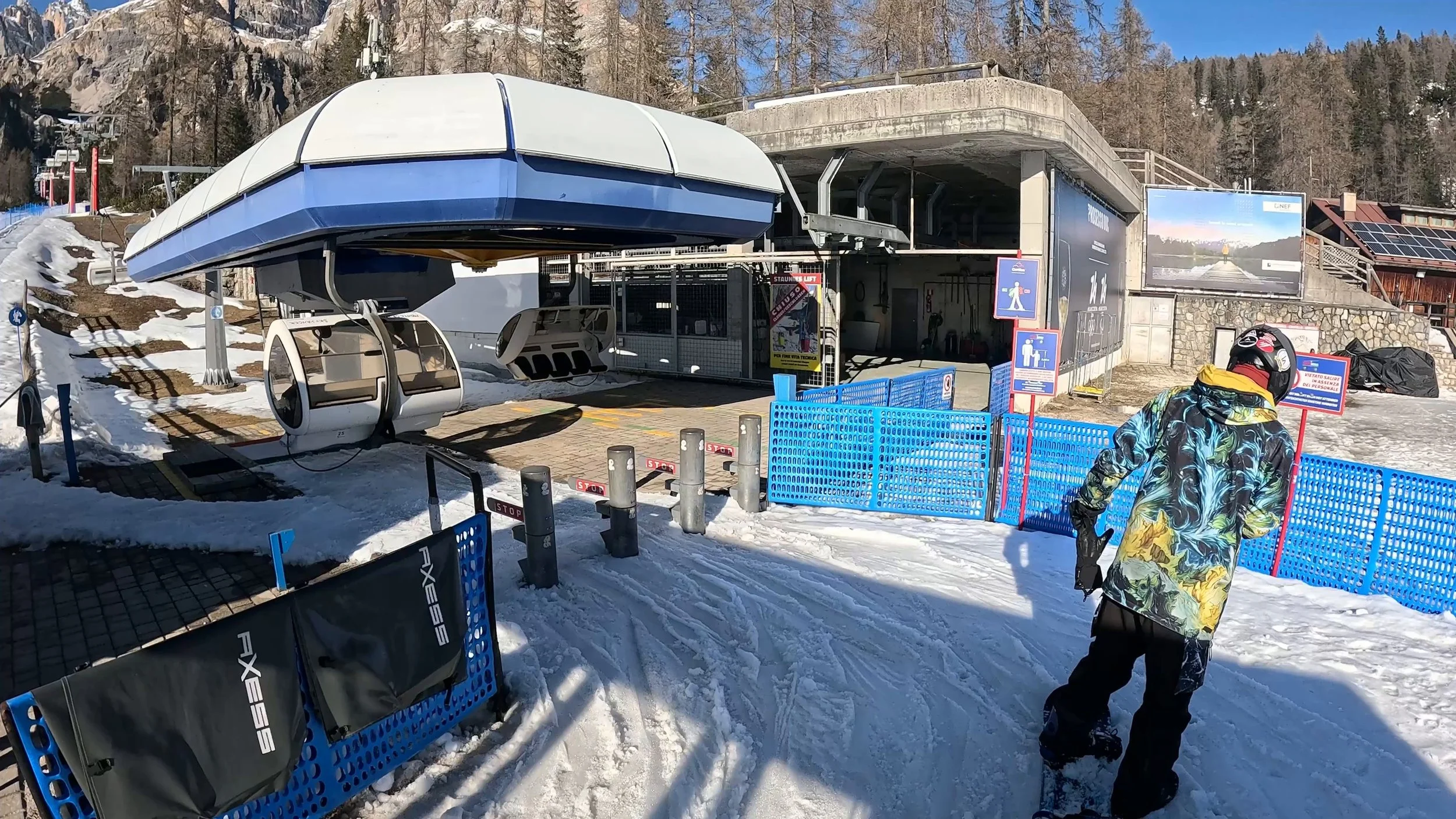
The main chairlift on the Cristallo side has bubbles that resemble spaceship pods.
Getting There
Cortina d’Ampezzo isn’t quite as convenient to reach as destinations with direct rail connections, but it is easily reachable by car or bus from major northern Italian cities and airports. For most international travelers, the most convenient airport is Venice, just over two hours away by car or bus. The resort is also about three hours from Innsbruck and four and a half hours from both Milan and Munich, though public transportation from those cities is much less accessible. If you aren’t staying in the town of Cortina itself, public transportation is limited and a car is highly recommended.
Parking is generally available at all base areas and isn’t a major headache, though arriving early on weekends is a good idea. For Tofana, there is also preferred parking surprisingly far up the mountain near the base of the Pié Tofana high-speed quad. Parking at that lot and at the one that serves Faloria from town is paid.
Lodging
The town of Cortina d’Ampezzo is the first place to consider, with a wide range of accommodations from small family-run pensions to high-end hotels. Most are a short shuttle ride from the slopes, and you’ll find plenty of classic Italian alpine character alongside modern comforts.
You can also stay directly on the mountain if easy slope access matters more than a walkable town. Several refuges offer lodging either slopeside or well up the mountain. These lodges are often inaccessible by road and are run with a cruise-ship mentality, with meals and other amenities usually packaged in.

Recommended intermediate board

Recommended advanced board

Recommended expert board

Recommended touring board
Crowds
Despite its fame, Cortina handles crowds reasonably well in most areas. The large footprint and multiple terrain pods help spread skiers out. High-traffic groomers can get busy on peak weekends, but it is manageable compared with many other marquee European resorts.
The big exception is the Lagazuoi tram. This 50-person cable car, which serves the iconic restaurant and the red pistes mentioned above, gets quite packed even on weekdays, and it is worth budgeting at least half an hour to wait in line. The other trams can have issues at peak times, but not as bad.
Facilities
Italy’s ski resorts are known for their restaurants, and Cortina doesn’t disappoint. Across the area there are plenty of options for a long lunch or a quick espresso, and the food quality and atmosphere are reliably excellent. Prices at most restaurants aren’t too bad either, and most base lifts have a coffee shop for a caffeine fix before heading up.
Some huts stand out. The Ra Valle hut on Tofana is a must-hit, with extraordinary views from a deck on top of a dramatic rock tower, perched so high above the slopes that you can look directly down onto some of them, along with great views of the town of Cortina. On the back side, the Lagazuoi Refuge may be even better. It is the largest and highest hut in the region, with a spacious terrace and some of the most jaw-dropping views in the Dolomites, including several iconic peaks dozens of miles away. You can even reserve a private sauna there, which also has views out into the mountains.
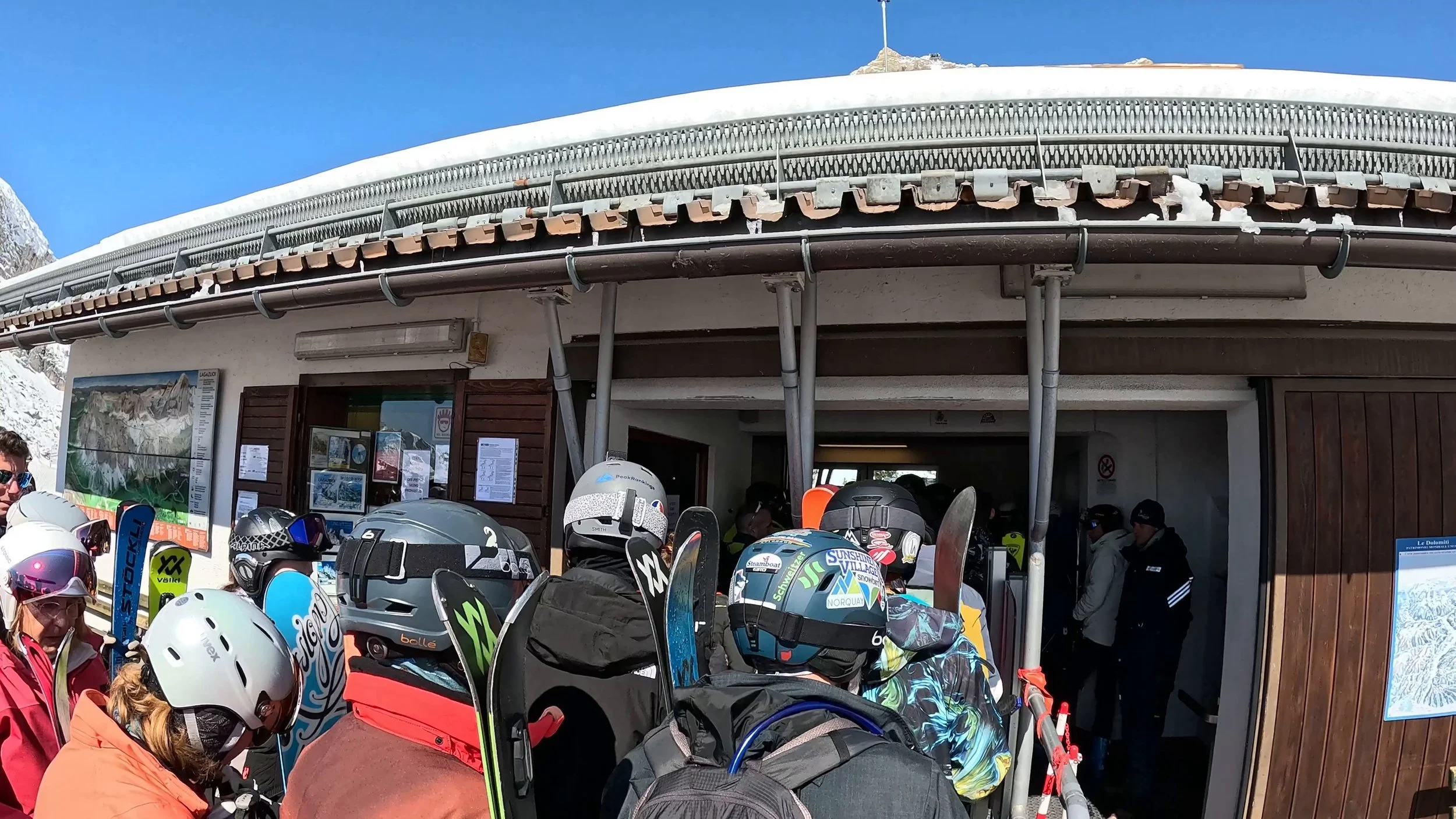
Lines at the tram stations can build quickly, especially at Lagazuoi.
Après
The après-ski scene at Cortina is classy but not especially rowdy. In addition to on-mountain establishments where you can grab a casual drink on the slopes, there are lively cafés and nice restaurants in town, including some standout wine bars. The town is also great to walk around, with plenty of Italian charm, art galleries and museums. Don’t expect slopeside dance parties or an extensive nightclub scene, though. Resorts in France, Switzerland and Austria are better for that.
Pass Partnerships
Cortina is part of the broader Dolomiti Superski network and is included on general Dolomiti Superski tickets and passes. The resort is also on the Ikon Pass, with five or seven days of access shared with the rest of the Dolomiti Superski network depending on your level of pass. Cortina is not part of the day-ticket-like Ikon Session Pass.
Mountain Aesthetic
Cortina stands out most for its aesthetic. The scenery is nothing short of spectacular, and skiing or riding here means being right up against towering Dolomite rock faces, much closer than at most other Dolomiti Superski resorts. The vertical walls form a dramatic backdrop to the pistes and make for some of the most striking views you’ll ever ski or ride. Their topography also makes for some of the most unique ski slopes anywhere in the world.
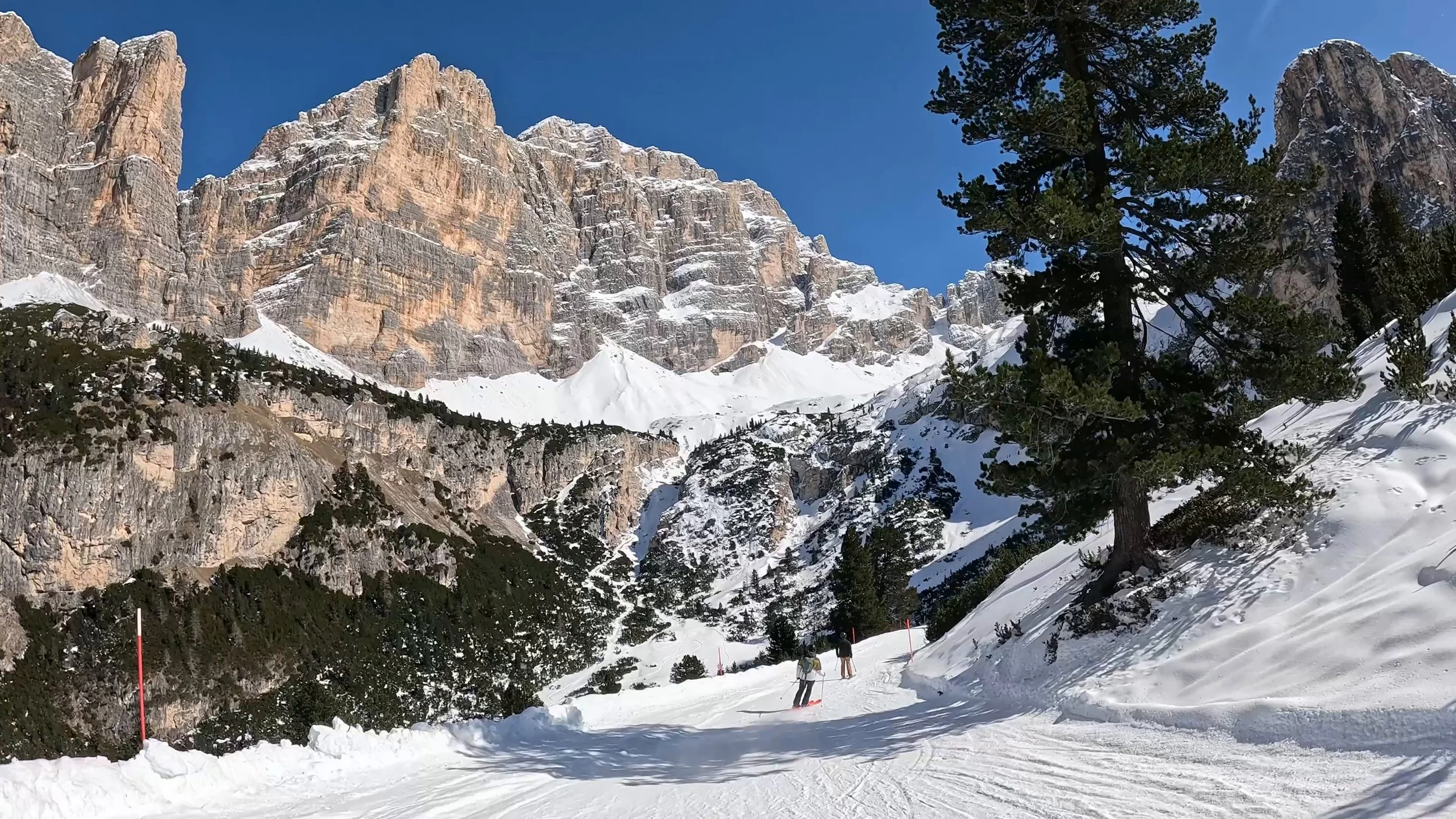
Towering Dolomite rock faces frame the pistes throughout Cortina.
Verdict
Cortina d’Ampezzo isn’t the largest ski destination in Europe, at least if you don’t count its discontinuous links to the broader Dolomiti Superski network, and a few quirks may hurt its appeal for those who value a continuous footprint and the utmost in snow-surety. But for some of the world’s most iconic groomed terrain and on-mountain restaurants, and an extraordinary backdrop throughout your vacation, it is hard to beat. And for anyone looking to check a bucket-list destination off the list, Cortina is a great way to do it.
Pricing
A 1-day adult lift ticket runs about €72–€89 ($81–$100 USD) depending on date, which is comparable to many other marquee European resorts and substantially cheaper than most American destinations of this caliber. A ticket covering the full Dolomiti Superski network usually costs a few euros more and is useful for reaching Alta Badia or other farther-away resorts. Cortina is also included for five to seven days of access, shared with the rest of the Dolomiti Superski footprint, on a full Ikon or Ikon Base Pass.