MOUNTAIN SCORES
CATEGORY BREAKDOWN
See our criteriaMountain Score by Area
GOOD TO KNOW
1-Day Ticket: €62–€78 ($70–$88 USD)
Pass Affiliation: None
On-site Lodging: Yes
Après-Ski: Moderate
Nearest Cities: Chambéry (1.25 hrs), Geneva (2.5 hrs), Lyon (2.5 hrs)
Recommended Ability Level:

+ Pros
One of the largest ski domains in Europe, at over 16,000 acres
Excellent beginner and intermediate terrain across all three areas
Iconic lifts, including the double-decker Vanoise Express
Phenomenal scenery from Aiguille Rouge and the La Plagne glaciers
Lift tickets that undercut many major European resorts
– Cons
Complex to navigate as one footprint, with a single cable car linking the two sides
Limited advanced terrain, especially at La Plagne
Some aging fixed-grip lifts and few bubble chairlifts
Long queues at the Aiguille Rouge tram at peak times
Lower-elevation areas can have variable snow coverage
MOUNTAIN STATS
Skiable Footprint: 16,067 acres
Ski Areas: 3
Marked Pistes: 425 km
Top Elevation: 10,663 ft
Vertical Drop: 6,726 ft
Lifts: 161
Trails: 838
Beginner: 62%
Intermediate: 25%
Advanced/Expert: 13%
VIDEO
Mountain Review
Thinking of planning an epic ski trip to the French Alps? Paradiski has long been a popular choice. Consisting of three interconnected resorts spanning over 400 kilometers of marked trails, plus iconic lift infrastructure and some really cool features, this ski region looks like a solid choice on paper. But when it comes to terrain, snow quality and overall experience, how does it stack up to the rest of the European Alps? Here’s a deep look at everything Paradiski has to offer.
Size and Terrain Layout
Paradiski is one of the largest ski domains in Europe, spanning a claimed 425 km of pistes across an absolutely massive 16,000-acre footprint. Technically, it consists of three resorts: Les Arcs, Peisey-Vallandry and La Plagne, under a unified lift network. Les Arcs and Peisey-Vallandry are essentially connected as one resort, and for all intents and purposes most people consider Peisey-Vallandry part of the broader Les Arcs ski area. La Plagne, which is a full valley away, is connected to the other mountains by a single two-way cable car.
Compared to other mega resorts, this chokepoint, combined with Paradiski’s long, linear layout, means that skiing or riding between La Plagne and the broader Les Arcs footprint is far from straightforward. It’s certainly possible to ski or ride from La Plagne to Les Arcs and back in a single day, but it requires careful timing, efficient navigation and a fair amount of lift hopping, which makes the experience more of a mission than a seamlessly linked crossover.
That said, the two sides are so big that most guests will find it easy to spend multiple days without feeling the need to traverse between them. Thanks to its 225 km of pistes across more than 8,800 acres, La Plagne is actually bigger than Les Arcs and Peisey-Vallandry combined, although the broader Les Arcs side still measures in at a gigantic 7,230 acres. For context, the broader Les Arcs footprint is around the same size as Park City, while La Plagne is bigger than every single ski resort in North America, including giants like Whistler Blackcomb and Vail.
Paradiski spans multiple valleys and elevation zones, offering a mix of high-alpine steeps, wide-open cruisers and sheltered tree runs. Les Arcs is more segmented, with distinct terrain pods and villages, while La Plagne’s layout feels more centralized and cohesive across the whole resort. Peisey-Vallandry sits at the west end of Les Arcs and functions primarily as a connector between the two bigger resorts.
Both the Les Arcs and La Plagne sides boast vertical drops of over 1,800 meters that are continuously skiable from top to bottom when conditions allow. The larger of the two is at Les Arcs, where guests can ski or ride from the top of Aiguille Rouge all the way down to the Villaroger base, a descent of 2,200 meters, or 7,300 feet. One thing to note: while La Plagne claims a top elevation of 3,250 meters, based on our calculations the highest lift tops out at 3,080 meters, so that resort’s vertical drop isn’t quite as high as the official stats claim.
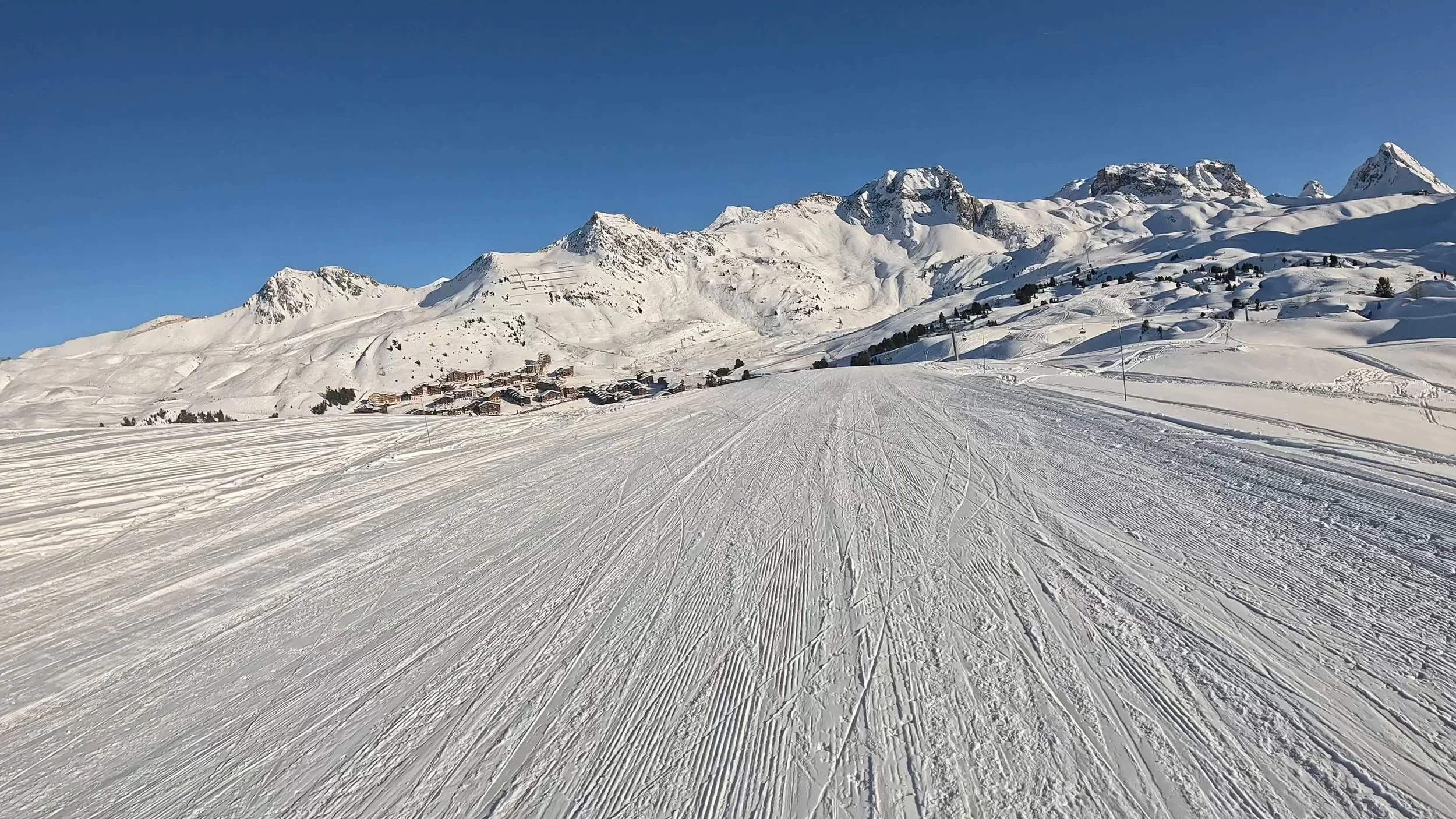
Paradiski spans more than 16,000 acres across multiple valleys and elevation zones.
Snow Quality and Resiliency
With terrain ranging from 1,200 to 3,250 meters (4,000 to 10,660 feet) and a good chunk of north-facing slopes, Paradiski generally offers strong snow reliability for the European Alps, although conditions do vary across elevations. Les Arcs’ higher alpine terrain, especially Varet and Aiguille Rouge, holds snow well, notwithstanding the wind issues common on the upper mountain. La Plagne has a solid base elevation and typically more consistent coverage overall, though some lower areas like Montchavin and Les Coches suffer from poor coverage and can see variably open valley runs.
A strong snowmaking system, especially in lower-mountain areas, keeps the domain reliably operating overall. Compared to the top French resorts, Paradiski is just a notch below in terms of consistent snow quality, but the domain outperforms lower resorts in poor snow years.
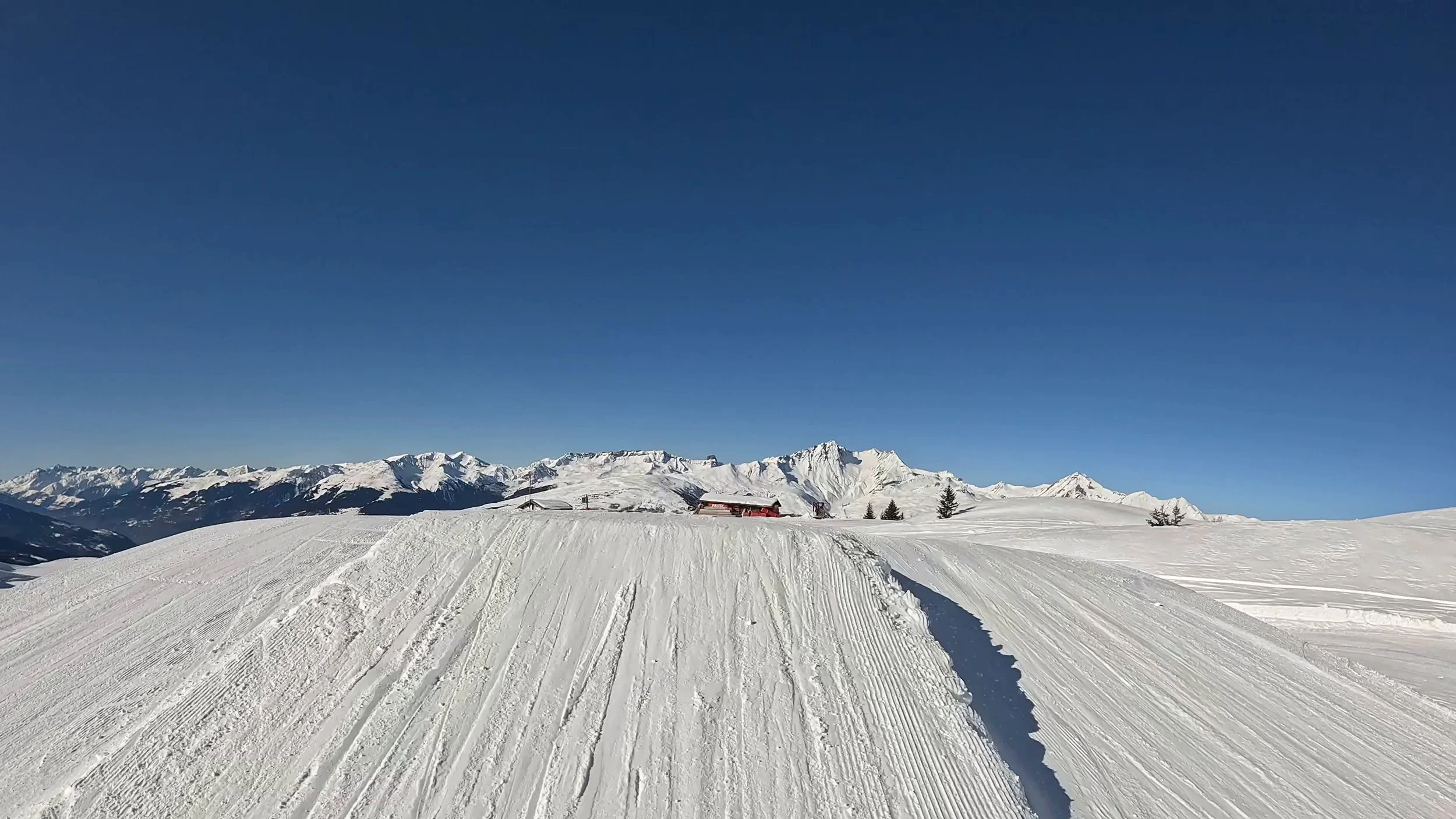
A strong snowmaking system keeps Paradiski reliably operating even in poor snow years.
Beginner
In terms of easier terrain, Paradiski is one of the best resorts in the French Alps, if not the entire world. Each of the three areas caters well to beginners, and with the exception of a handful of upper-mountain lifts, every part of the domain offers a blue-rated easy way down. Peisey-Vallandry is especially ideal for first-timers, with gentle, uncrowded below-treeline slopes. La Plagne specializes in wide, above-treeline blue pistes, with some of the most beautiful mellow runs one can find anywhere. Les Arcs has several beginner zones as well, spanning various elevations and offering excellent views.
One blue run just about everyone will find cool is the Tunnel piste in the upper part of La Plagne. The trail meets a massive ridge about two-thirds of the way down, and the resort’s solution, you guessed it, involves skiing or riding through a tunnel to get to the other side. The inside is lit up and plays techno music, although it’s a little flat and snowboarders may not have the best time.
Intermediate
Paradiski is fantastic for intermediate skiers and riders as well. Les Arcs is packed with fast, rolling red-rated groomers, especially off the Arpette lift. Over at La Plagne, visitors will find wide, lower-angle alpine runs that provide confidence-building progression, although occasional flat runouts may be a drawback for skiers seeking constant flow. While its red runs are generally lower in elevation than the rest of the domain, Peisey-Vallandry is almost entirely intermediate terrain and is perfect for long, cruisy laps.
Advanced
When it comes to expert-rated black runs, Les Arcs delivers the best advanced skiing in the domain. Guests looking for the steepest groomed runs should head to the Varet gondola and Aiguille Rouge tram, which serve sustained steeps with epic views, though wind exposure can impact snow quality. La Plagne has a handful of black runs, almost entirely in its upper elevations, but the overwhelming majority of them are difficult to lap, and the resort caters much more to lower ability levels. Black-rated pistes are quite limited at Peisey-Vallandry as well.
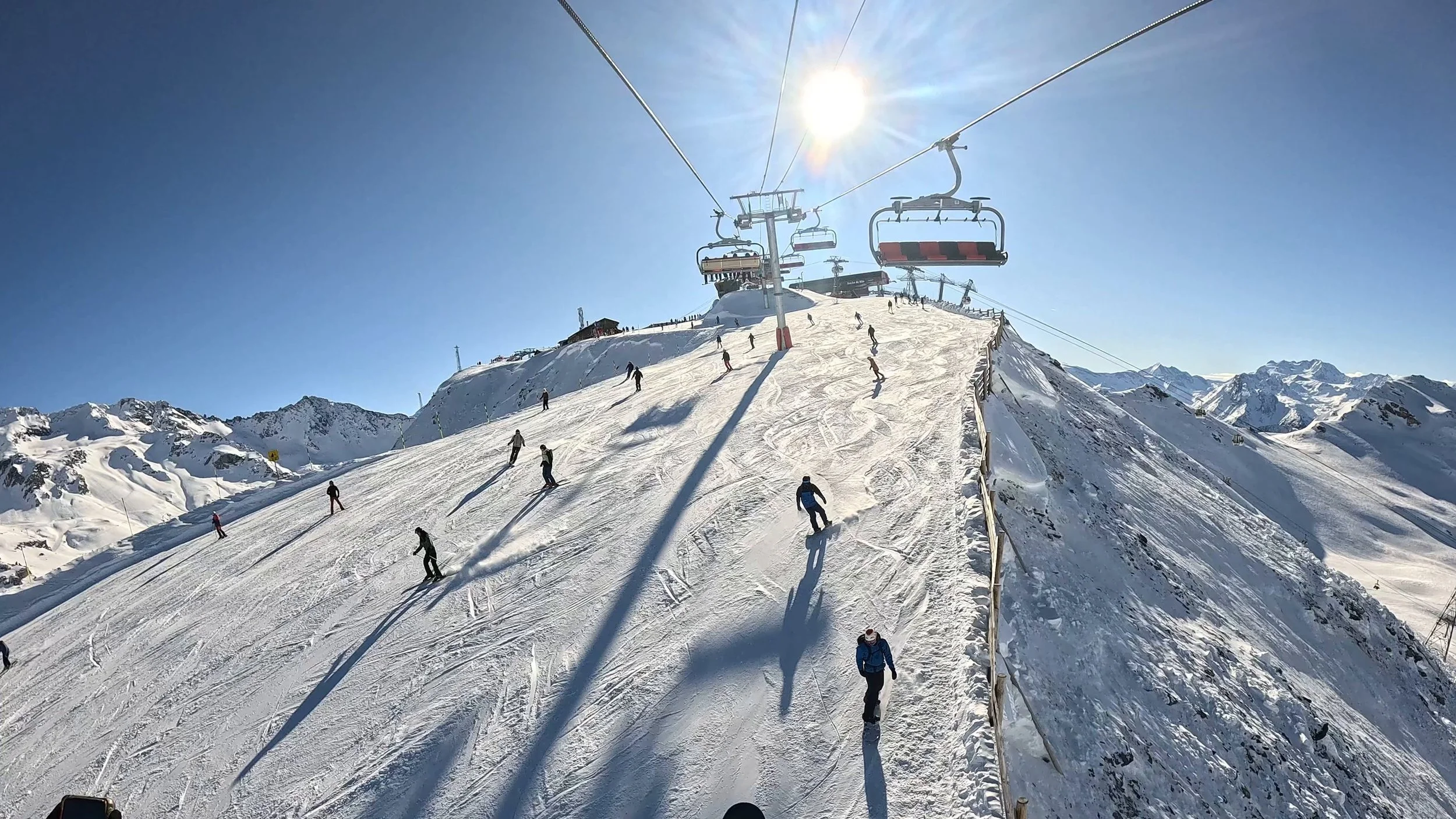
Les Arcs offers the best advanced skiing in the domain, with sustained steeps and epic views.
Terrain Parks
When it comes to terrain parks, Paradiski doesn’t quite match the elite park scenes of the best Alps resorts, but it offers more than enough for casual park rats. Les Arcs features a solid, well-maintained park near the Arpette lift along with a boardercross course. La Plagne’s main park is located near Belle Plagne, close to the glacier, and caters to both progression and freestyle riders.
Expert
When it comes to maintained freeride terrain, Paradiski marks some of its black trails with the word “Natur’”. All of these natural trails are on the Les Arcs side, although several La Plagne black pistes are regularly ungroomed in practice as well, especially off the Glaciers gondola.
The 2,000-meter descent from the top of Aiguille Rouge in Les Arcs is perhaps the most impressive in-bounds expert experience at Paradiski. Conditions can be variable due to wind and sun exposure, but it offers serious vertical and panoramic views. That said, other French Alps resorts offer more demanding experiences overall.
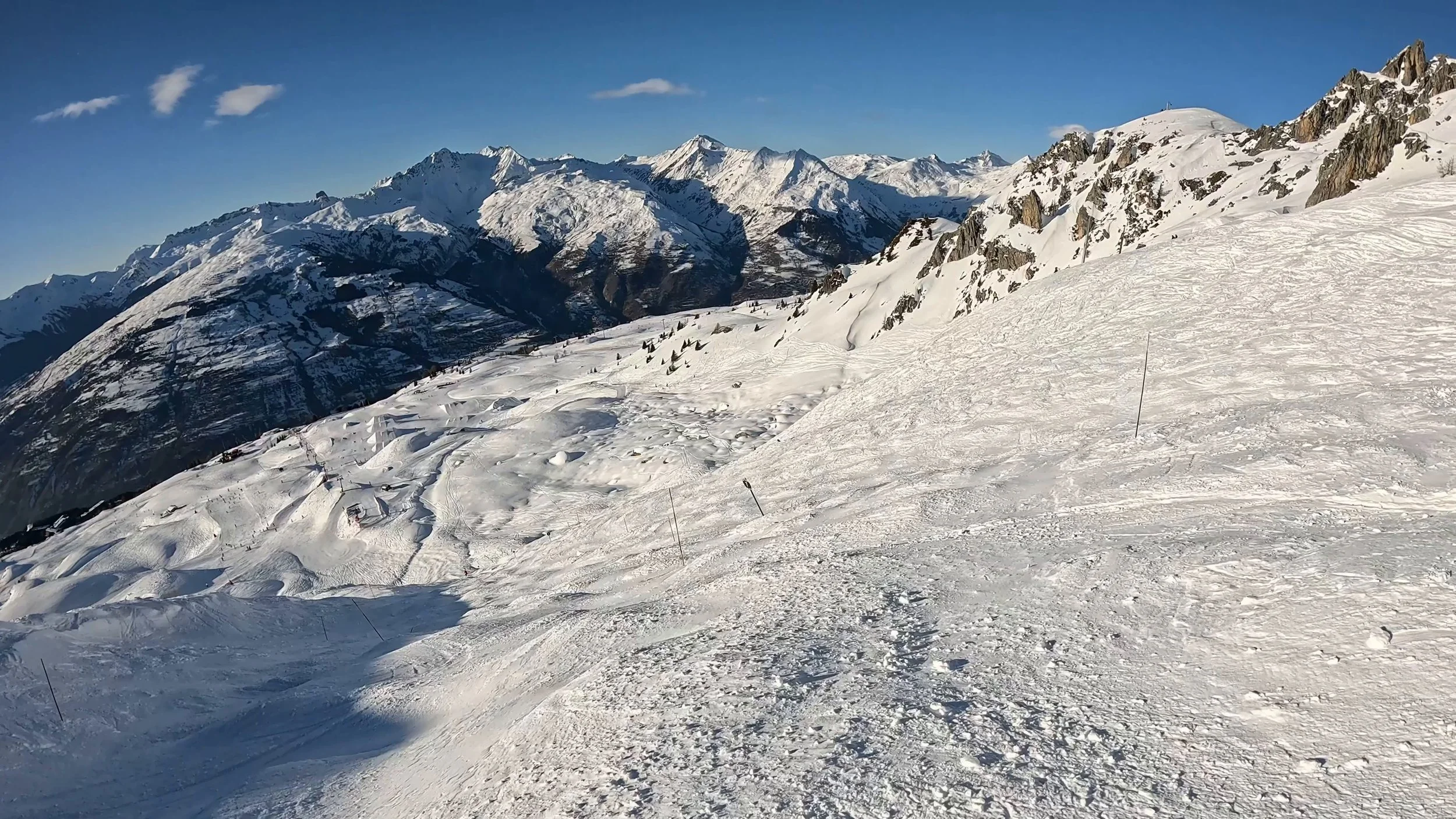
Some of Paradiski’s black trails are marked “Natur’,” all of them on the Les Arcs side.
NOTE: We may receive a small affiliate commission if you click on the below links. All products listed below are unisex.

Recommended all-mountain ski

Recommended carving ski

Recommended glade ski

Recommended expert/touring ski
Off-Piste
Both Les Arcs and La Plagne feature readily accessible off-piste terrain above treeline, ideal for intermediate to expert skiers looking to explore just outside the trail sticks. Paradiski attracts much more of a family crowd than resorts like Chamonix and Verbier, so the off-piste tends to be significantly less tracked.
While Les Arcs and La Plagne are known for relatively low-risk off-piste zones when conditions allow, there are still a number of out-of-bounds circumstances that can get you into serious trouble if you aren’t familiar with the terrain, including serious chutes, couloirs and cliff drops on both sides of the domain. This can be especially surprising at La Plagne, where the official maintained pistes tend to be a lot mellower. If you’re going off-piste and don’t know the area, we highly recommend you hire a guide. Even if you do know the area, the off-piste is not patrolled for avalanches, so it’s wise to go with a partner, check avalanche forecasts, and bring a beacon, shovel and probe.
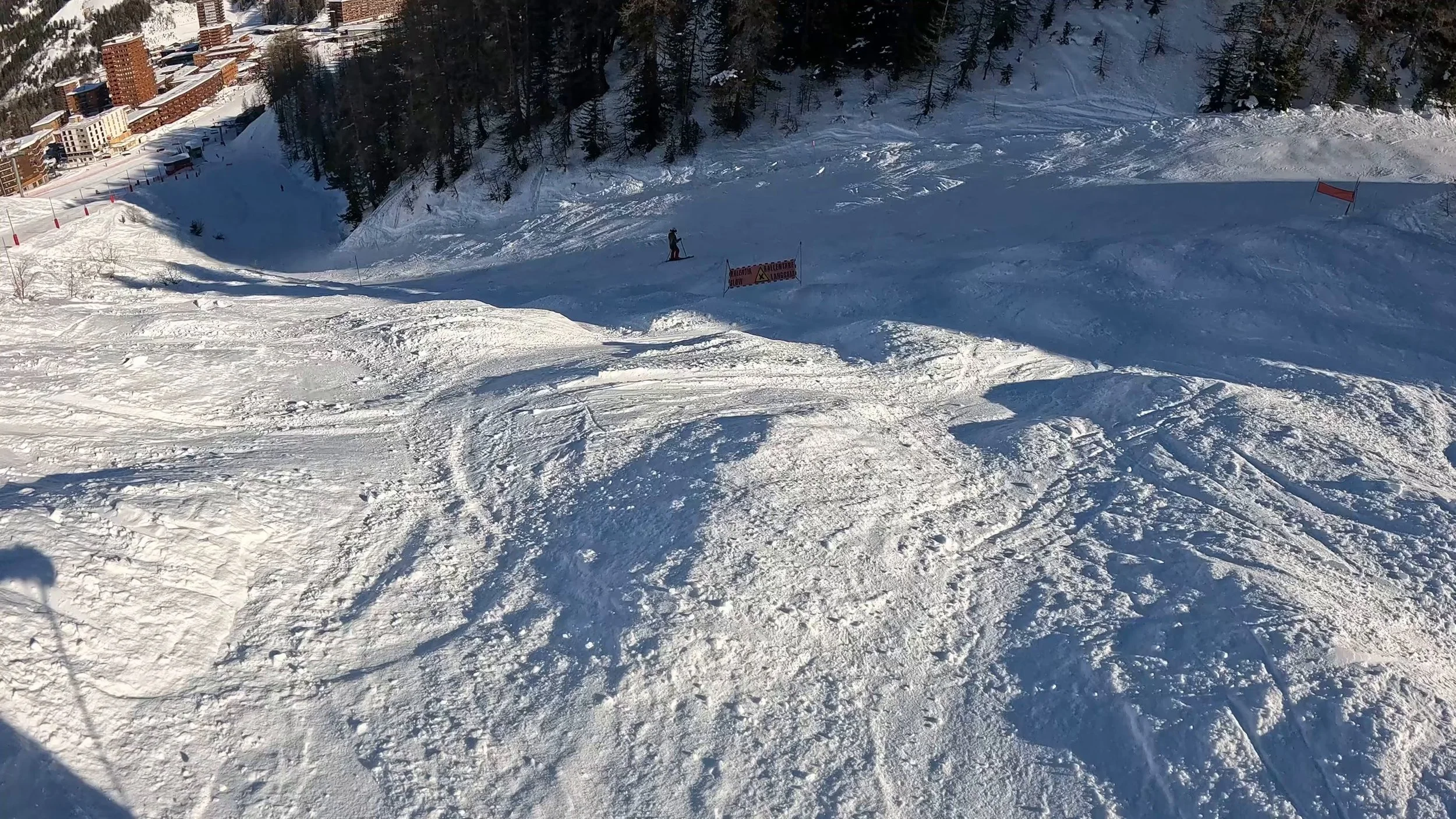
Both Les Arcs and La Plagne have readily accessible off-piste terrain above treeline.
Lifts
At first glance, Paradiski boasts some of the coolest lifts in Europe, but overall the infrastructure is a mixed bag. On the plus side, both Les Arcs and La Plagne have modern, high-speed lifts in their central areas, including over a dozen gondolas, especially on the La Plagne side. Several upper-mountain areas are served exclusively by tram, which provides fast service if you time your arrival right but can also cause queueing when it’s busy.
It’s also worth touching on just how wild it is to ride the Vanoise Express, which connects the two resort sides. This is one of the only aerial tramways in the world with double-decker cabins, and with a capacity of 200 people per car, it is home to the world’s largest ski lift cabins as of the time of publication. The lift spans a deep gorge between La Plagne and Peisey-Vallandry, making for phenomenal views, although those who are afraid of heights may not want to look down.
Another very unique lift is the Les Arcs Express funicular. This 250-passenger alpine train provides access from Bourg-Saint-Maurice, the main town in the valley, to the rest of the resort by way of the Arc 1600 base. The funicular is a fast and scenic ride, but it runs on headways of 15 to 20 minutes, so you’ll want to time your departure right.
However, both resort sides have several lifts that feel behind the times. Many of these slower lifts are redundant to more modern options, but in some cases they provide the only access to significant terrain. At Les Arcs, this has historically been especially true on the Villaroger side; if you’re coming up from the base there as of early 2025, you have to bear through three fixed-grip chairlifts before you can get anywhere else on the mountain. Two of these older lifts were on track to be replaced with a gondola over the summer of 2025. La Plagne is generally a bit more modern than Les Arcs, but there are still a few places with dated infrastructure, including two of the only fixed-grip six-pack chairlifts we’ve ever seen. Most of Paradiski’s high-speed chairlifts also do not have bubbles, which are often standard at higher-end European resorts. Ultimately, compared to the ultra-modern lift systems at the best European resorts, Paradiski is a half-step behind.
Navigation
Thanks in large part to its horizontal layout and massive footprint, Paradiski is not the easiest ski region in the world to get around. Things get a lot less complex when viewing Les Arcs and La Plagne as individual resorts, and the clear, well-maintained signage helps guests find their way. Unlike in North America and certain other French resorts, the names on most Paradiski piste signs are not that of the trail itself, but of the terrain zone or base that the piste leads to. Some markings provide direct guidance to specific lifts, which is very helpful when traversing across multiple zones. La Plagne’s layout is more intuitive thanks to its coherent and central focus, whereas Les Arcs can feel a bit more disjointed due to its spread-out villages. The Vanoise Express is a critical connector but not something you’ll want to cross more than once a day.
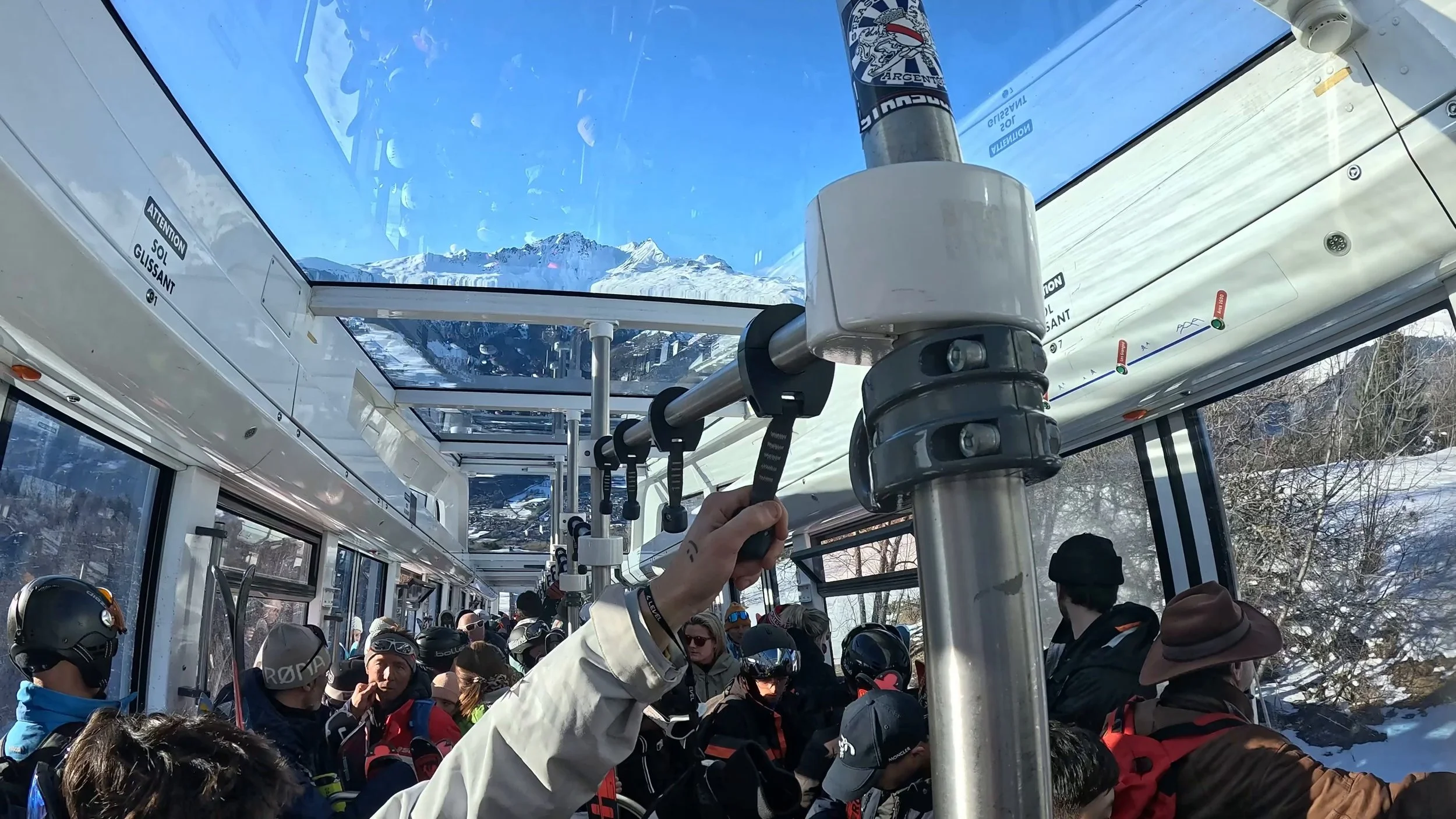
The Vanoise Express is one of the only aerial tramways in the world with double-decker cabins.
Getting There
Paradiski is easily accessible both by car and public transit. If you’re arriving by train, the best gateway is Bourg-Saint-Maurice, which has the direct funicular link to Arc 1600. BSM is well connected to Lyon, Chambéry and Geneva by France’s high-speed TGV and regional train services, and for certain parts of La Plagne, guests can take the train to the Aime-La Plagne station. From Geneva, the closest international airport, train travel typically takes around four and a half hours and involves a transfer at Chambéry. The luggage areas on some of the trains are not ski-friendly, so if possible, try to be one of the first people on to store your gear appropriately.
For those driving, all of the resorts are about a two-hour drive from Geneva, with most of the route on the French highway network. For those staying at higher elevations, the final part of the drive involves winding mountain roads, although they are well maintained.
Lodging
Paradiski offers plenty of lodging options both on-site and near the slopes. Les Arcs has multiple lodging hubs: Arc 1950 is upscale and family-friendly, Arc 1800 is lively with good après access, and Arc 2000 is quiet and ski-focused. La Plagne’s mid-mountain villages have true ski-in/ski-out options but less nightlife. Peisey-Vallandry is the quietest option, ideal for families. For budget travelers, the Base Camp hostel in Bourg-Saint-Maurice is a fantastic option with a bar and restaurant. If you want something really different, you can even stay overnight in the igloo at the Arc 2000 base.
If you have an RV or camper van, La Plagne offers overnight parking lots within easy access of the lifts.

Recommended intermediate board

Recommended advanced board

Recommended expert board

Recommended touring board
Crowds
Crowd flow at Paradiski is generally well distributed, and lift lines are manageable across most of the domain. In the most popular areas, crowds are helped by uphill lift redundancies. The Aiguille Rouge tram at Les Arcs is the only consistent pinch point, with the lift’s low capacity and iconic terrain creating long queues, especially during peak times. February is the busiest month, but outside of Aiguille Rouge, lift lines still rarely reach unbearable levels.
The higher-elevation blue runs at La Plagne, especially at and around Plagne Bellecôte and Belle Plagne, can get quite congested during busier periods, so they’re best avoided at peak times if you want to stay away from less-experienced skiers and riders. Les Arcs’ slopes don’t tend to build up quite as much congestion, although popular family areas such as Arcabulle can get crowded. Les Arcs does offer an express lane pass if you want to skip the lines, but it doesn’t get you priority access at La Plagne, and in most circumstances it’s probably not worth it.
Facilities
Both La Plagne and Les Arcs offer a wide range of on-mountain dining, from classic, independently run alpine huts to outdoor après bars. Compared to the highest-end competitors, Paradiski is more affordable but slightly less gourmet.
Notable stops include the bar near Arpette in Les Arcs, with a live DJ and a specialty in mulled wine, and several glacier-view terraces in La Plagne. For the most memorable experience, check out the igloo bar at Les Arcs, a multi-room man-made ice cave with several impeccably done wall carvings.
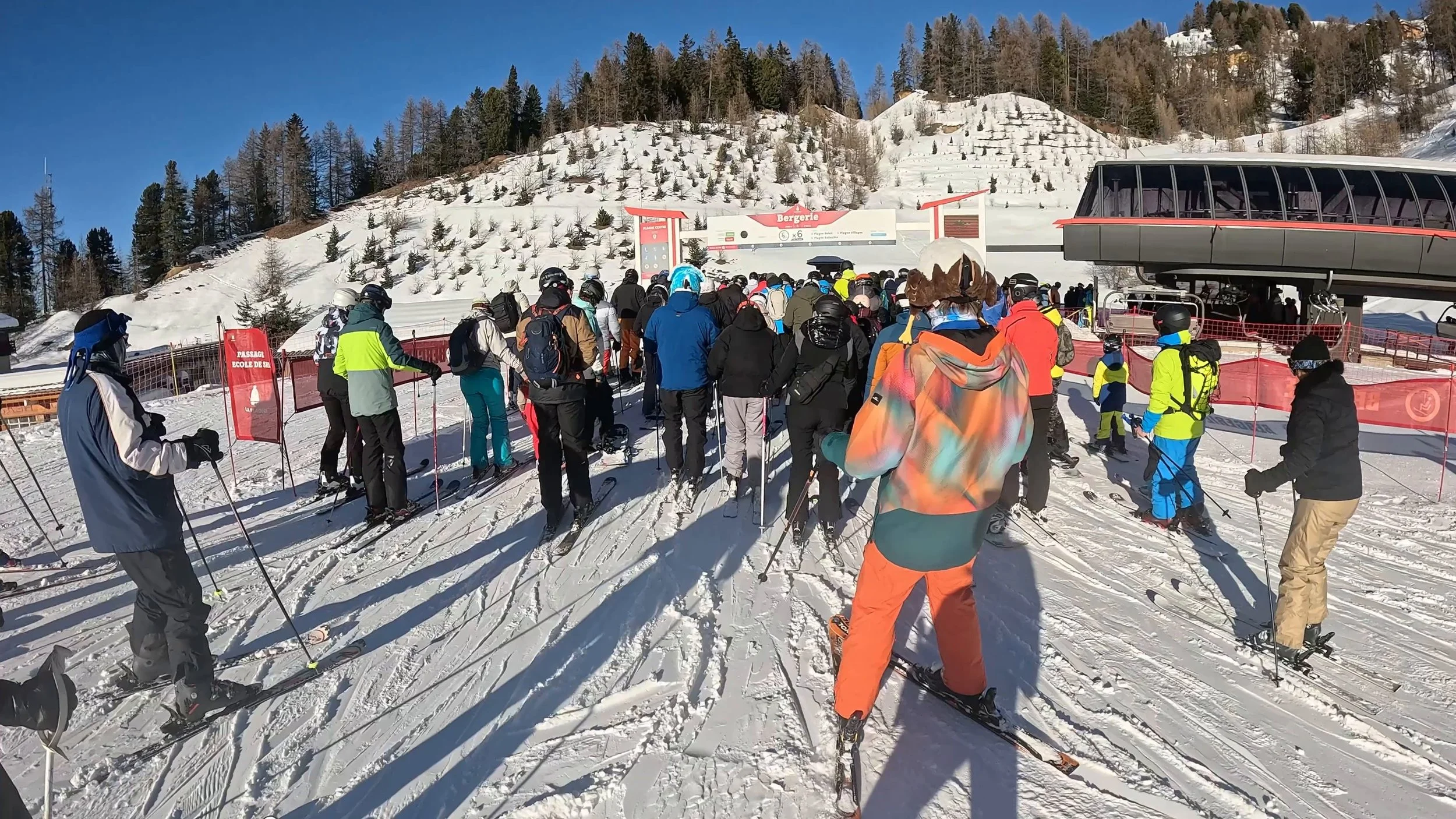
Lift lines are manageable across most of Paradiski, with pinch points at the most popular lifts.
Après
Paradiski is certainly fun-focused, although it might not offer the party vibes of places like St. Anton. Of the two resort sides, Les Arcs has the more energetic scene. The Folie Douce in Arc 1800 is a highlight, but other slope-side bars make for great post-slopes parties as well. La Plagne is more subdued, but it still offers a few cozy pubs and live music venues, with La Bergerie at Plagne Villages being an especially notable highlight.
Pass Partnerships
Paradiski isn’t included on any major multi-resort passes like Epic or Ikon, but the affordability of its ticket prices makes it a great option for skiers who missed the mega pass deadlines or simply want to take advantage of a Euro trip without breaking the bank.
Mountain Aesthetic
If you’re looking for views on your trip to Paradiski, the experience doesn’t disappoint. The scenery is phenomenal; especially from the top of Les Arcs and the glacier areas in La Plagne, guests can soak in some of the best views the French Alps has to offer. The Aiguille Rouge is undoubtedly the pinnacle of Les Arcs, with multiple viewpoints for a 360-degree panorama. Les Arcs’ modernist architecture is surprisingly attractive up close, and Arc 1950 in particular feels elegant and cohesive. La Plagne’s villages are more utilitarian, although one could argue they’re still picturesque in their own way.
While not quite as iconic as world-renowned destinations like Zermatt or the Dolomites, Paradiski has a few other decidedly memorable tricks up its sleeve. At the top of the Transarc gondola, there is an unassuming mineral exhibit with all sorts of cool rocks on display, and if you keep walking through a door at the end of the exhibit, you’ll find a laser rifle shooting range. Try to find that on your other typical European ski vacation.
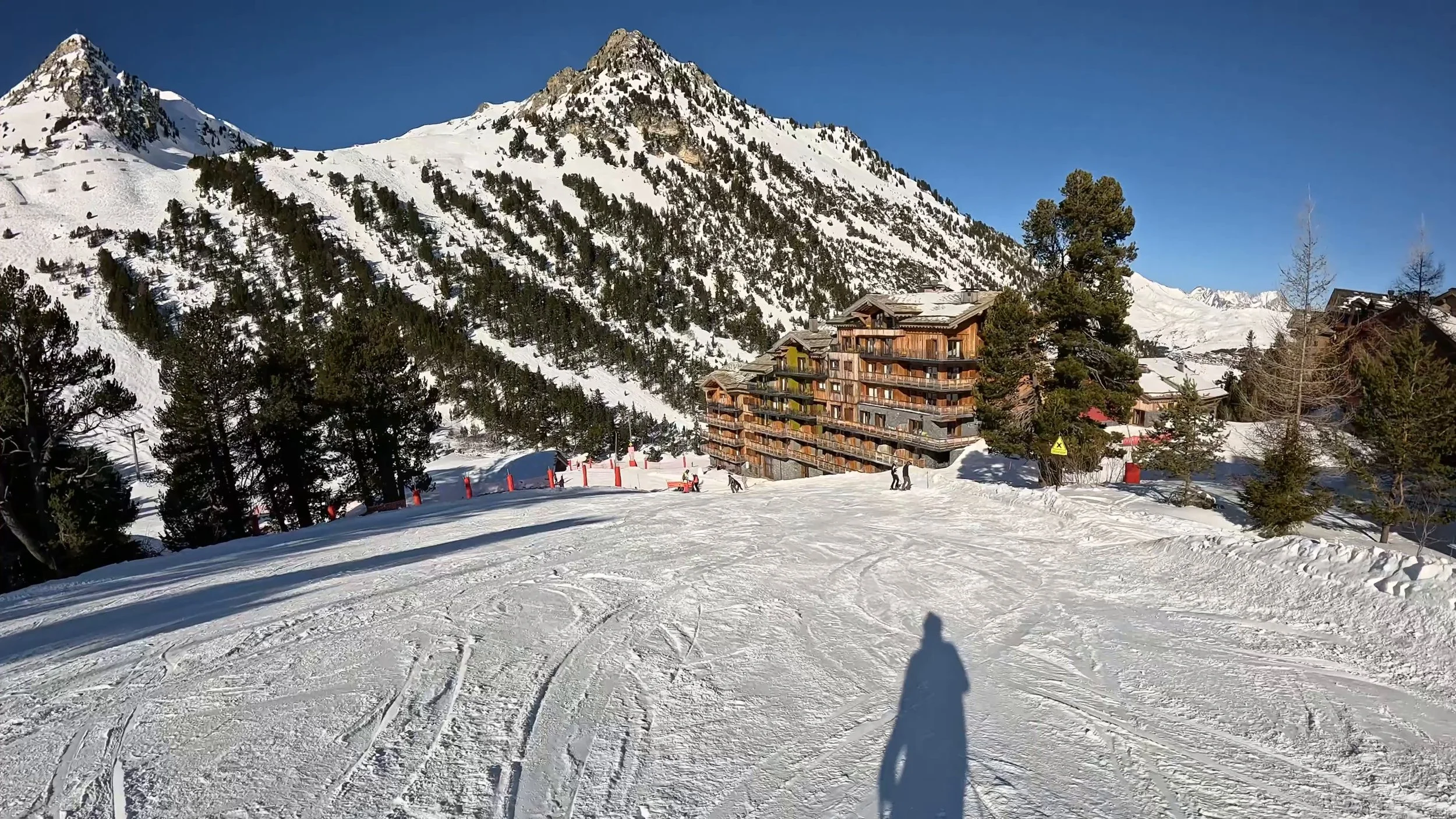
Les Arcs’ modernist architecture is surprisingly attractive up close.
Verdict
So no, Paradiski isn’t perfect. Its overall layout isn’t the most intuitive, and some areas still rely on aging infrastructure. But despite those drawbacks, the domain delivers the size, variety and scenery to earn its place among the heavy-hitters in the European ski scene. Lapping the entire domain in a single day takes more effort than at some of its more seamlessly connected peers, but both Les Arcs and La Plagne are strong enough to stand on their own as world-class destinations. For most people, they are better viewed as two separate resorts than one comprehensive footprint, and for the vast majority of people booking a trip to this part of the world, neither will let you down.
Pricing
Paradiski offers solid value. Adult 1-day lift tickets for the full domain run roughly €62–€78, which undercuts many major European resorts and comes in well below anything comparable in the U.S. For those who prefer to stick to one side, 1-day tickets for Les Arcs or La Plagne alone run roughly €56–€72.