Introduction
Maine’s Sugarloaf Mountain doesn’t feel like it should be real. High-alpine snowfields, seemingly endless glades, and intense hike-to terrain aren’t exactly the first things that come to mind when you think of skiing the East. But somehow, Sugarloaf has all of them.
The resort is home to three of the most unusual terrain zones anywhere in the East: the Snowfields, a massive area of exposed alpine terrain off the mountain’s summit; Brackett Basin, an enormous network of wild, largely undeveloped glades; and Burnt Mountain, an even more remote sidecountry area requiring a substantial effort just to access.
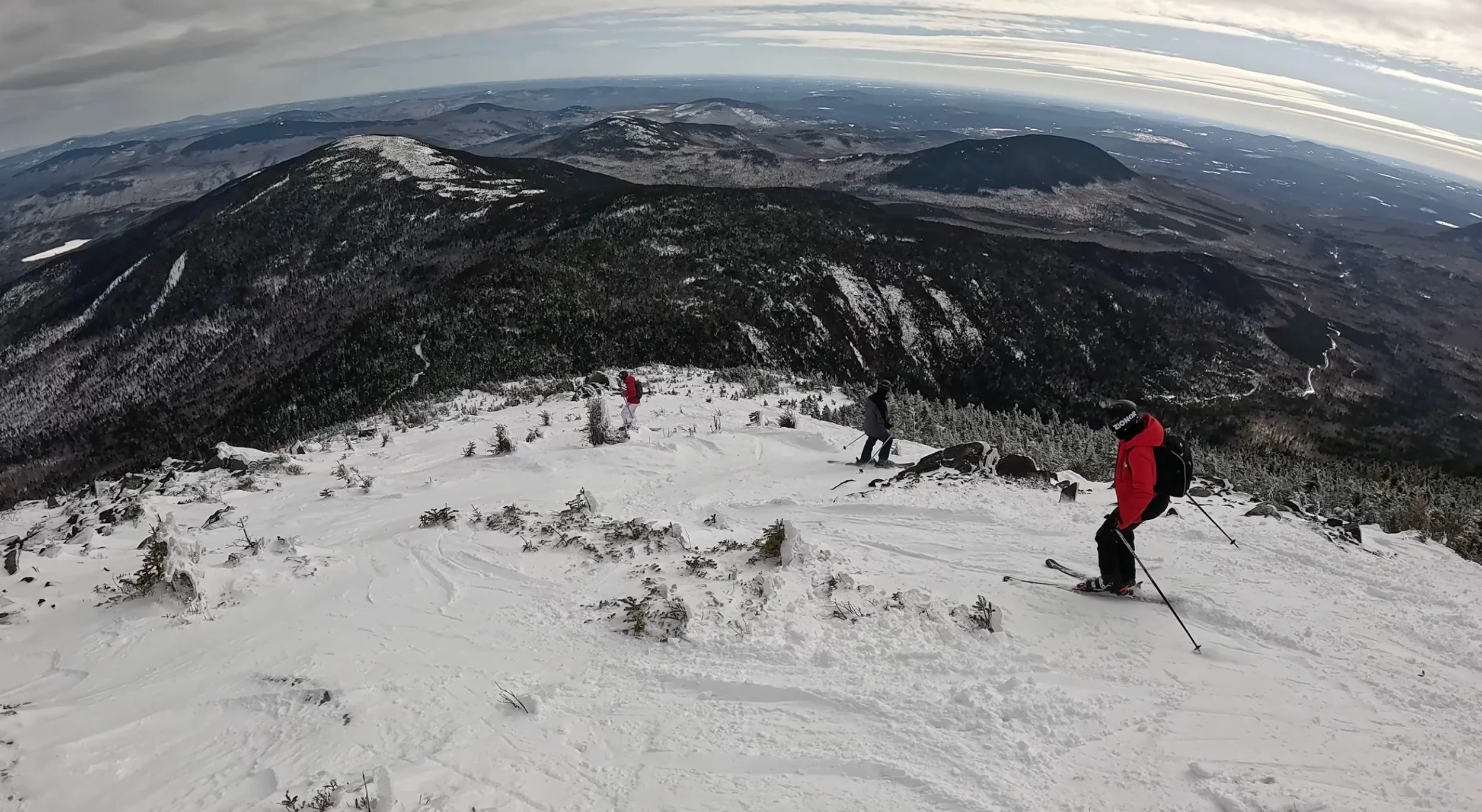
Sugarloaf’s Snowfields are a massive area of exposed alpine terrain off the mountain’s summit.
But here’s the catch: it’s incredibly rare to have the opportunity to ski much, if not all, of this terrain. The Backside Snowfields in particular can go entire seasons without opening, and the other areas are quite fickle as well.
But in February 2026, after one of the best stretches of snow conditions the Northeast had seen in years, we arrived at Sugarloaf with an extraordinary opportunity. Not only was Brackett Basin firing on all cylinders, but the Backside Snowfields had just opened for the first time in nearly three years, and Burnt Mountain was expected to open for hiking as well. Some locals told us this was the first time they’d seen all three of these zones available at once.
So with an opportunity like this, we had to take full advantage. We couldn’t resist trying to check all three off our bucket list over a single weekend, during perhaps the only time period in our lives we could ever do that, and figuring out whether they lived up to the lore.
But as we were about to discover, there’s a big difference between a ski resort being fully open on paper and actually being able to ski or ride everything it has to offer.
Day 1: The Backside Snowfields
Our trip to Sugarloaf started on the last Thursday of February 2026. As we drove up to the resort, conditions were clear and absolutely beautiful, and the news had come in that the Snowfields had briefly opened that day, for the first time in three years. So we checked into our accommodation and got excited for an exceptional weekend of skiing and riding.
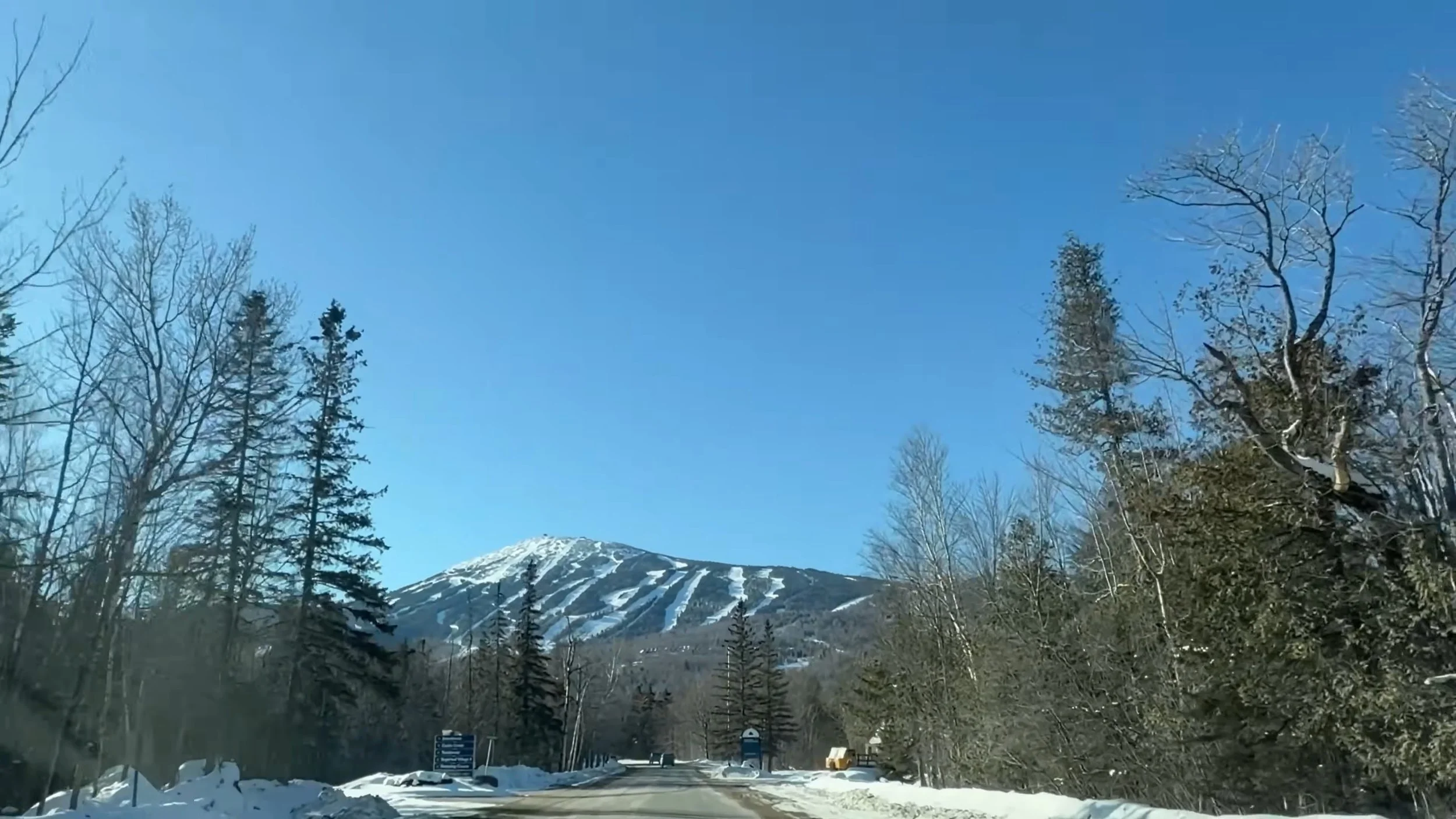
Conditions were clear and absolutely beautiful as we drove up to the resort.
The bluebird weather continued into the next morning. We made it to the resort base and checked the status boards, but they didn’t seem to have any information on whether or not the Snowfields would open up again. Still, the day was looking absolutely pristine as we boarded our first lift. After a warmup lap to get ourselves up to speed, we couldn’t wait any longer, and headed to the lift that would take us up to the summit to check on the Snowfields’ status. At the top, we were greeted with the sight of an open gate.
Beyond this gate is a pretty short hike across the summit, and the surroundings became surreal immediately. The views from the summit were absolutely stunning, and we took some time to soak them in before deciding how to enter the actual backside runs, which start a short distance below the summit. The rocky terrain made it somewhat difficult to find a spot to clip in, so I went ahead and skied from the very summit.
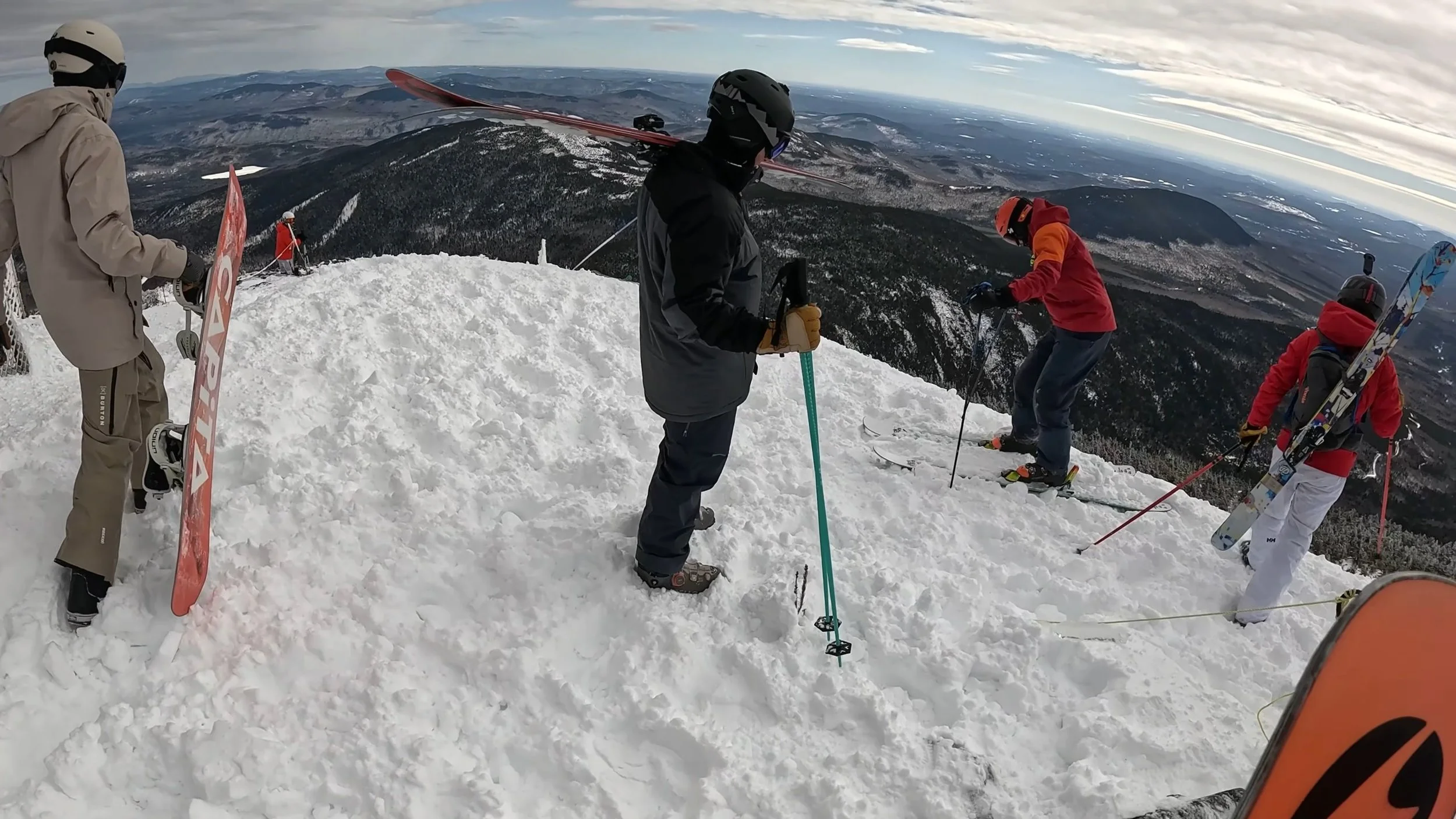
The views from Sugarloaf’s summit were absolutely stunning.
Then it was time to navigate the somewhat spotty coverage of the open meadow. The rocks, shrubs, and windy exposure created a truly irregular terrain experience on these snowfields. While it’s definitely not the same as an alpine bowl out west in the traditional sense, it does offer its own unique challenges as a ski run, and it wasn’t easy to get into a rhythm with all the obstacles.
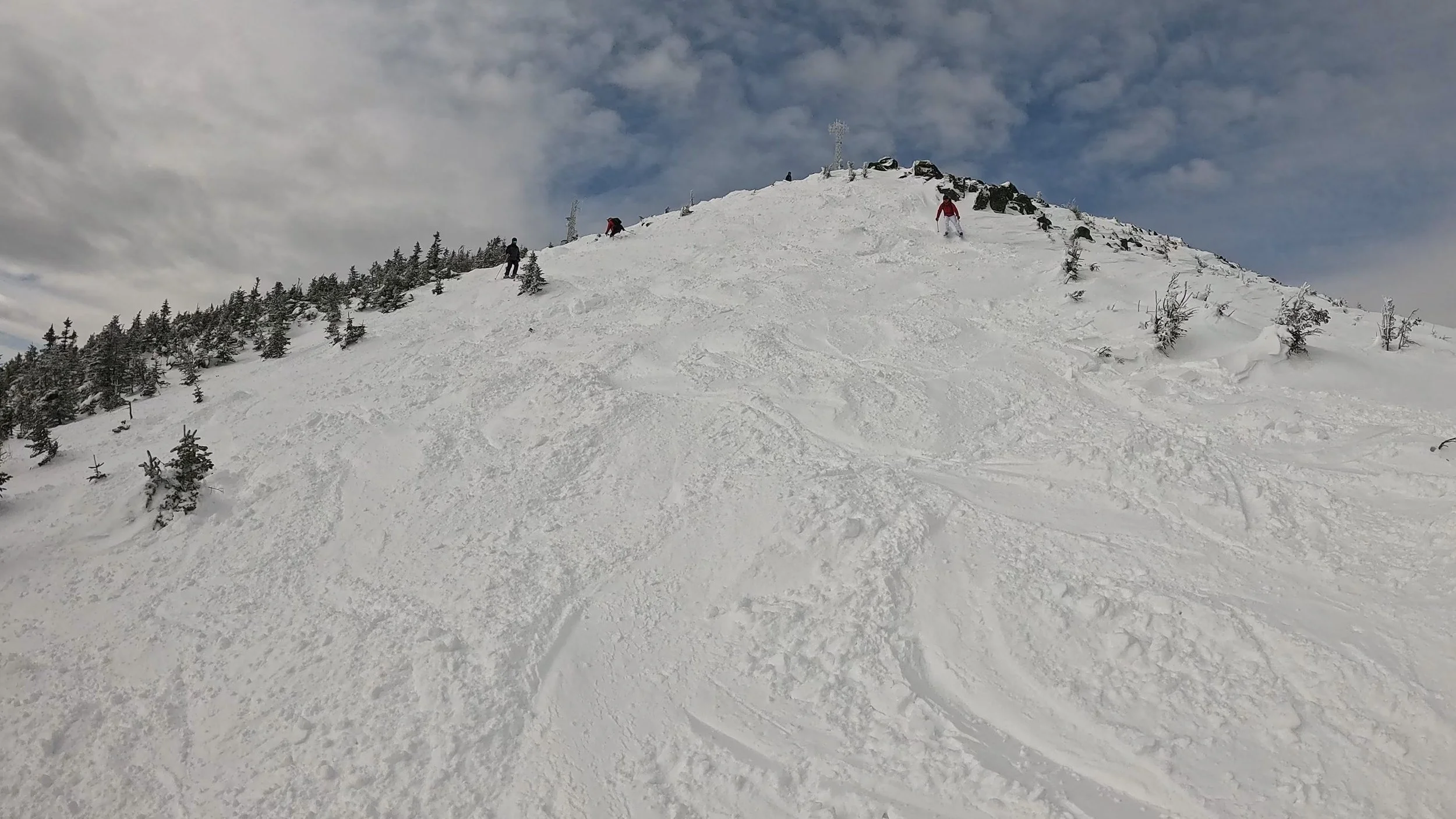
Rocks, shrubs, and windy exposure made for a truly irregular terrain experience on the Snowfields.
Skiing the area with true flow and finesse wasn’t necessarily possible with our group under these conditions. And there were a lot of people in and around the area who were definitely out of their comfort zone. While it was worth it for the novelty, we wouldn’t say it was exactly marquee skiing.
So our first run through the Snowfields was amazing, but it also wasn’t. The conditions had been that spotty even with the great and consistent season the resort was having, which just goes to show that Sugarloaf’s carefulness with opening the backside is probably justified.
The weather took a turn at that point, and snow began to fall. We headed back up to the summit with hopes of getting a better run in off the frontside. The snow on the frontside summit terrain was a little more consistent, though these runs are technically still part of the Snowfields. And one thing that was 100% delivering at Sugarloaf was the lunch, at a burrito spot hidden behind an unmarked door.
Our choice of lift to get back onto the mountain may have been poor, but we did eventually make our way back to the summit area. The upper gate was tracked out by then, so we went through a lower gate that still entered the Snowfields without requiring any hiking. There was still some good snow to be found, but it reinforced our sense that the Snowfields weren’t exactly delivering a marquee alpine bowl experience. As one of our group put it, “up there, it’s just so rocky.”
Day 1: Brackett Basin
With the Snowfields checked off our bucket list, it was time to turn our attention to the second of Sugarloaf’s three elusive terrain zones: Brackett Basin.
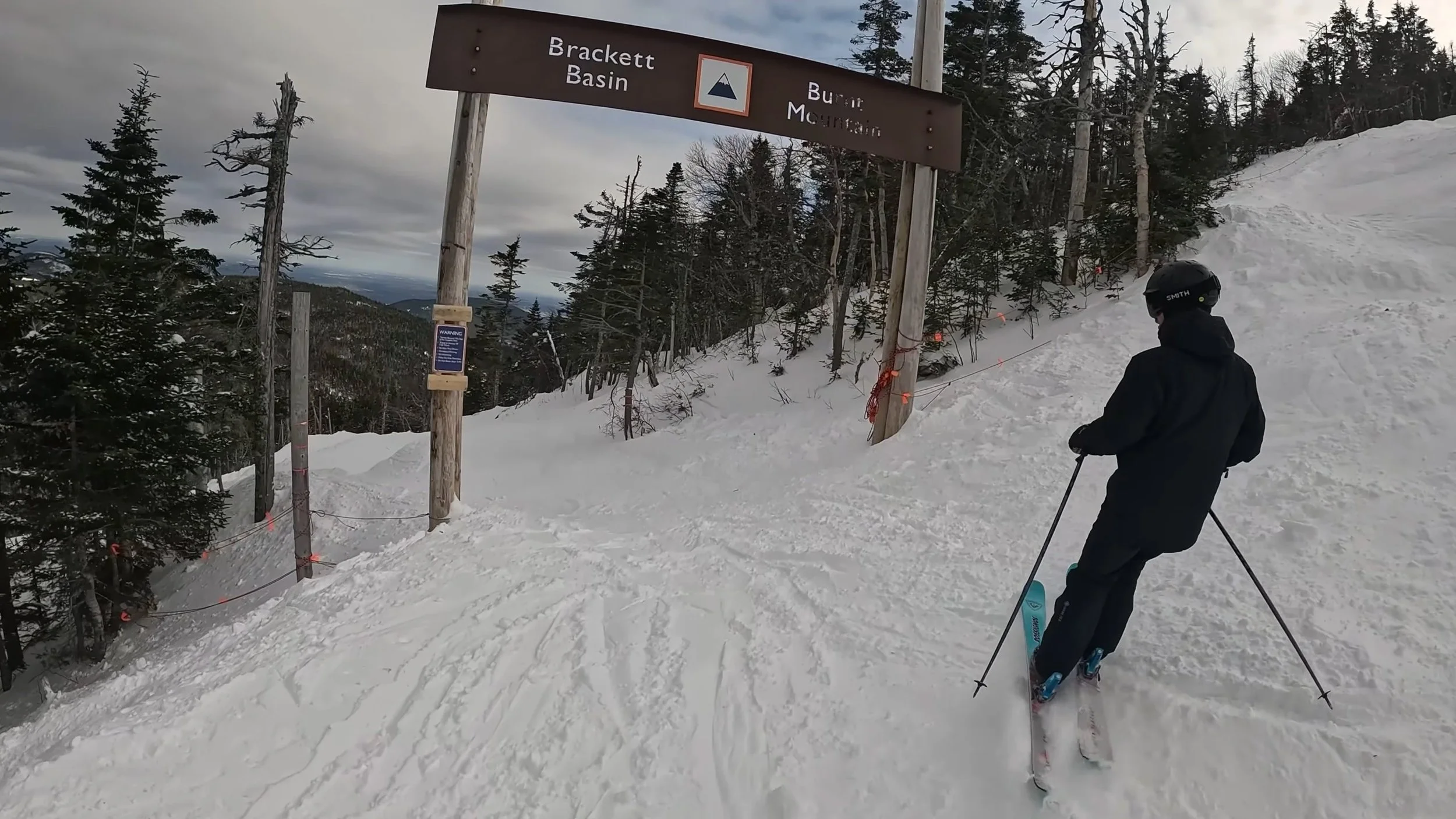
Brackett Basin is the second of Sugarloaf’s three elusive terrain zones.
Brackett is part of what Sugarloaf officially calls its sidecountry, massive gladed areas on the far skier’s right side of the mountain. These areas offer a surprisingly undeveloped experience while still being within the resort’s patrolled boundaries. Some of the glades have been hand-cut and thinned, while others have been left largely untouched by humans.
After our somewhat mixed experience on the rocky, exposed Snowfields, we were eager to see whether Sugarloaf’s much more sheltered specialty woods could deliver the kind of slopes we’d been hoping for. There are some defined traverses, hike paths, and signs back here, though the resort’s trail map leaves a bit to be desired when it comes to actually navigating the terrain.
And while the Snowfields we were looking back at hadn’t quite felt like the most practical place to spend much time, these sidecountry glades were another story. The trees felt endless, with almost the full vertical of the mountain at our disposal. Not to mention that the snow had held up much better than anywhere else at the resort. And the best part is that if you know what you’re doing, you can cut over and get right back to the bottom of the same King Pine lift.
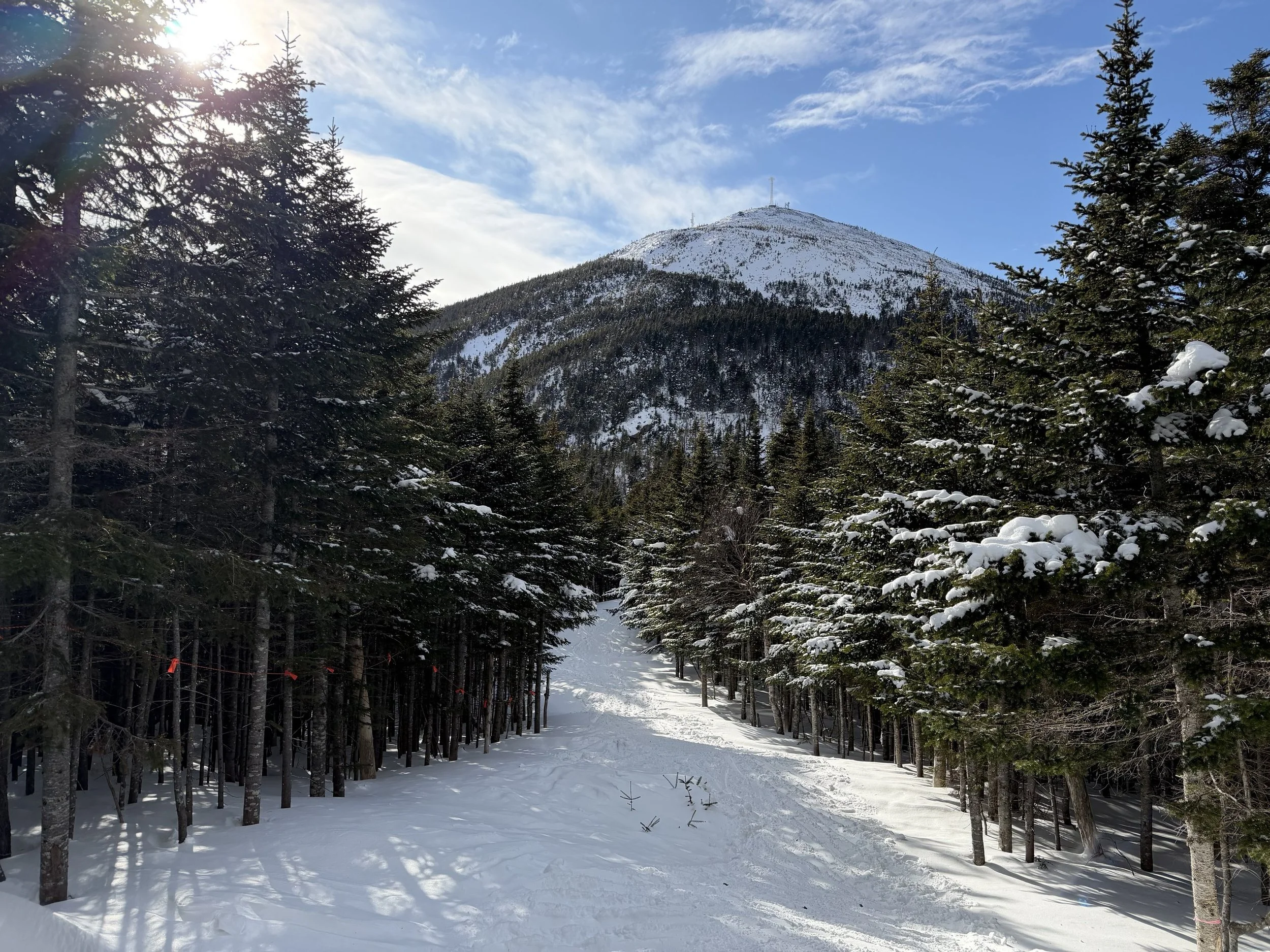
The trees in Brackett Basin felt endless, with almost the full vertical of the mountain at our disposal.
Unfortunately, we didn’t have any more time that day to get more Brackett Basin runs in. But we were hopeful that we’d come back stronger for Day 2, both for the Snowfields and the woods again.
Day 2: Crowds and Wind Holds
However, our second day at Sugarloaf did not exactly deliver the expected experience. Not only was it incredibly crowded, but the entire mountain was down for wind hold. This left us wondering whether we’d even get any skiing or riding in that day. We’d barely gotten the chance to scratch the surface of Brackett Basin the day before, and we still hadn’t touched Burnt Mountain. So was our slim window to achieve our terrain goals already over?
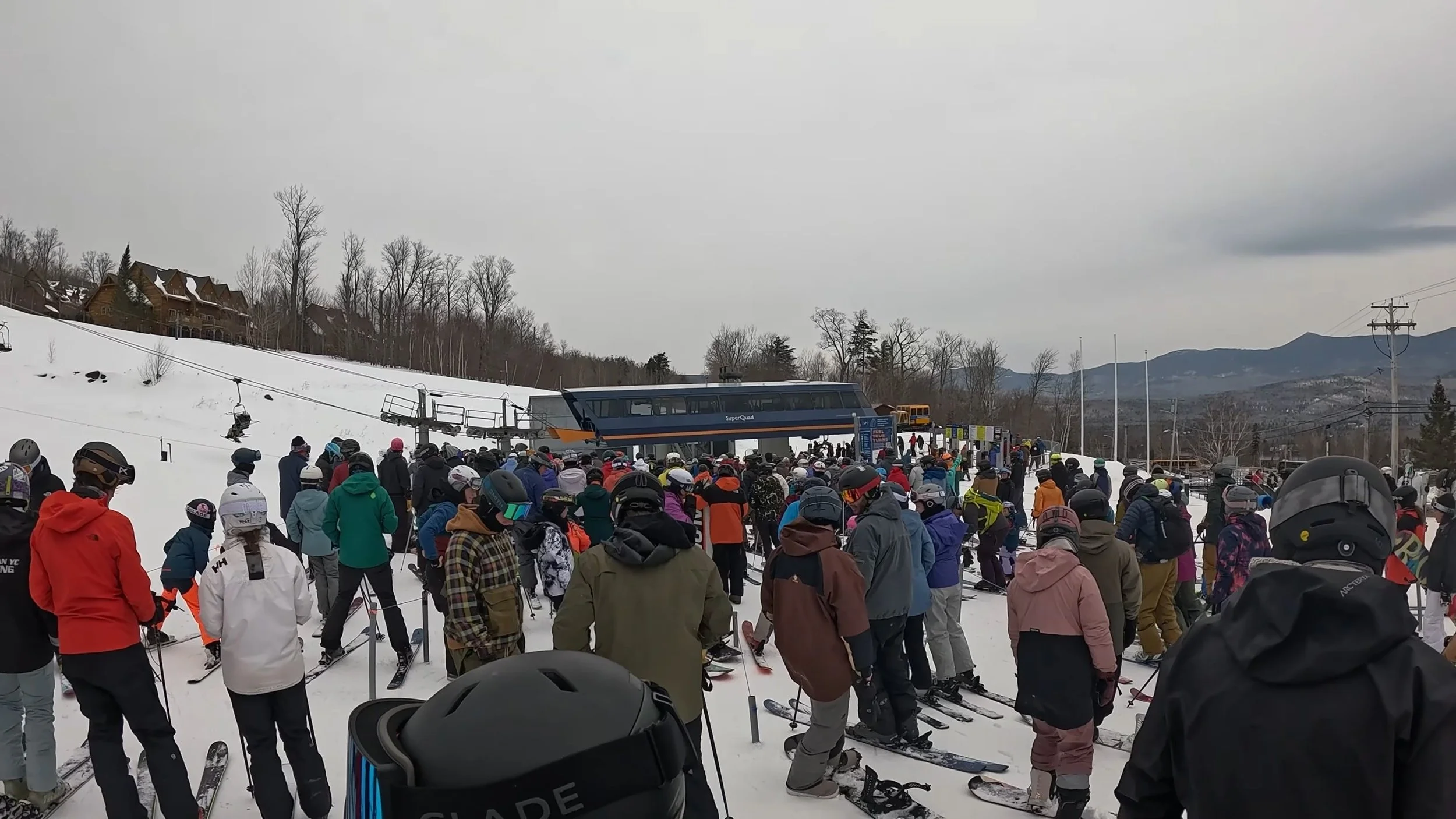
Our second day at Sugarloaf was incredibly crowded.
We regrouped in the base lodge to decide our next steps, and in order to get some turns in, we had a long walk ahead of us. The resort had begun spinning a couple of lifts, but our hike had still put us ahead of most everyone else. We had to alter our plans a bit based on what the resort was actually opening, however. For our best chance of getting back to Brackett, waiting indefinitely for Skyline was certainly not the move.
We had to wait in a very long line, but did eventually make it onto the lift. We had a reasonably good attitude about our situation, but at that point, the lift we had waited so long for actually stopped with us on it for a worrying period of time. And while we had waited, the weather had taken a stormy turn.
With a storm on the way, it was still a tossup as to which lifts the resort would actually be getting up and running, and for how long. However, we did have one surefire way to get close to the top: the T-bar. It would take us just high enough on the mountain to get over to Brackett Basin, with only a very short hike to make up a small amount of elevation.
But as we clipped in and looked down at the resort, we realized that we’d gotten up there literally just in time. Every single lift on the mountain was back on wind hold.
Day 2: A Private Run Through the Sidecountry
All our hard work had paid off. We had managed to catch the exact tiny window of opportunity while the lifts were open to gain most of Sugarloaf’s vertical, which almost no one else at the resort had managed. That meant we effectively had a totally private run ahead of us.
We traversed over to the Brackett Basin entrance, and indeed, we were the only group anywhere in sight. However, that also meant we had to be extra careful once we entered the woods. While we were obviously more sheltered from the wind, the fickle conditions had definitely changed things in the basin since our run the day before.
We made it down the initial pitch and reached the Golden Road, a traverse that gave us more options for the second half of the run. Unfortunately, parts of this were more bootpack than traverse. But with this potentially being our only run of the day, we were committed to going as far over into the woods as we physically could.
Once we finally reached the boundary, we again had to be super careful and stick together. But the payoff was some of the best tree skiing of the trip, and having what felt like a private mountain was not a bad feeling. As it turned out, though, we weren’t completely alone out there, running into another group on a little adventure of their own.
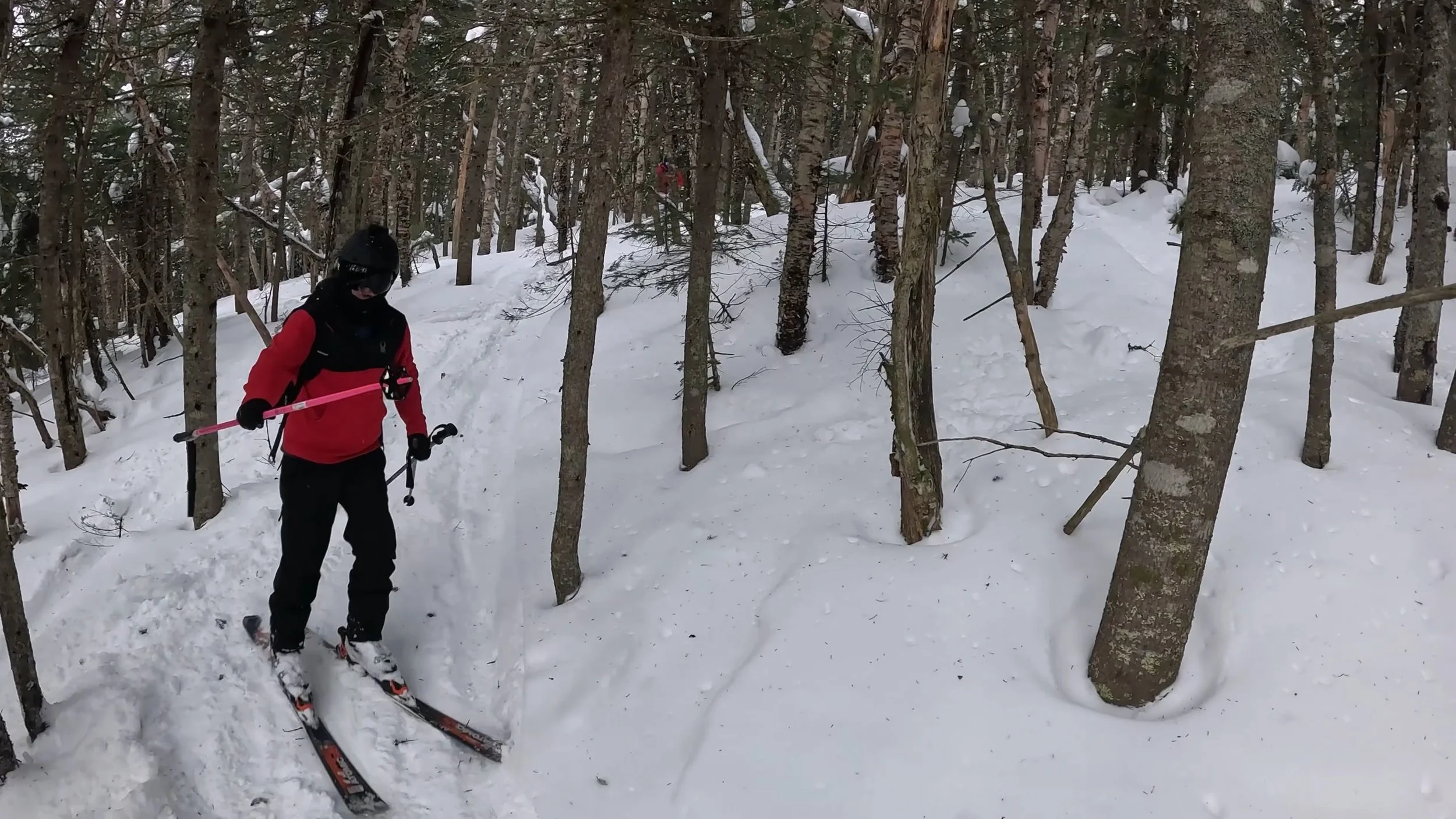
Our “private” run through Brackett Basin had some of the best tree skiing of the trip.
We finally found our way back to the bottom of the King Pine lift, where we’d exited the area the day before. But it turned out that the only easy way back to the base would be to keep going through the lower part of the sidecountry. Along the way, we went past the main entry point to Burnt Mountain, the even more distant sidecountry area beyond Brackett Basin, accessible only by hiking or snowcat. Despite the infrastructure and this area technically being within resort boundaries, it’s hard to overstate just how far away you feel out here.
It was a long, brutal trek back to the base area, following signs where we could, going past condos, and doing a lot of skating and hiking. Eventually, we found ourselves back at the road, and finally at the base area again. So despite the entire mountain essentially shutting down around us, we’d somehow managed to turn what could’ve been a complete washout into one of the most memorable ski days we’d ever had.
But all that effort had come at a cost. Between the uphill hiking, difficult traverses, and unexpectedly long trip back to the base, we’d certainly gotten our exercise for the day. And as we headed back to our accommodation and settled in for a dinner of champions, there was still one glaring item left unchecked on our Sugarloaf bucket list.
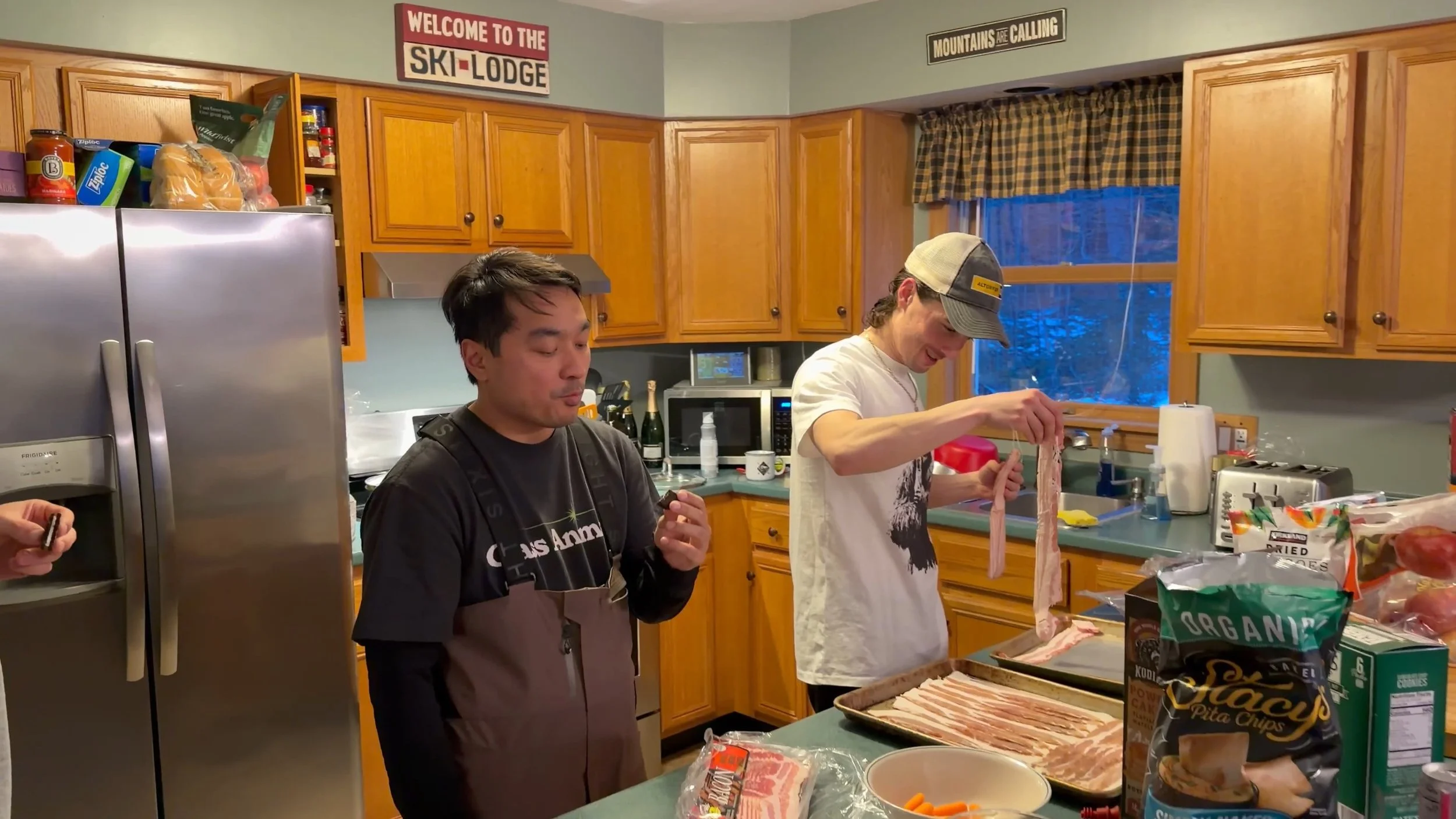
After a long day in the sidecountry, we settled in for a dinner of champions.
Day 3: Burnt Mountain
The next morning was our final day at Sugarloaf, and our last chance to hit Burnt Mountain. And after seeing how quickly Sugarloaf’s weather could change, there was no guarantee we’d get the chance.
When we got to the resort, the wind was still a factor. It turned out the Timberline chair would be closed for the full day, meaning no more access to the Snowfields for the weekend. So we had seriously lucked out in choosing to prioritize that area on the first day. But it looked like the other parts of the mountain would be operating regularly, and thankfully, that meant the route to Burnt Mountain was still fair game.
After such a chaotic weekend, the other tripgoers decided to pass on Burnt Mountain, leaving me to tackle it without my group. One cool part about the path to Burnt Mountain is that you can cut down a bit on the hike if you traverse through Brackett Basin, meaning I was able to hit a few additional woods on my way over. But the route I took involved a bit more, to put it lightly, bushwhacking than the previous days.
Eventually, I found myself at the bottom of the Burnt Mountain hike. At that point, not attempting it was pretty much out of the question. But that didn’t mean it was going to be easy, with at least 1,000 feet of elevation gain ahead, making it by far the longest in-bounds hike at a New England ski resort. But given that this might be my only chance to ever ski all three of Sugarloaf’s “big three” on the same trip, I had no choice but to suck it up and go.
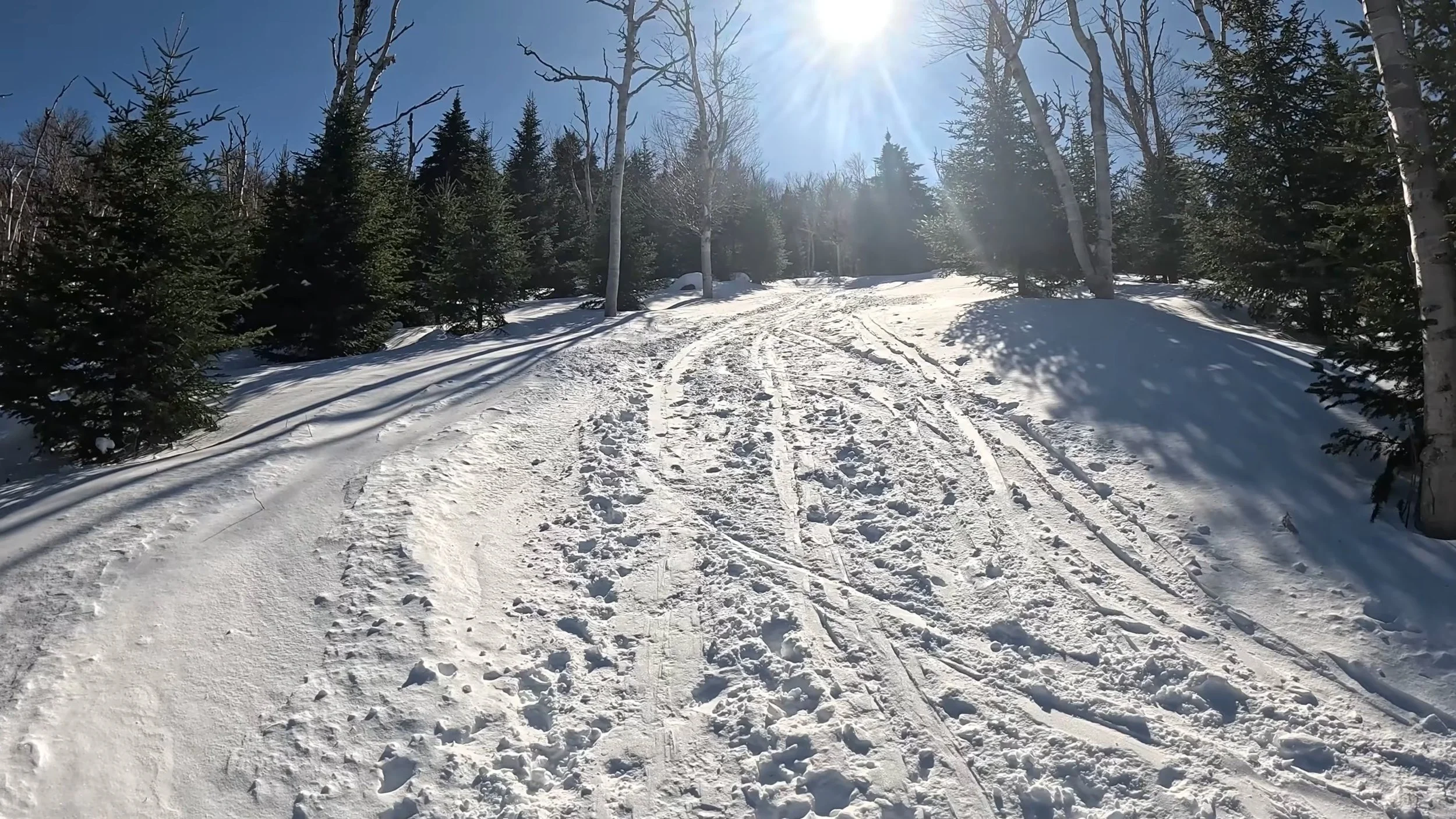
The Burnt Mountain hike involves at least 1,000 feet of elevation gain.
And boy, was this a workout. It was a long and brutal hike, but the views at the top alone were 100% worth it. And while the wind around the main mountain had died down somewhat since the day before, that was most certainly not the case on Burnt Mountain’s summit.
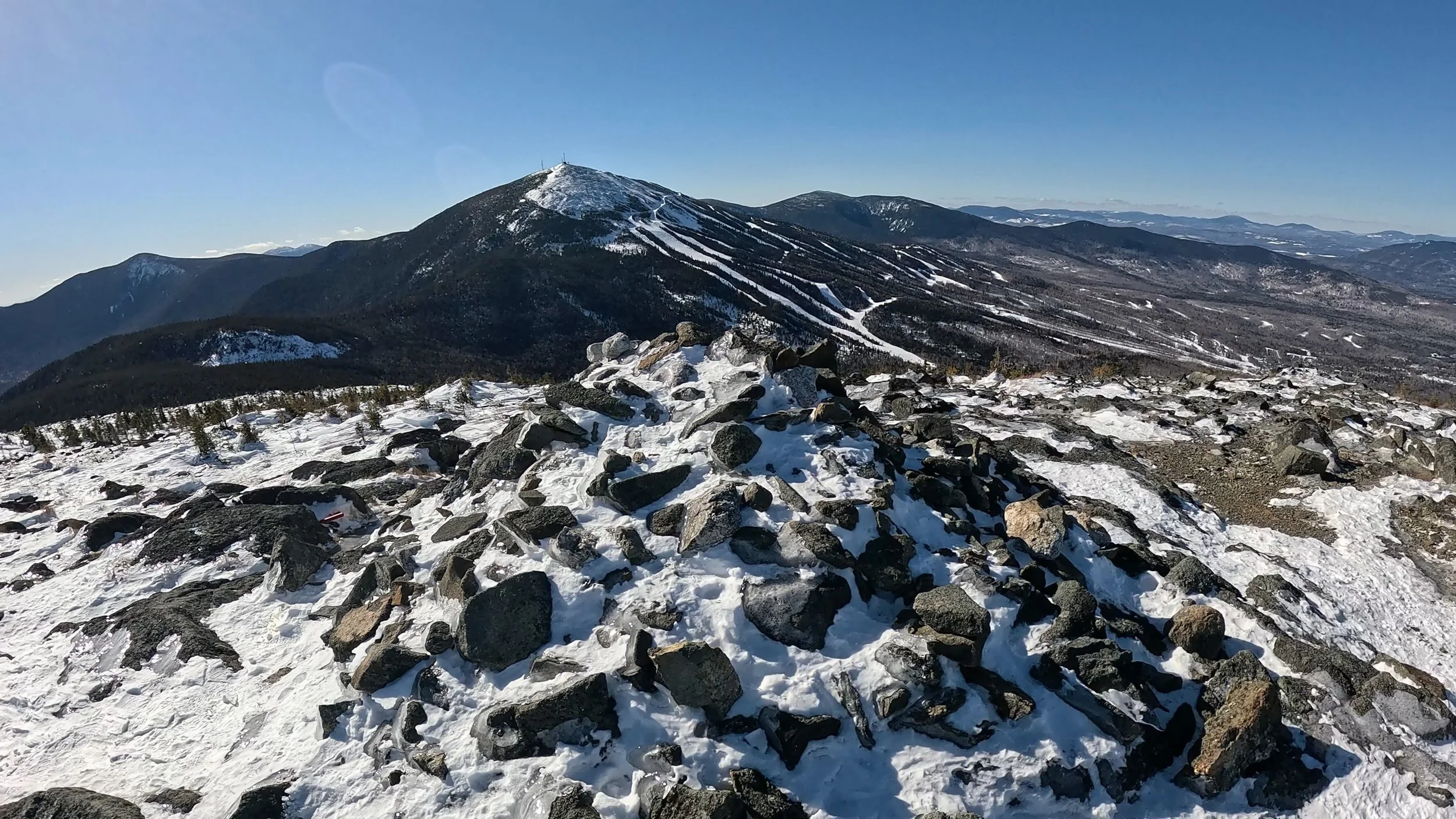
The views from the top of Burnt Mountain alone were 100% worth the hike.
And the actual run down was something special. The top part technically wasn’t a trail, but I skied it anyway. It was similar to the unusual bowl-like terrain that the main mountain’s Snowfields advertised, but with worse snow retention, probably due to a higher degree of wind exposure. But below that, getting onto the official trail network, the experience changed completely.
This was some of the most phenomenal glade skiing on the East Coast. In fact, it barely felt like a ski resort at all. And what’s most insane is that despite the isolation, overgrowth, and backcountry-like feel, this is all technically within the bounds of the resort. After everything we’d gone through to reach this point, it felt like a pretty fitting way to finish off the weekend.
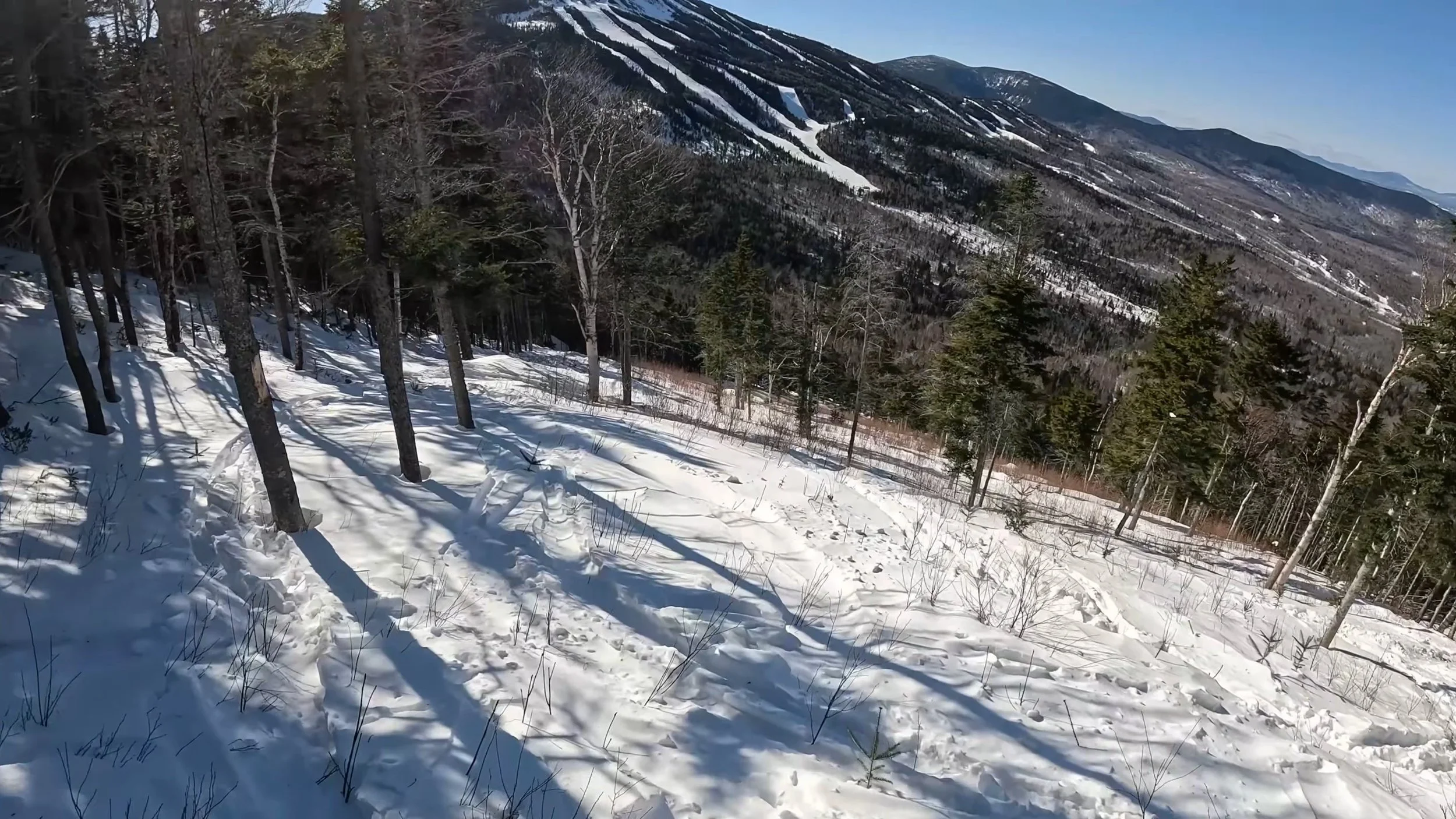
Below its summit, Burnt Mountain has some of the most phenomenal glade skiing on the East Coast.
Final Thoughts
So there’s no denying that Sugarloaf is an incredibly striking and standout resort among Northeast mountains, at least when it’s 100% open. But do its more unique terrain areas actually deliver the experience that is advertised? Well, yes and no.
The Backside Snowfields were unquestionably the most visually striking part of the experience. There’s just nothing else quite like them at an Eastern ski resort, and finally having the opportunity to explore that area after nearly three years without an opening was pretty incredible. But the skiing and riding on the Snowfields was far from perfect, and probably not worth the timing and effort for most people.
On the other hand, the sidecountry areas are absolutely all that they’re cracked up to be. Brackett Basin and Burnt Mountain provide some of the most sustained, raw, and isolated tree skiing you can get anywhere in the Northeast while still being within a resort’s boundary. Burnt Mountain might have been the most rewarding experience of the weekend, in large part because of how much effort it took to get there, but also because of just how distinctive it was, both snow and aesthetic-wise.
But despite some extraordinary terrain, it’s clear the mountain’s dramatic exposure does have substantial disadvantages. The wind holds we dealt with are unfortunately not as uncommon as you’d want them to be. And it would take an almost unfathomably perfect season for the Snowfields to turn into true powdery bowls in the same way many bowls out west reliably do.
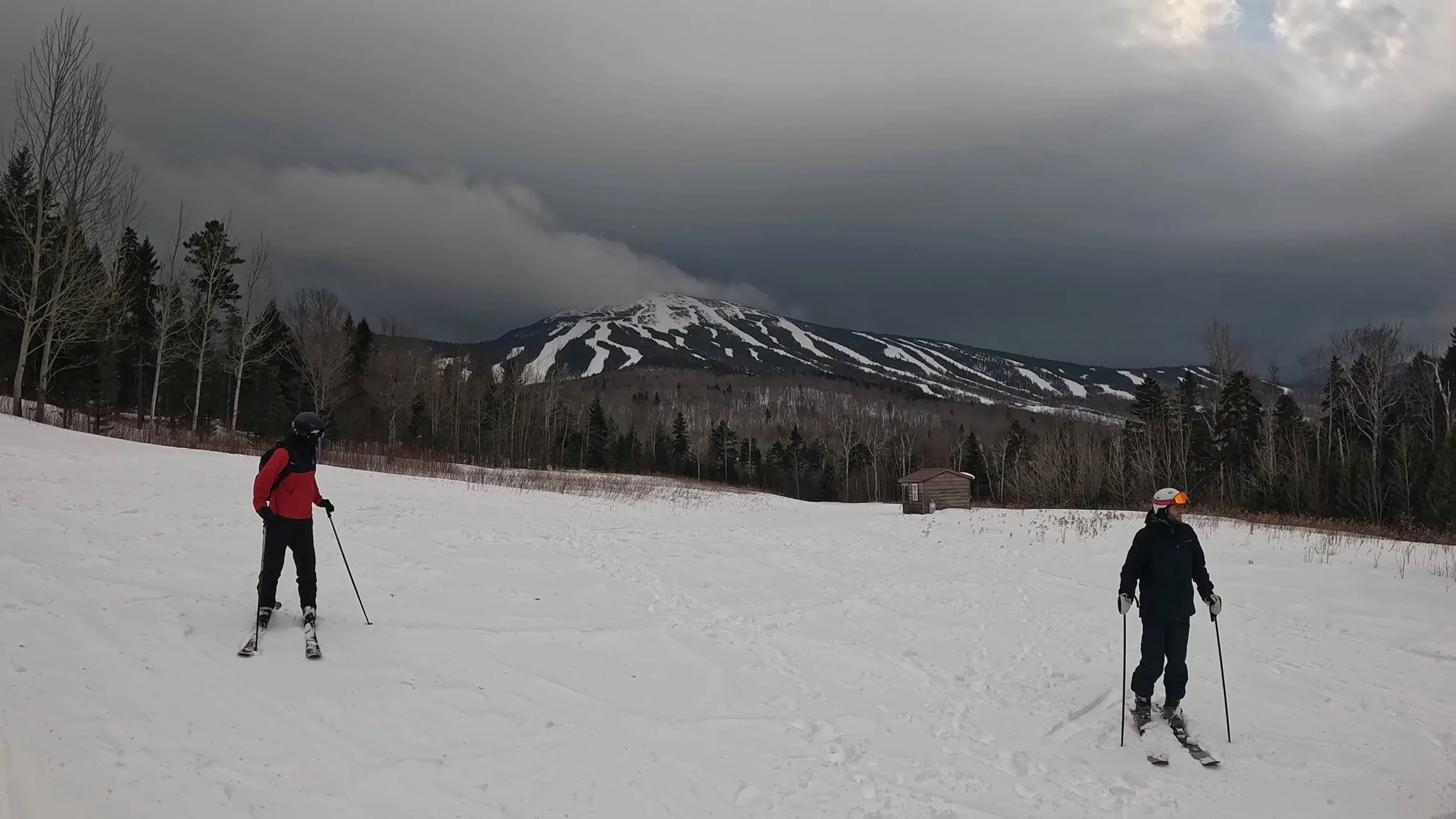
Sugarloaf’s dramatic exposure means wind holds are more common than you’d want them to be.
But then again, that’s not really what it’s trying to be. While Sugarloaf does have the scale and feel of a western mountain in certain ways, it is so quintessentially East Coast in other ways. From the shrubs and rocks and tight trees to the wind and the cold, it truly exemplifies the best and worst extremes of what skiing in the region really is. And for those who see that kind of experience and think it looks just right for them, we would say that Sugarloaf is absolutely worth the trek.