MOUNTAIN SCORES
CATEGORY BREAKDOWN
See our criteriaMountain Score by Area
GOOD TO KNOW
1-Day Ticket: CHF 92–120 ($112–$146 USD)
Pass Affiliation: Ikon Pass
On-site Lodging: Yes
Après-Ski: Extensive
Nearest Cities: Zurich (3.5 hrs by train), Geneva (4 hrs by train), Milan (2.5 hrs to Cervinia)
Recommended Ability Level:

+ Pros
Iconic Matterhorn views from nearly every slope
One of the best lift systems in the world
Huge cross-border footprint with a 7,425-foot descent
Excellent on-mountain dining and a world-class ski town
– Cons
Frequently icy lower slopes
Very little challenging terrain on-piste
Confusing signage and lift layout
Crowded pistes on the Swiss side
MOUNTAIN STATS
Skiable Footprint: 14,485 acres (9,150 in Switzerland)
Marked Pistes: 360 km (200 km in Switzerland)
Ski Areas: 5 (3 Swiss, 2 Italian)
Top Elevation: 12,740 ft
Vertical Drop: 7,425 ft
Lifts: 60
Trails: 296
Beginner: 21%
Intermediate: 71%
Advanced/Expert: 8%
VIDEO
Mountain Review
Planning the ultimate European ski trip? Zermatt is probably one of the first places that comes to mind. Set beneath the iconic Matterhorn, the Swiss resort pairs one of the most picturesque towns in the world with a huge skiable footprint that crosses the border into Italy. But when it comes to fundamentals like snow and terrain, how does it stack up?
Size and Terrain Layout
The full continuous footprint, officially known as Matterhorn Ski Paradise, includes five distinct areas. From skier’s right to left on the trail map, they are Sunnegga-Rothorn, Gornergrat, and Matterhorn Glacier Paradise on the Swiss side, and Breuil-Cervinia and Valtournenche on the Italian side. Only the first three are formally part of Zermatt, while the Italian areas operate under their own branding and sell their own tickets, although international tickets cover all five. The two countries connect at the top of the ski area, on a glacier shared by the Matterhorn Glacier Paradise and Cervinia sectors.
With 200 km of slopes and roughly 9,150 acres from boundary to boundary on the Swiss side alone, Zermatt is bigger than the vast majority of European competitors and pretty much every North American ski resort. Including Cervinia and Valtournenche, the total grows to 360 km of slopes and more than 14,000 acres. Zermatt also offers a world-class vertical drop, with a continuous top-to-bottom descent of 7,425 feet from Matterhorn Glacier Paradise to the village, one of the longest in the world and by far the most reliably open in-bounds descent of that length.
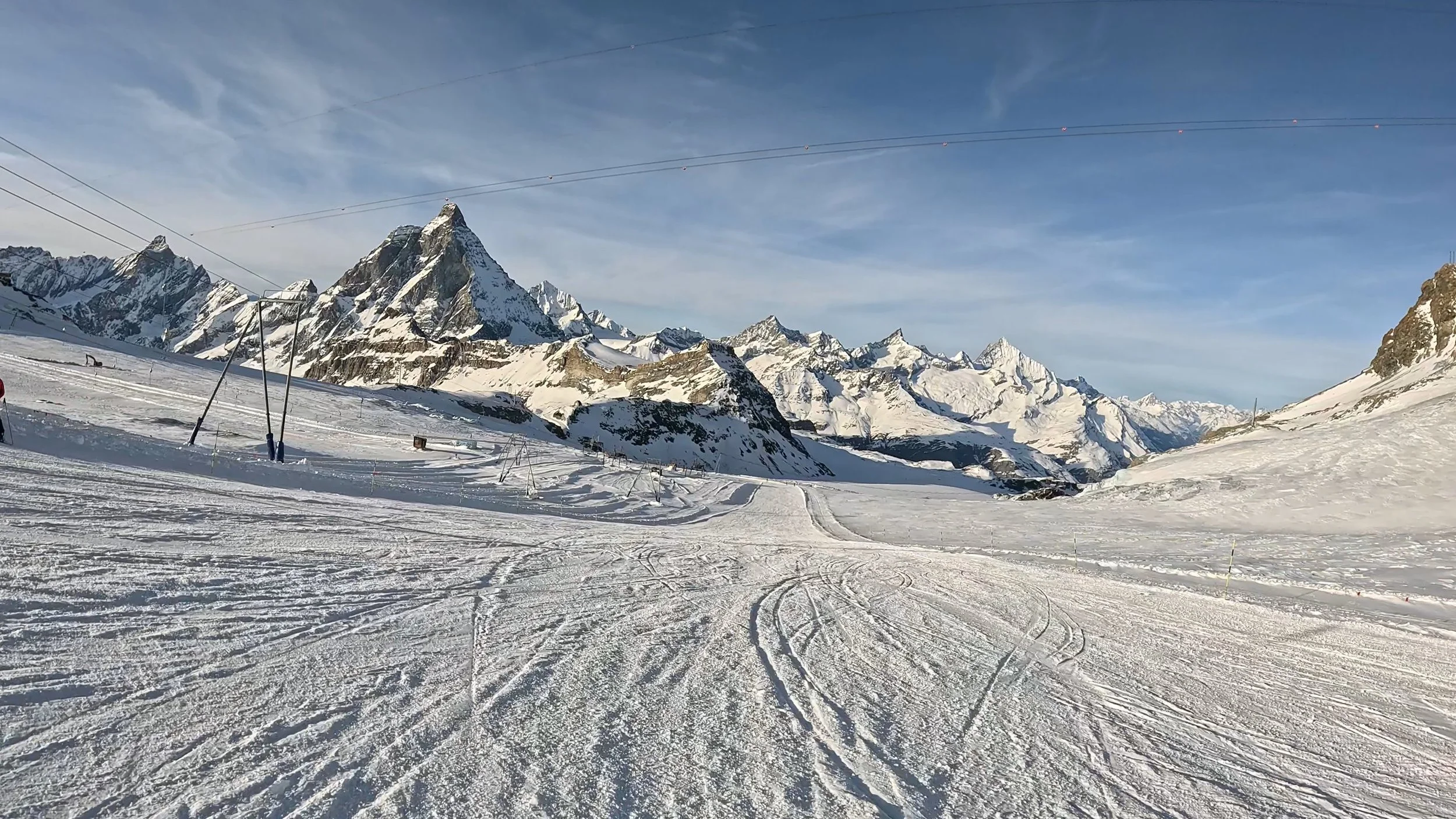
Zermatt’s highest slopes sit on glaciers along the Italian border.
Beginner
While Zermatt isn’t built for tenured experts, it isn’t really built for beginners either. The resort has some easier blue-rated runs, with solid mid-mountain beginner pods in the Sunnegga-Rothorn, Gornergrat, and Valtournenche sectors, but no easy trails lead down to the bottom of the Swiss side, so guests who aren’t comfortable on reds will need to download a lift at the end of the day. Cervinia is the only part of the ski area where guests can ski all the way to the base on beginner pistes. None of the beginner areas are linked by easier runs either, so moving between them means taking a red piste.
Intermediate
Zermatt is really best for intermediate skiers and riders, and for groomer-savvy advanced visitors too. More than two-thirds of the prepared pistes are red-rated intermediate runs, with plenty of moderately pitched cruisers in every sector. In several parts of Matterhorn Glacier Paradise and Cervinia, red pistes are the only way down, and in parts of Gornergrat and Valtournenche, the black and yellow alternatives are open so rarely that the reds are the only practical choice.
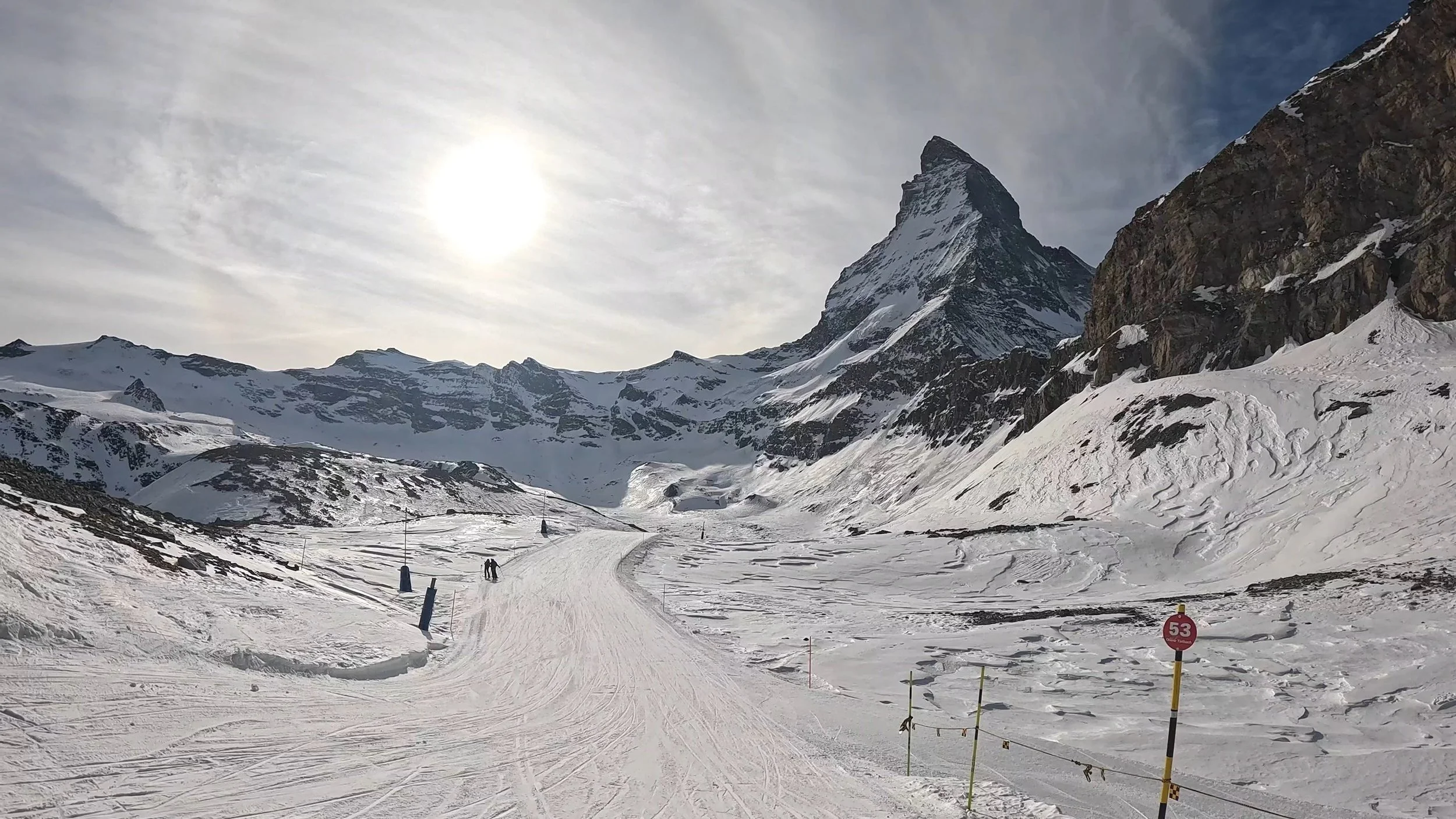
Red-rated cruisers with Matterhorn views make up most of Zermatt’s terrain.
Expert
Zermatt’s snow totals have a direct impact on the quality of its advanced and expert terrain. The vast majority of reliably open runs are groomed, and with more than 80% of marked pistes rated for beginners or intermediates, there isn’t much challenge on-piste. Zermatt does have a handful of yellow-marked freeride routes that aren’t groomed or directly maintained, but conditions on them are variable, to say the least, and some are rarely open. The Italian side has no freeride routes at all.
Off-Piste
As you might expect from a resort of its size, Zermatt has a vast amount of off-piste terrain. In typical years, though, much of it is rocky and not very skiable, especially on the Swiss side. The skiable lines are a big step up in difficulty from the resort’s blacks and yellows, with technical cliffs and narrow chutes, but the snow is inconsistent and, if it hasn’t snowed in a while, usually much worse than on any open trail. Off-piste terrain isn’t patrolled or controlled for avalanches, so bring proper training, equipment, and a partner. Unless you really know what you’re doing, avoid the heavily glaciated upper-mountain terrain, where the risk of falling into a crevasse is much higher than it looks. Cervinia’s off-piste is somewhat better covered and more approachable, and hiring a guide is a good idea on either side.
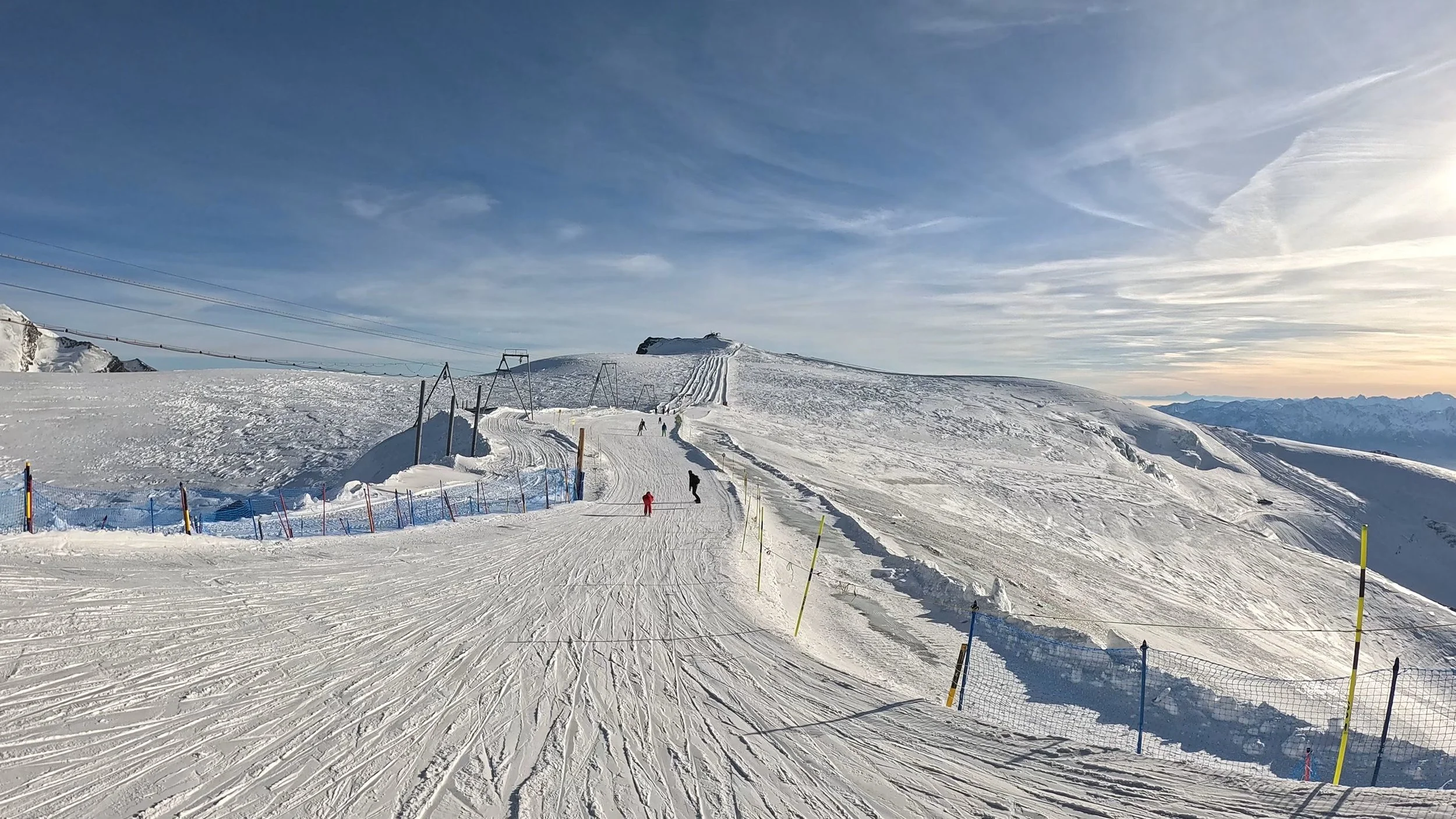
Even at the top of the resort, Zermatt’s pistes are almost entirely groomed.
Snow Quality and Resiliency
Perhaps Zermatt’s biggest issue is its natural snowfall. The resort isn’t exactly barren, but with accumulation at or just under 200 inches per season, it falls well short of the best in Europe and is nowhere near the top destinations in the U.S. and Canadian Rockies. Zermatt’s very high upper elevations help preserve snow, but mid- and especially lower-mountain areas tend to get icy and crusty, with conditions that may remind North Americans of the East Coast. Widespread snowmaking helps keep slopes open, but popular trails get skied off quickly, and guests often need to stick to the edges to avoid ice. The Italian side gets much more sun, so expect more variable coverage but softer snow in the afternoons, along with wider, less crowded slopes that don’t get skied out as quickly.
Where Zermatt does stand out is summer skiing. Because much of the upper mountain sits on a glacier, the highest parts of Matterhorn Glacier Paradise have historically operated close to year-round, with snow farming and seasonal T-bars supporting a limited set of summer slopes. That isn’t guaranteed anymore: in 2026, guest skiing on the Theodul Glacier was suspended from late July to mid-October because of heat and glacier conditions. Ikon Pass access also doesn’t extend into summer.
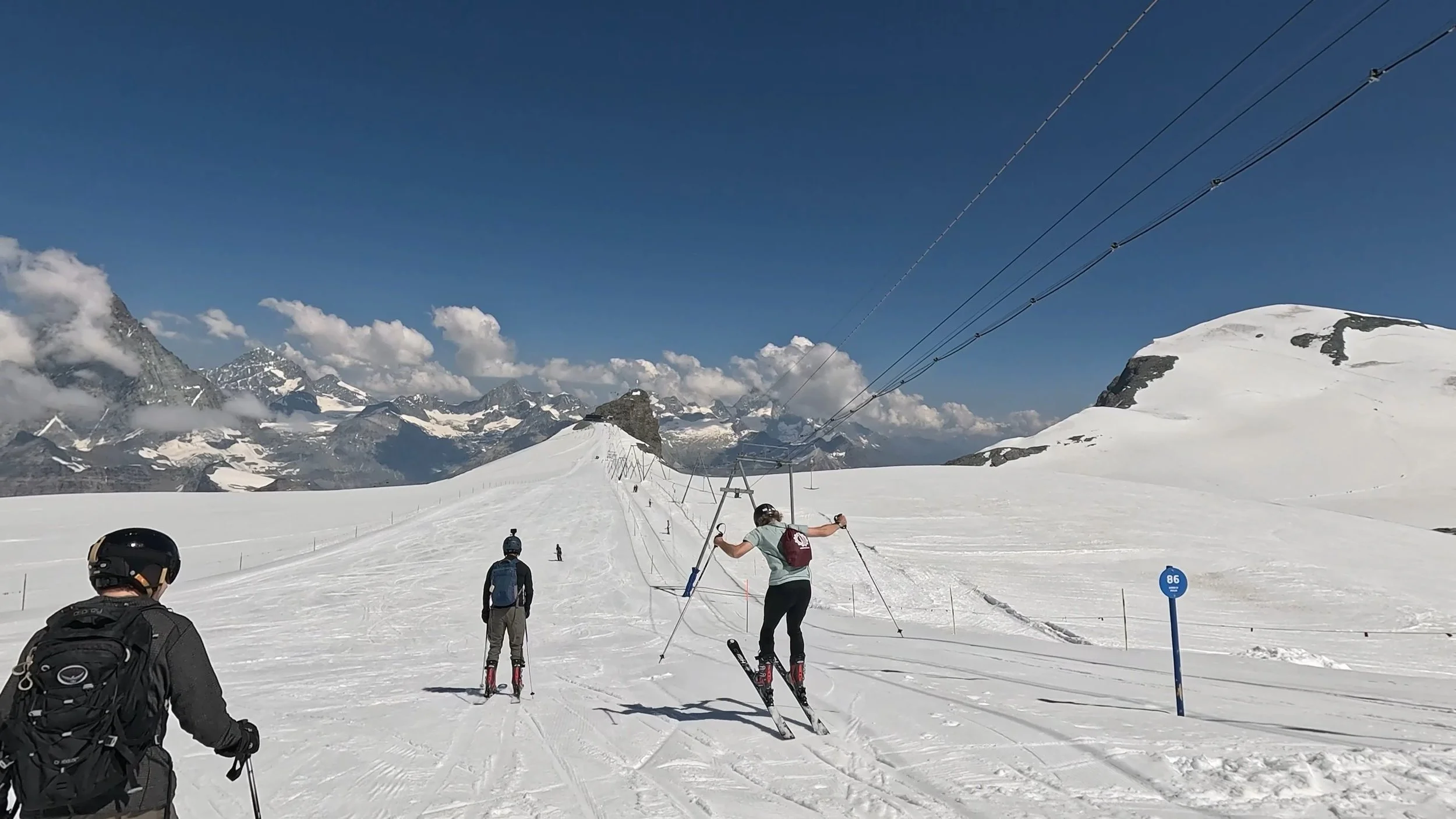
Summer skiing on the glacier is one of Zermatt’s biggest draws.
NOTE: We may receive a small affiliate commission if you click on the below links. All products listed below are unisex.

Recommended all-mountain ski

Recommended carving ski

Recommended glade ski

Recommended expert/touring ski
Lifts
Zermatt might have one of the most impressive lift systems in the world. The Swiss side has high-speed lifts almost everywhere, including bubble chairs, gondolas, trams, and tricable gondolas up to Matterhorn Glacier Paradise, and some stations even have escalators. Upgrades keep coming, with a new eight-seat chairlift at Gifthittli for 2025-26 and a new six-seat chair at Patrullarve, in the Sunnegga sector, for 2026-27. The Italian side has some older, slower lifts, but it also has trams, gondolas, and bubble chairs, plus the Glacier Ride II tricable gondola from Testa Grigia to Matterhorn Glacier Paradise. That gondola is scheduled to close from January 7 to February 26, 2027, so check lift status before planning a cross-border day in that window. Cervinia is also planning a pair of tricable gondolas from Breuil to Plateau Rosa, expected for 2029-30.
Zermatt is also one of the few resorts with slopes served directly by train. The Gornergrat Bahn cog railway climbs more than 4,800 vertical feet to a summit observation deck and hotel, running alongside several slopes, and it’s worth riding to the top at least once for the views. Trains typically run every 24 minutes, but all but two of the runs it serves have other lifts as well. The Sunnegga funicular, meanwhile, runs through a steep underground tunnel from the village at 12 meters per second, more than twice the speed of a typical detachable lift. And at the top of Matterhorn Glacier Paradise, the Glacier Palace ice cave, with its sculptures and ice slide, is a must-visit.
Navigation
Zermatt’s large, complicated footprint isn’t easy to figure out, and the signage could use a lot of work. Trail signs are small and mostly show numbers, leaving the names in hard-to-read text, and finding a run that takes multiple connections is tough without studying the trail map. Swiss-side signs for lifts, sectors, and restaurants are uniformly red with small symbols, and on the Italian side, there sometimes aren’t signs for restaurants and lifts at all. The lift network doesn’t help: you’d never find the Hirli chair unless you got off at the second Matterhorn Express mid-station, and Sunnegga-Rothorn and Gornergrat are connected only by a tram or the railway. At the base, the funicular and the Matterhorn Express are about a 20-minute walk or 10-minute bus ride apart. Visibility is tough on storm days too, although trail posts help guests stay in bounds.
Ending up on the wrong side of the border at the end of the day can be costly. There’s no public transportation between Zermatt and Cervinia, and the trip by road takes over three hours and costs hundreds of euros. Guidance for getting back to Italy from Zermatt is clear, with warnings at the Matterhorn Express on the last return time, but warnings on the Italian side are less prominent, so plan ahead. High winds can also close the upper lifts midday, so on questionable weather days, it may be best to stay in your home country.
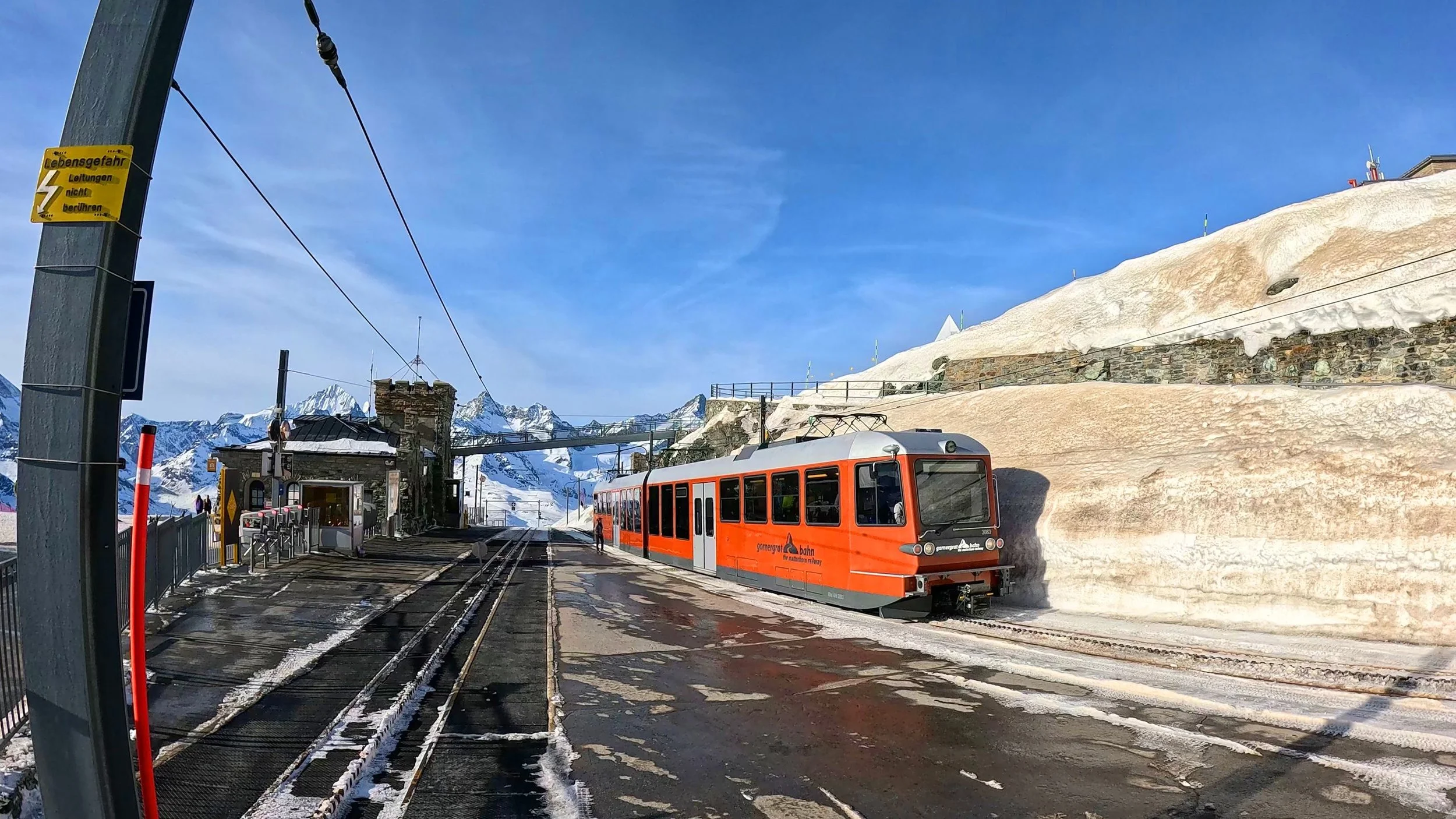
The Gornergrat Bahn cog railway serves several of Zermatt’s slopes directly.
Crowds
Lift lines aren’t a serious problem at Zermatt. Its large lift capacity and limited lodging mean most waits rarely exceed five minutes, even at peak times. Lines can be longer at the trams, but nowhere near the hour-long waits common at some North American trams, and the trains are long enough that you can almost always board the first one. The bigger issue is congestion on the slopes, at least on the Swiss side, where most lifts serve only a handful of pistes and passing people can be difficult. Visitation is much lower on the Italian side, where lift lines and crowded trails are rare.
Facilities
Zermatt’s on-mountain dining is fantastic. Both sides are full of restaurants, with one at seemingly every junction, especially in Switzerland. Most are independently owned, with their own character, excellent food, and outdoor seating with world-class views. Some of the fancier Swiss-side spots require reservations. Quick options are harder to find, although a few cafeterias sit in the Matterhorn Glacier Paradise lift terminals, and restaurants on the Italian side tend to offer better value.
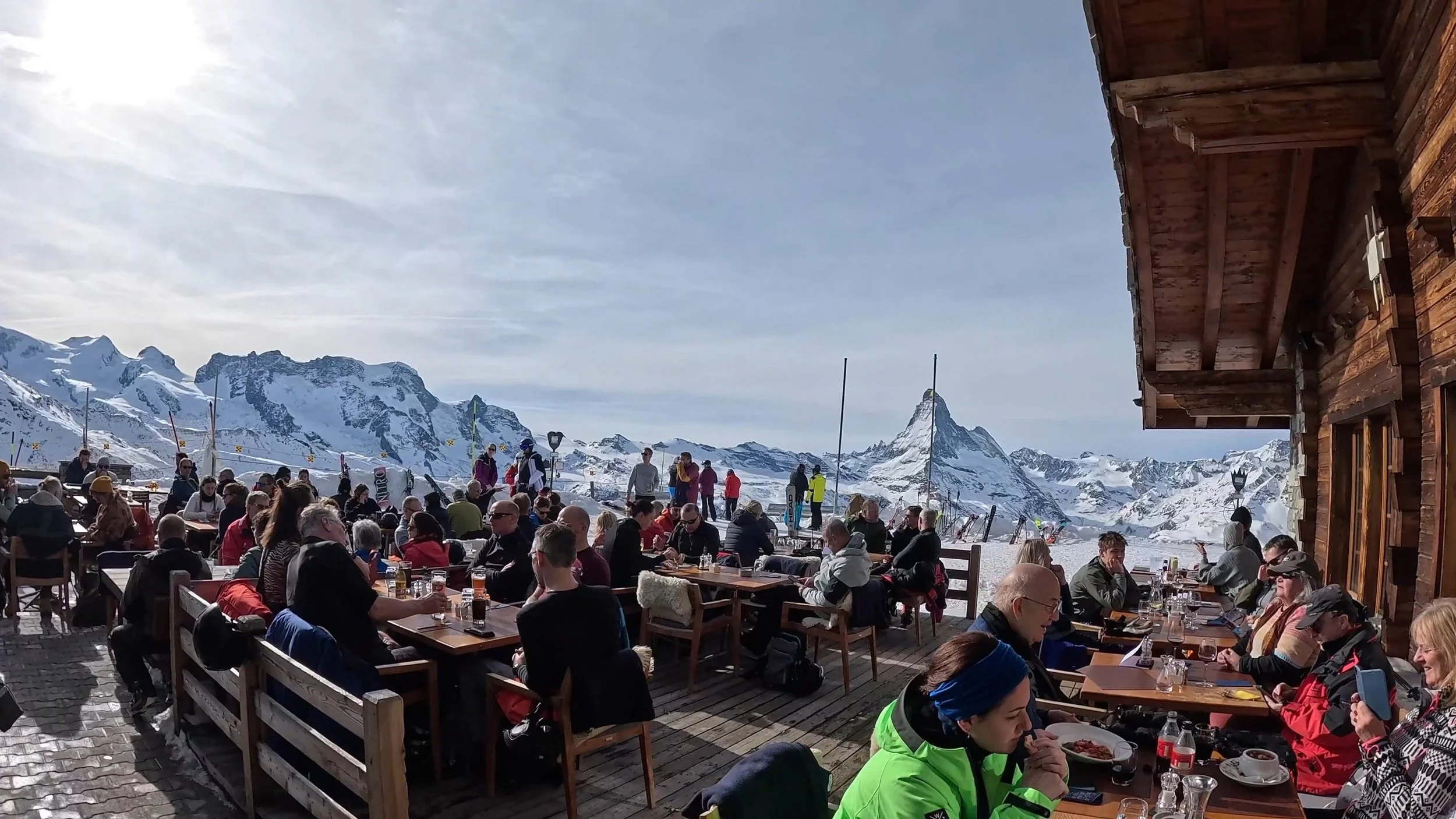
Zermatt’s on-mountain restaurants pair excellent food with outdoor seating and Matterhorn views.
Getting There
Zermatt is car-free, and most guests arrive by train. The village is about four hours from Geneva Airport and about three and a half hours from Zurich Airport, with a change at Visp, where connections can be tight. Drivers park in Täsch and take a shuttle train that runs about every 20 minutes. The train arrives right in town, with most lodging within walking distance or a short ride on the free electric buses, although those buses can get packed at the start and end of the ski day. There’s no train service to Cervinia or Valtournenche: Milan Malpensa is about two and a half hours away by car, and Turin is closer, at under two hours.
Lodging
Zermatt might be one of the greatest ski towns in the world, with mountain-influenced architecture, a walkable, car-free layout, and the Matterhorn in view from all over town. Lodging ranges from budget hostels to five-star hotels, although some are a bit of a trek from the lifts. Staying in Cervinia means giving up those views and much of the nightlife, but you’ll get a more low-key atmosphere, better food for the price, and the ability to drive. Valtournenche is much smaller and quieter still.

Recommended intermediate board

Recommended advanced board

Recommended expert board

Recommended touring board
Après
Zermatt’s on-mountain après is excellent, especially on the Swiss side, where many restaurants double as bars, with good happy hour deals and party vibes starting as early as lunch. It isn’t quite as wild as some Austrian resorts, but there are plenty of lively spots. Hennu Stall, off the Klein Matterhorn Express, has live music, DJs, and great drink deals, and for a casual bar crawl, the No. 2 run in the Sunnegga sector has four slopeside bars in a row. Cervinia and Valtournenche are less known for après, although most restaurants serve drinks.
The village keeps things going after dark, with a restaurant scene that includes excellent pizza, fondue, and schnitzel, plus some surprises like Asian and Mexican food, and bakeries with the fruit and chocolate products Switzerland is known for. Bars and clubs stay open late, and Broken Bar, a packed basement spot with live music and dancing, runs into the early morning on weekends.
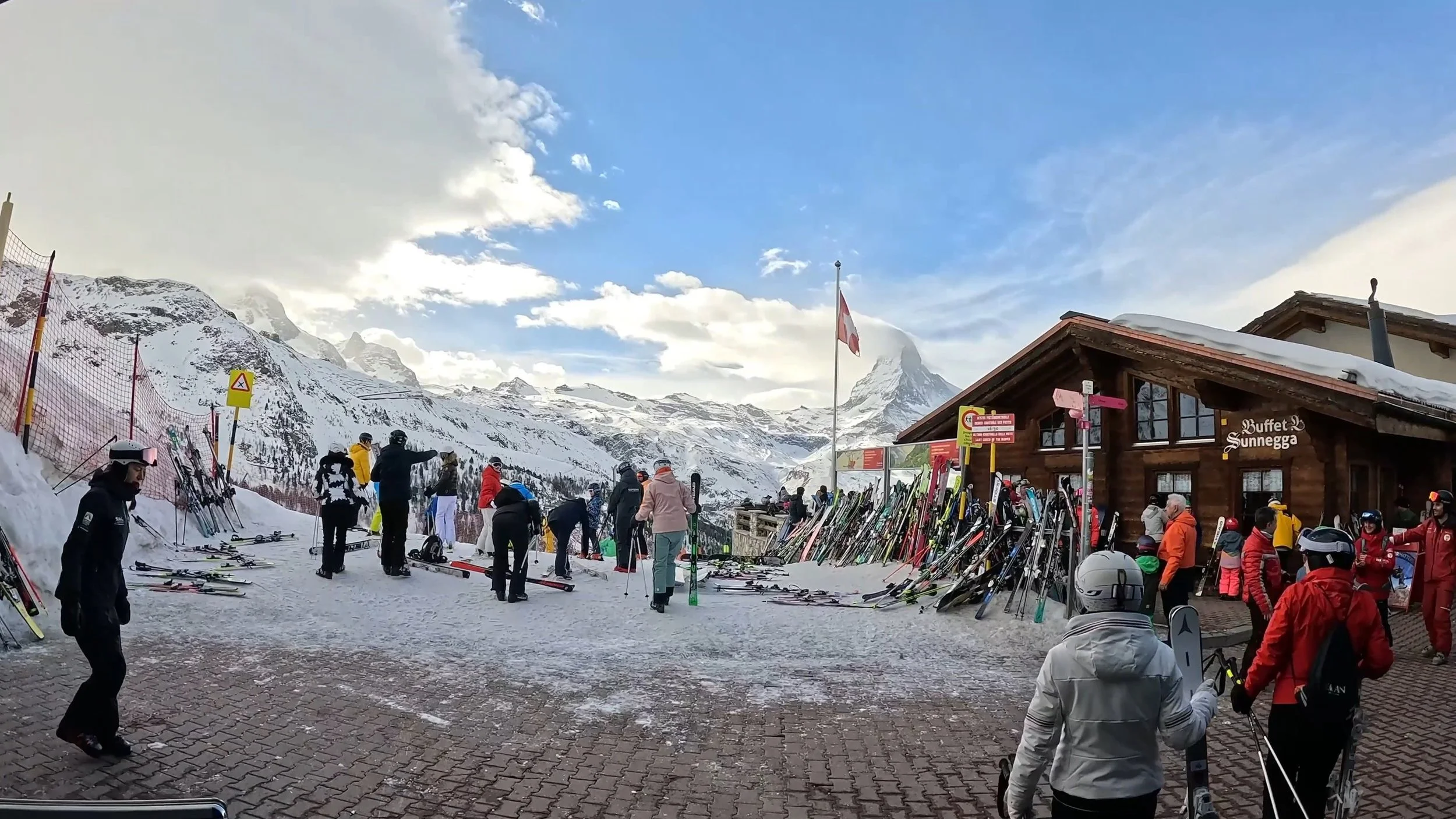
Slopeside spots in the Sunnegga sector are a big part of Zermatt’s on-mountain après scene.
Pass Partnerships
Zermatt is on the Ikon Pass for 2026-27, with up to seven days on the full Ikon Pass and five on Ikon Base, valid from November 1 to April 30. Cervinia is on the Ikon Pass separately, as part of the Valle d’Aosta allotment, so a day that crosses the border uses one day from each. Ikon access doesn’t include summer skiing.
Mountain Aesthetic
The first thing that stands out about Zermatt is how stunning it is. The Matterhorn is visible from nearly every part of the resort, and most of the slopes are wide open, with views across the surrounding Alps. The most beautiful area is probably Matterhorn Glacier Paradise, with the closest views of the Matterhorn and blue-ice glaciers alongside the slopes. The Italian side has less iconic views of the peak and less favorable aspects, but it’s typically sunnier.
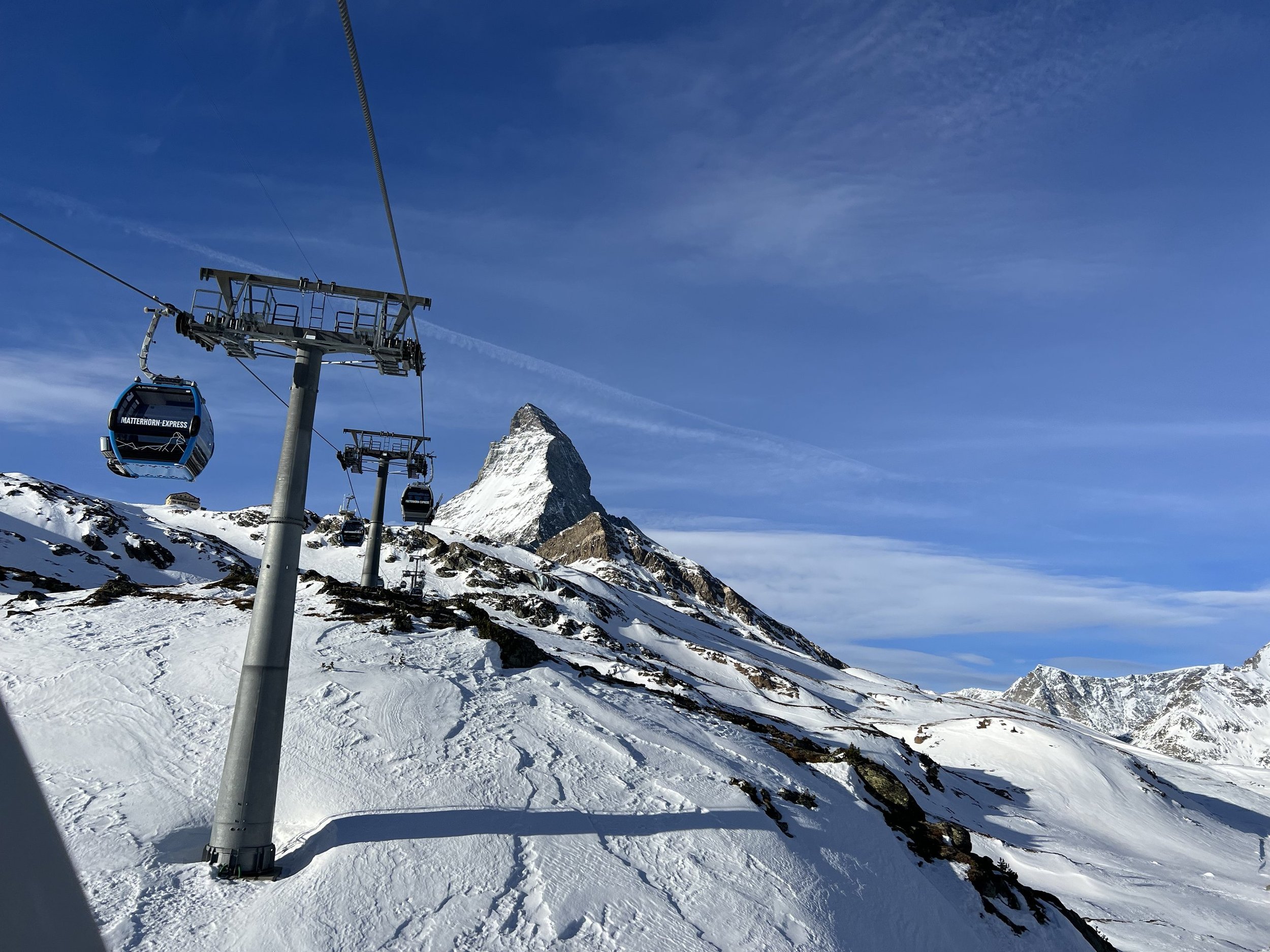
The Matterhorn is visible from nearly every part of the ski area.
Verdict
Zermatt isn’t for powder hounds or most people looking for a serious challenge. But if you’re in it for the town, the après, the sheer size, and stunning groomers, it’s hard to beat. Zermatt has better lifts, more favorable aspects, and much more iconic views of the Matterhorn, while Cervinia has less crowded slopes and a more down-to-earth feel. The terrain itself is fairly middle-of-the-road, but as a destination, few ski resorts are more memorable.
Pricing
Lift tickets are pricey for Europe but still much more reasonable than most U.S. destinations. For 2026-27, a 1-day adult ticket for Zermatt starts at CHF 89, and an international ticket covering both countries starts at CHF 104, with prices varying by date. Cervinia-only tickets are much cheaper. Tickets for 1 to 21 days now include insurance for illness, accidents, and extreme weather, but rescue costs are covered only by the optional SnowAssist Plus add-on, at CHF 5 per day, which is well worth it.