Valle Nevado’s two-stage gondola would take lift access above 4,000 meters.
Chile’s Valle Nevado has announced a two-stage gondola that would take skiers and riders above 4,000 meters (13,123 feet), potentially making it the highest lift-served ski resort in the world. The project represents a $25 million USD investment, one of the largest ever made on the continent.
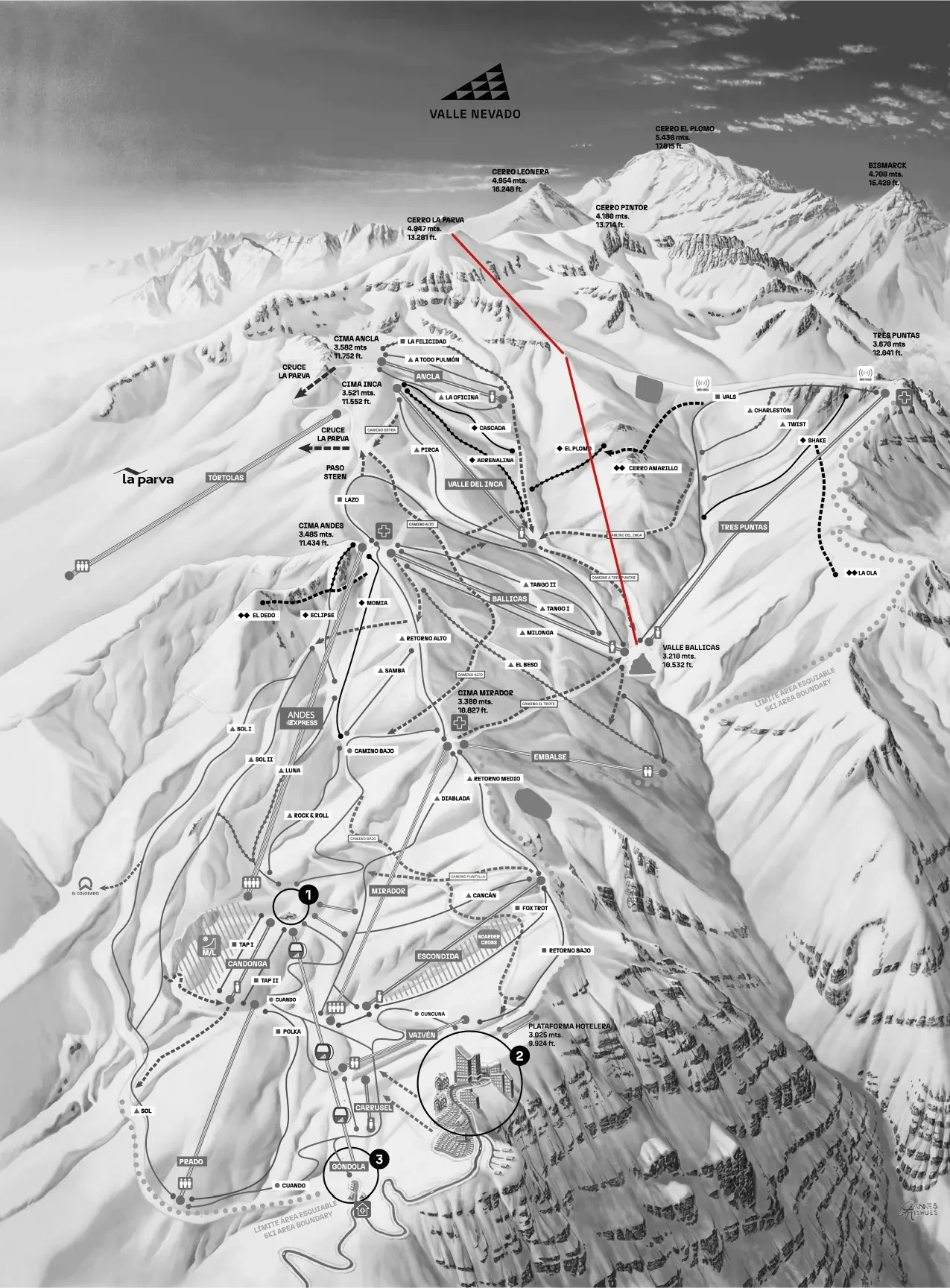
Valle Nevado’s trail map with the proposed gondola alignment in red, running from Valle Ballicas toward Cerro La Parva.
The first stage would run from Base Ballicas to a midstation and is slated to open for Chile’s 2027 ski season. The second would continue toward the 4,047-meter summit of Cerro La Parva, with completion targeted for 2028. Valle Nevado has confirmed a terminal above 4,000 meters, but has not published its exact elevation. The project would extend lift access more than 1,080 vertical feet above the resort’s existing 3,670-meter Tres Puntas high point.
That would also put Valle Nevado above Breckenridge’s 12,840-foot Imperial Express, North America’s highest chairlift, as well as Gulmarg, India, where lift access tops out at 3,980 meters (13,058 feet). Based on those current benchmarks, Valle Nevado’s completed project would in all likelihood take the top spot in both the Americas and the world.
Valle Nevado says the expansion will add ski runs and improve its connection with neighboring La Parva, with which it already has a trail connection. A detailed map of the new runs, their difficulty ratings, and the terrain opening with each phase has not yet been released.
Speaking of La Parva, that resort announced it has also started construction on El Paso, a fixed-grip double chairlift slated to open in 2027. The lift will run from the Águilas return trail to the top of Cerro Franciscano, making it easier to move between the resort’s Águilas and Tórtolas sectors and giving skiers and riders a second way to connect to Valle Nevado.
Our Take
If completed as planned, this gondola project has the potential to be the most consequential investment for Chilean skiing since Valle Nevado’s opening in the late 1980s.
The upper section would push lift access into a steep and jagged part of the mountain above the existing boundary, an area that is currently out-of-bounds and only accessible by bootpacking or touring. If the upper terminal sits in the area suggested by the map, Valle Nevado could gain some of the most consequential expert lift-accessed terrain in Chile.
It's also worth noting this expansion could impact access to the neighboring La Parva ski resort, which physically borders Valle Nevado but is technically a separate resort. The upper gondola terminal would provide direct lift access to some technical off-piste lines above the La Parva side, and it could shorten bootpack access to a few other descents as well.
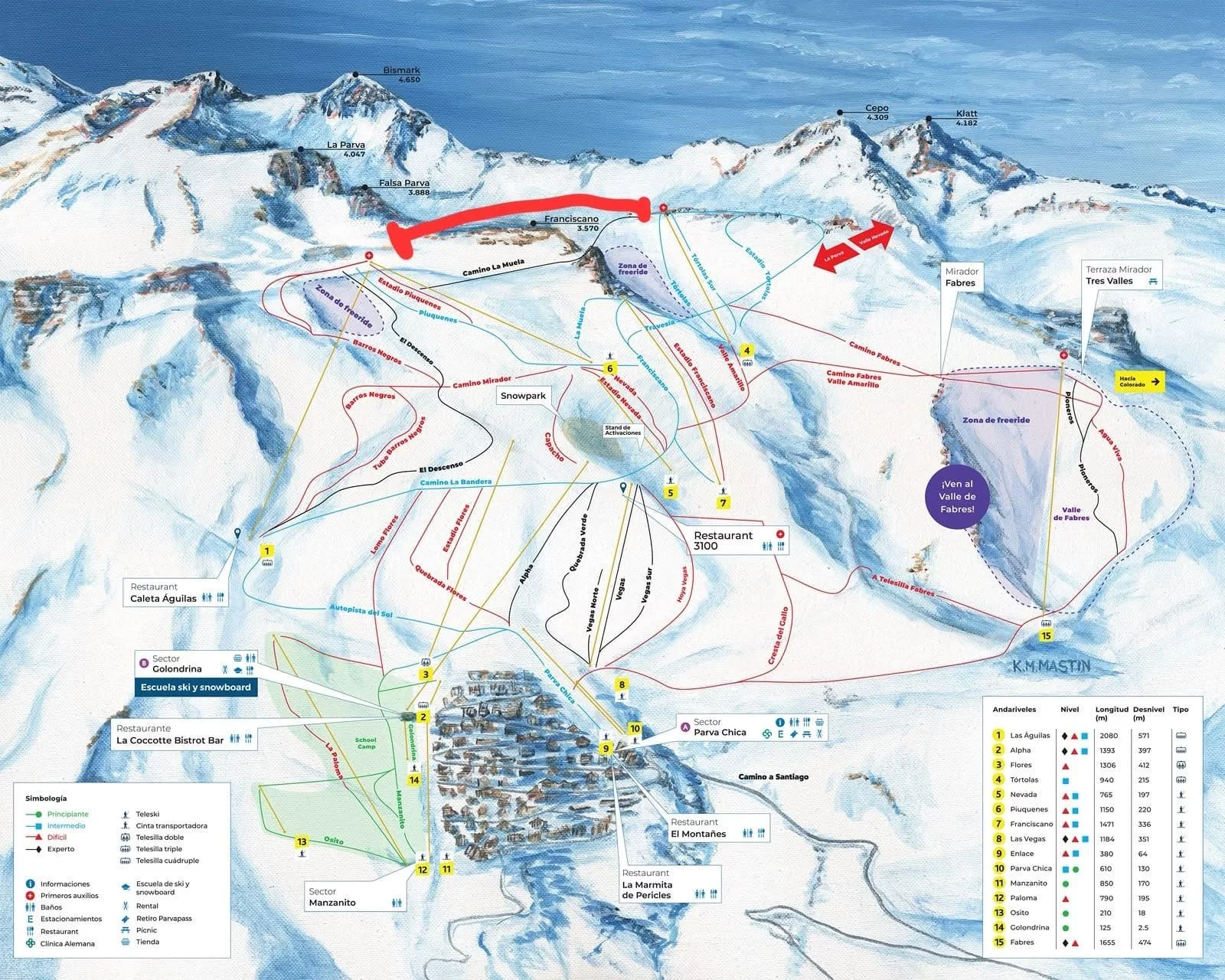
La Parva’s trail map with the new El Paso double chairlift in red, running from the Águilas return trail to the top of Cerro Franciscano.
One important thing to note is that in Chile, terrain outside the marked runs is considered off-piste and is often not controlled for avalanches, even when it sits within the resort’s broader footprint. On terrain like this expansion footprint that is over 30 degrees in pitch, it is entirely possible that going off the trail network could have much more significant consequences than the more mellow terrain further down Valle Nevado's footprint. It still remains to be seen how much of this newly-lift-served terrain would become part of the official trail network, as Valle Nevado has not announced any official trails yet. Because of these circumstances, the actual trail decisions could carry extraordinary weight to the mountain's overall experience changes.
For anyone visiting in 2027, only the lower section is expected to be complete, but even this first stage should bring significant benefits. In addition to serving some new trails in the resort’s upper mountain, it would introduce high-speed lift access to Valle Nevado’s upper mountain for the first time. On top of that, the gondola will provide an alternative route to terrain served by the Valle del Inca and Ancla surface lifts, hopefully relieving pressure on the Tres Puntas and Ballicas surface lifts, where substantial lines can build during peak periods.
Based on the topography, we expect the terrain opening in the first stage to primarily be intermediate and advanced in nature, with the true expert terrain coming with the second stage in 2028.
We also have to quickly touch on La Parva, as it is notable is that La Parva announced construction on the El Paso double right after Valle Nevado announced the gondola. It seems clear that La Parva is designing this lift to go hand in hand with the gondola expansion (especially considering both resorts are owned by the same company).
On the surface, the new double chair will already make it easier to get to the Valle Nevado trail connection. If you’re at the top of La Parva’s Águilas chair (Lift 1), you’ll no longer have to ski or ride all the way down to mid-mountain or traverse off-piste to get to the Tórtolas chair (Lift 4). But much more consequentially, once the gondola’s second stage is in place, El Paso could give skiers and riders who descend on the La Parva side a more direct way back to the gondola’s base.
Ultimately, we'll be following along with this development and we're excited to check out the first part of the project this upcoming Southern Hemisphere winter.