Why South American Skiing Has Never Reached Its Full Potential
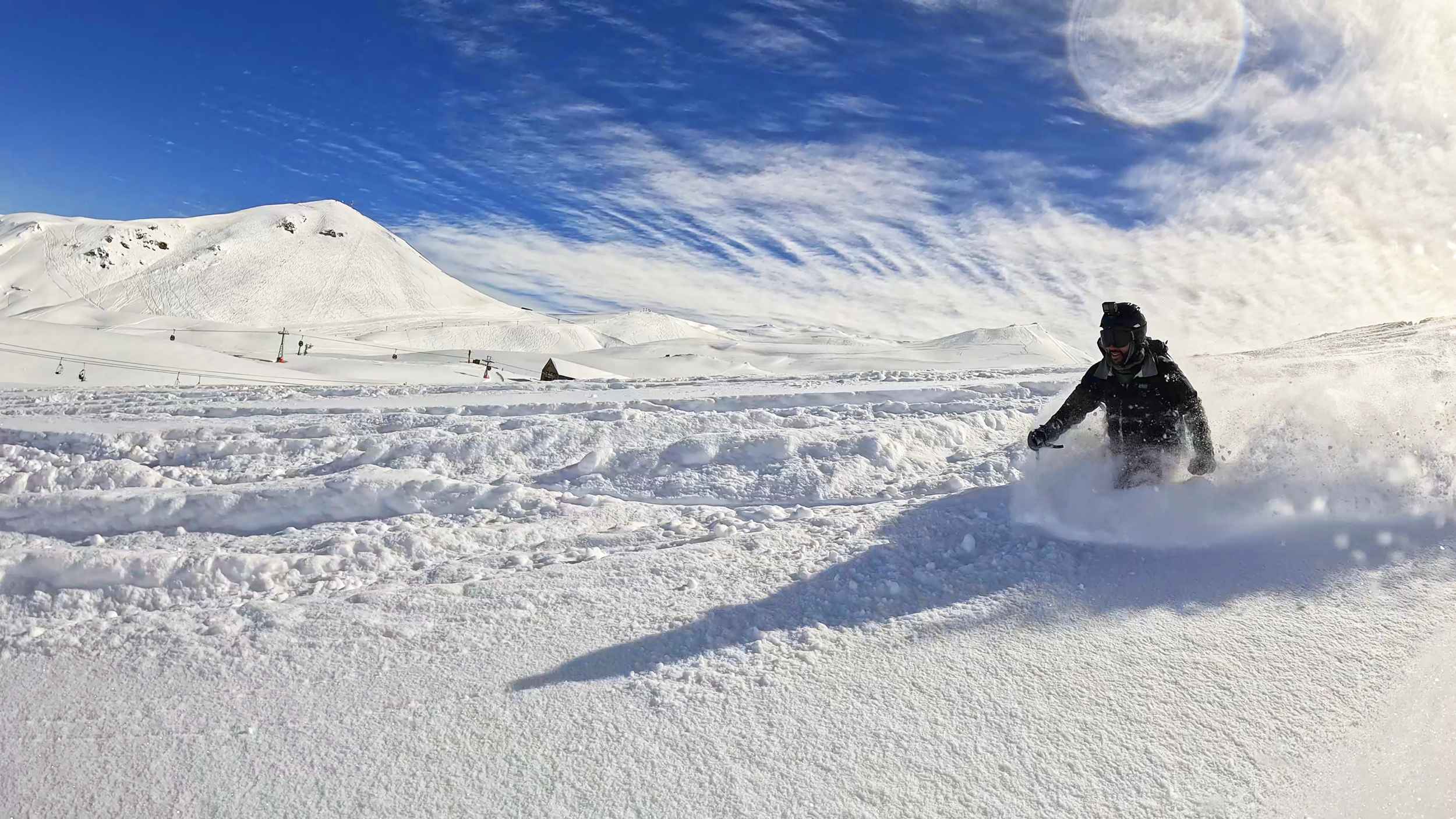
With powder like this, why don’t the Andes play a bigger role in the global ski scene?
Background
At a first glance, South America looks like it should have one of the greatest ski industries in the world. The continent’s Andes mountains are the tallest range on Earth outside Asia, with peaks of over 22,000 feet. This is paired with some of the stormiest weather patterns on the planet and incredible volcanic topography. And for those coming from the Northern Hemisphere, Chile and Argentina offer something almost nowhere else can: real winter in July and August.
And yet, when thinking about the world’s great ski regions, South America’s ski resorts don’t really live up to the quality of the Alps, the Rockies, or Japan.
So why didn’t the Andes’ commercial ski industry develop to the level the terrain seemed to promise? The surface level explanation is economics—it doesn’t take a rocket scientist to know that Chile and Argentina do not have the markets of places like Western Europe, Canada, or the United States.
But it goes much deeper than that. In reality, the conditions of the Andes created a barrage of factors so difficult that it would be hard to imagine this part of the world developing top-tier ski resorts even if it were the wealthiest on the planet.
In this piece, we’ll dig into the extensive history of South American skiing’s development and associated hiccups, including its earliest origins, the surprising barrage of investments along the way, and the problems that influenced which resorts got built at all—and what they had to become to survive. Let’s jump right into it.
South American Skiing’s Beginnings
The first thing to understand about South American skiing is its timing of origin. And perhaps surprisingly, the industry didn’t really start all that much later than better-known regions in the Northern Hemisphere.
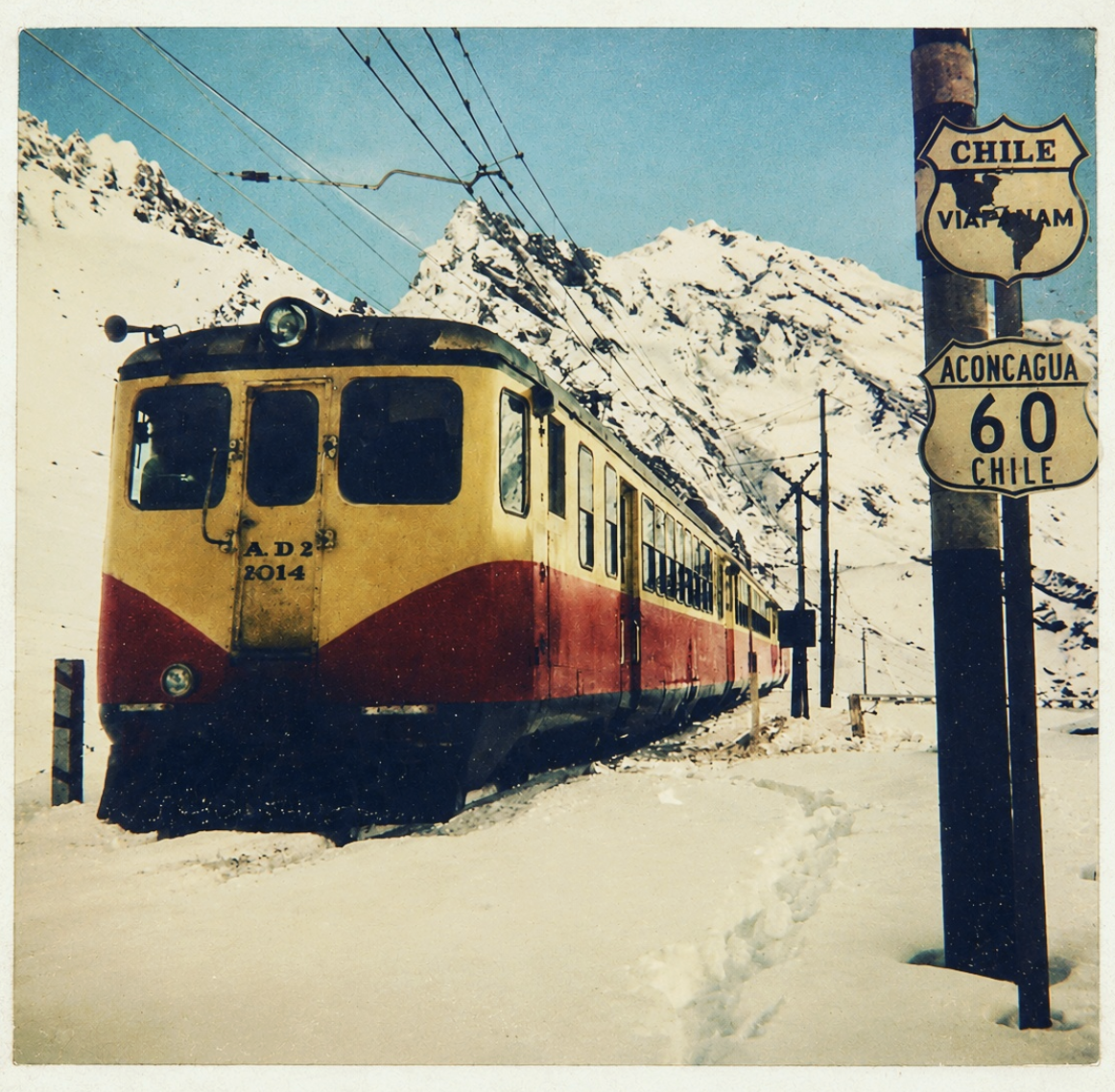
South America’s first ski lift was actually a train.
Source: @alpsandmeters on Instagram
The earliest documented skiing on the continent was in the context of labor. In the late 1880s, workers began building a train line across the Andes to link Chile and Argentina, through some of the most punishing terrain on the continent. To move and work through the deep snow, the engineers and laborers got around on skis, the only practical way to cross the high cordillera in winter. When the line opened to the public in 1910, recreational skiers began riding the train up toward the Caracoles pass and skiing back down, which made the Trans-Andean railway, in effect, Chile’s first ski lift.
While the railway was planting skiing’s first seeds, immigration was providing the next source that would grow the sport. Recreational alpine skiing largely arrived through a professional class of Western European transplants, with Germans driving the club culture on both sides of the Andes. In Chile, their community founded excursion clubs in Valparaíso in 1909 and Santiago in 1924, and by 1929 they had affiliated as the Chilean chapter of the German-Austrian Alpine Club. In Argentina, German and Swiss immigrants brought the sport to the mountain town of Bariloche, which had been a hub for sightseeing and trading beforehand but quickly became popular for skiing as well.
At that point in time, getting to the snow was its own expedition in Chile. Above Santiago, the club skiers gathered in the city, rode horse-drawn coaches up the Mapocho valley, swapped out the team partway, then finished on foot or by mule before skinning up and skiing down. There was no lift and no ski-specific road at this point, making for a rather arduous journey. Around Bariloche, Argentina it was quite a bit easier, as the skiing happened on Cerro Otto right by town until at least 1930.
So by the end of the 1920s, immigration had built a regional interest in winter sports in Chile and Argentina. But what it hadn’t built was a single piece of mechanized uphill transportation. However, that wasn’t unusual yet. Almost nowhere had real ski resorts in the 1920s, and the sport still meant climbing up under your own power to ski down.
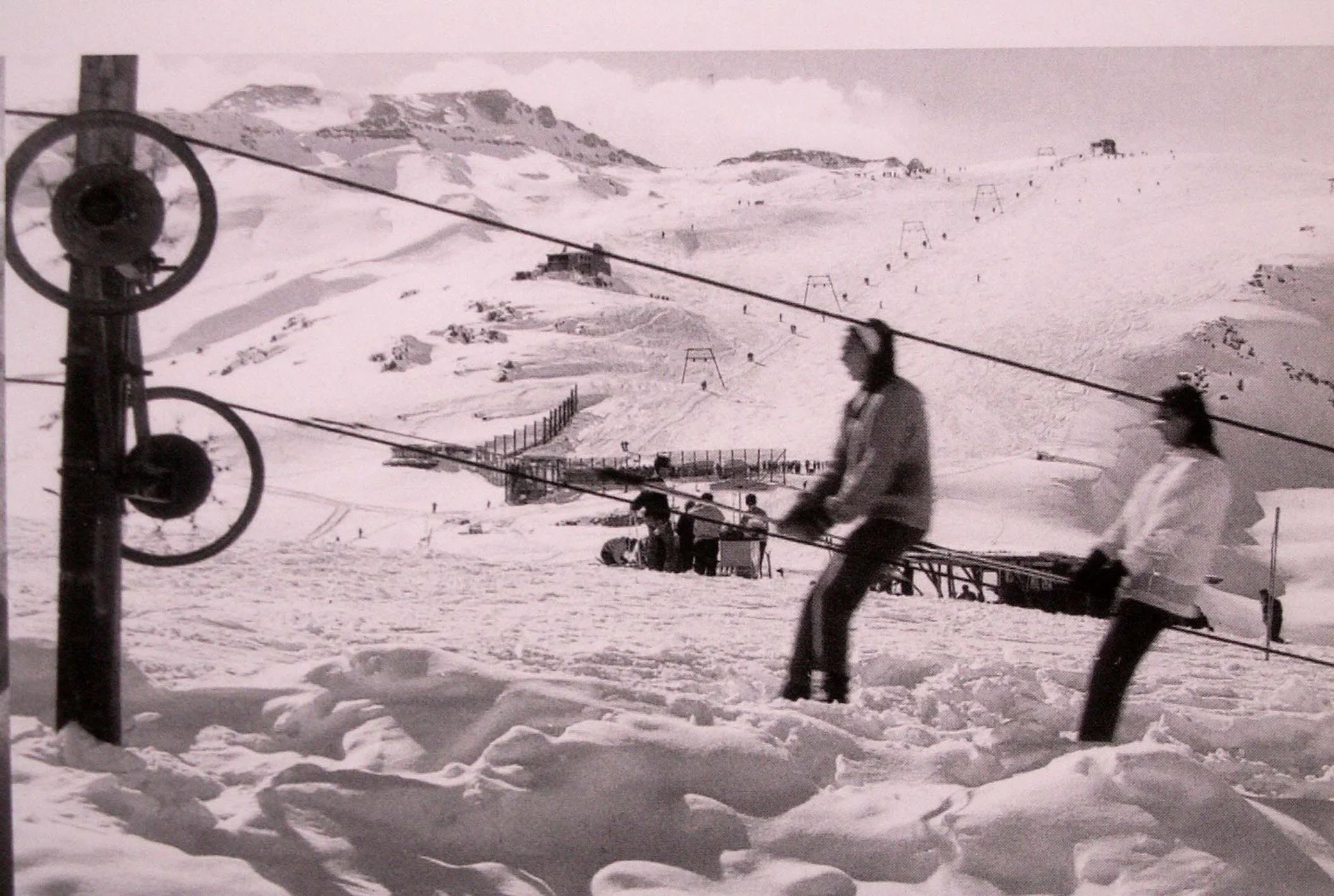
A tractor-engine rope tow was the first lift built above the mountain village of Farellones, Chile, in the area today known as the Tres Valles.
Source: skifarellones
1930s & 40s: Resorts Start to Get Built
By the 1930s, things began to change. Like in North America and Europe, skiing in the Andes transformed from backcountry excursion into a truly practical recreational activity during this decade.
Farellones, the small village above Santiago, became Chile’s first real metropolitan ski setting over the course of the decade. Starting in around 1934, a cluster of club and private refuges allowed for skiers to finally stay directly on the mountain after years of using a lower-elevation staging point. Then by the end of the decade, a road up to the village was finished,and it was complemented by the construction of a crude tractor-engine rope tow. These developments went a long way toward adding a comfort proposition to the skiing experience in the area.
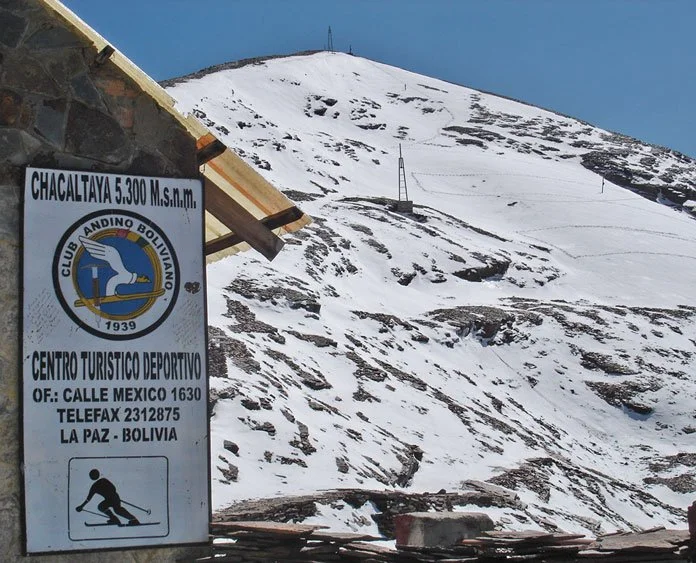
Chacaltaya, Bolivia, the highest lift-served skiing in the world until it closed in 2009.
Source: Paul Tansley / Snow Action
Argentina's anchor resort showed up around the same time, and it was actually spearheaded in large part by the country’s government. With the help of an Austrian ski champion and a new national parks agency created a few years earlier, Cerro Catedral debuted in 1938. The state cut in roads and strung the first drag lifts, while the army helped clear the forested slopes. A ski hotel opened in 1942. It is worth touching on why the Argentine government had such an appetite for building a ski resort. Yes, there was a small cluster of locals who skied there, but there was not a paying crowd worthy of private investment. Instead, the government was concerned that Bariloche's existing frontier-based economy leaned too heavily towards Chile, and a ski resort grand enough to pull the Buenos Aires elite south was an ideal way to hedge against that.
It’s also worth noting that Cerro Catedral’s location selection would be a sign of the scarce pickings to come in the future. The parks agency’s expert had originally preferred a different mountain entirely, but it was rejected once it became clear there was no way to reach it except a boat across a lake.
Then, South American skiing showed up in what might seem in the present day to be a wild card country. In 1939, a rope tow powered by an automobile engine went up at Chacaltaya, Bolivia, above La Paz. This tow sat at a staggering base elevation of 17,100 feet, and for decades, Bolivia held a strange distinction as home to the highest lift-served skiing on Earth. The lift sat on a tropical glacier, which would matter enormously later down the line.
1940s & 50s: Problems Arise
Over the next few decades, and especially after World War II, ski resort development exploded throughout much of the world. However, the 1940s and 50s were when South America’s structural problems really started to surface.
In the early 1940s, South American alpine skiing started to revolve around a surprisingly practical circumstance: the military. For Chile and Argentina, the Andes not only provide a mountain backdrop but are the literal border between the two countries. In order to defend that border, soldiers needed to know how to move through and survive in snowy, wintry conditions, and operate in places where roads could disappear for months. So what would be the perfect military solution? Skiing, of course.
In Chile, the Army’s high-mountain school was established at the site of Portillo in the late 1940s and early 1950s. In Argentine Patagonia, the Army’s Mountain Regiment 21 near Esquel built the first refuges and trails on what would eventually become the La Hoya ski area.
In Argentina, the biggest development was arguably Catedral becoming a mature ski resort. After the first lifts and hotel were put in place in the late 30s and early 40s, by 1950 the resort had an aerial cable lift—the first of its kind in South America. Meanwhile, a few hundred kilometers north, the future Chapelco was being born the hard way. A club of skiers from nearby San Martín de los Andes built a refuge in 1948, and cleared the first run by machete in 1953. Chapelco would later get its first chairlift in the 1960s.
Over in Chile, the Santiago cluster inched along in terms of development as well. The road up to Farellones had been pushed through around 1939, largely on private initiative, and the first real lift at what became El Colorado arrived in the 1950s. Much further south, there was a ski club and a refuge on Villarrica, which is home to the present-day Pillán ski resort, by 1948.
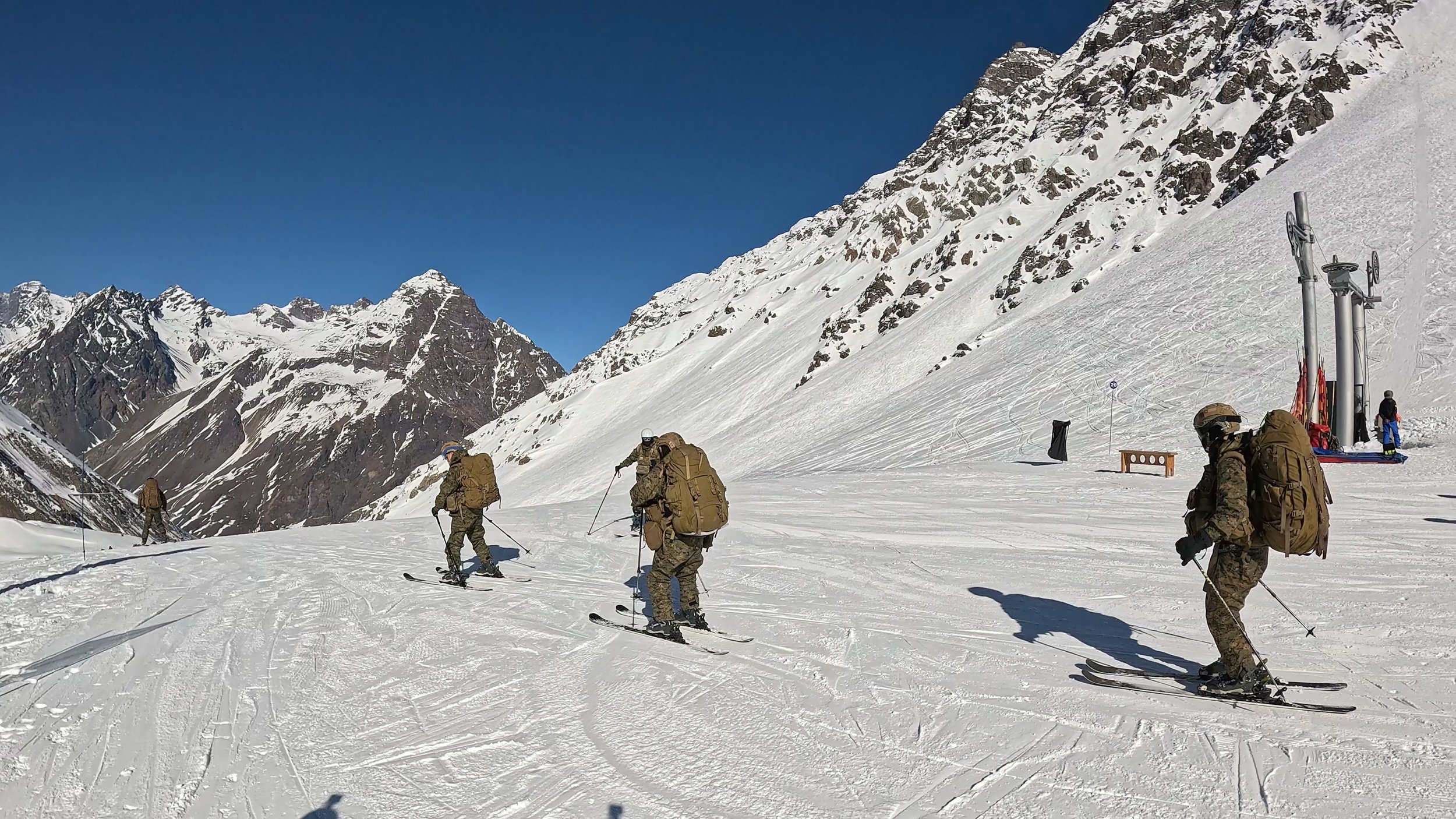
Chilean soldiers training at Portillo.
But while these handful of locations were showing promise in this part of the 20th century, they also happened to be the only resorts that were fairly easily accessible by road. With Villarrica and the Argentine resorts having base elevations of about 3,000-4,500 feet, constructing access roads was not all that tough from the nearby towns. And for Farellones, while it sat much higher at an elevation of 7,800 feet, it was one of the few places where building a road, even if it had dozens of switchbacks, was topographically practical to do, and it benefitted from the economic advantage of having Santiago immediately below (there was simply too much demand from the Santiago region to go without having any skiing, and Farellones was the easiest choice of all the mountains in the vicinity).
Unfortunately, the same wouldn’t be true in other parts of the Andes. While getting the Chilean Army up to Portillo for mandatory training was one thing, convincing the general public to go up there for leisure purposes was another. And the resort had one crippling problem: into the 1960s, the only way in was that six-hour narrow-gauge train from Santiago that had existed since the early 20th century, and the train regularly got stuck in the snow high in the mountains. The first attempt to build a hotel up there was in the 1940s, but the developer went bankrupt before being rescued by the state and finished in 1949. The resort had built a couple of chairlifts by the 1950s and hired world-class instructors to attract international tourists, but it still struggled immensely due to its location.
It was also in this time period that the volcanic nature of the Andes would rear its ugly head. In October 1948, Villarrica erupted violently, and the eruption completely destroyed the ski club's refuge. Tragically, the eruption took the lives of two of its caretakers and contributed to a broader disaster that killed roughly 50 to 100 people in the region. It would be decades before the mountain saw serious ski development again.
By 1960, after roughly 75 years of skiing in the Andes, South America had only a handful of real ski resorts, and one of them could only be reached by an unreliable train. And it was becoming clear that with terrain this steep, high, and remote, roads were brutally expensive and slow to build, and a great mountain was extraordinarily difficult to develop without them.
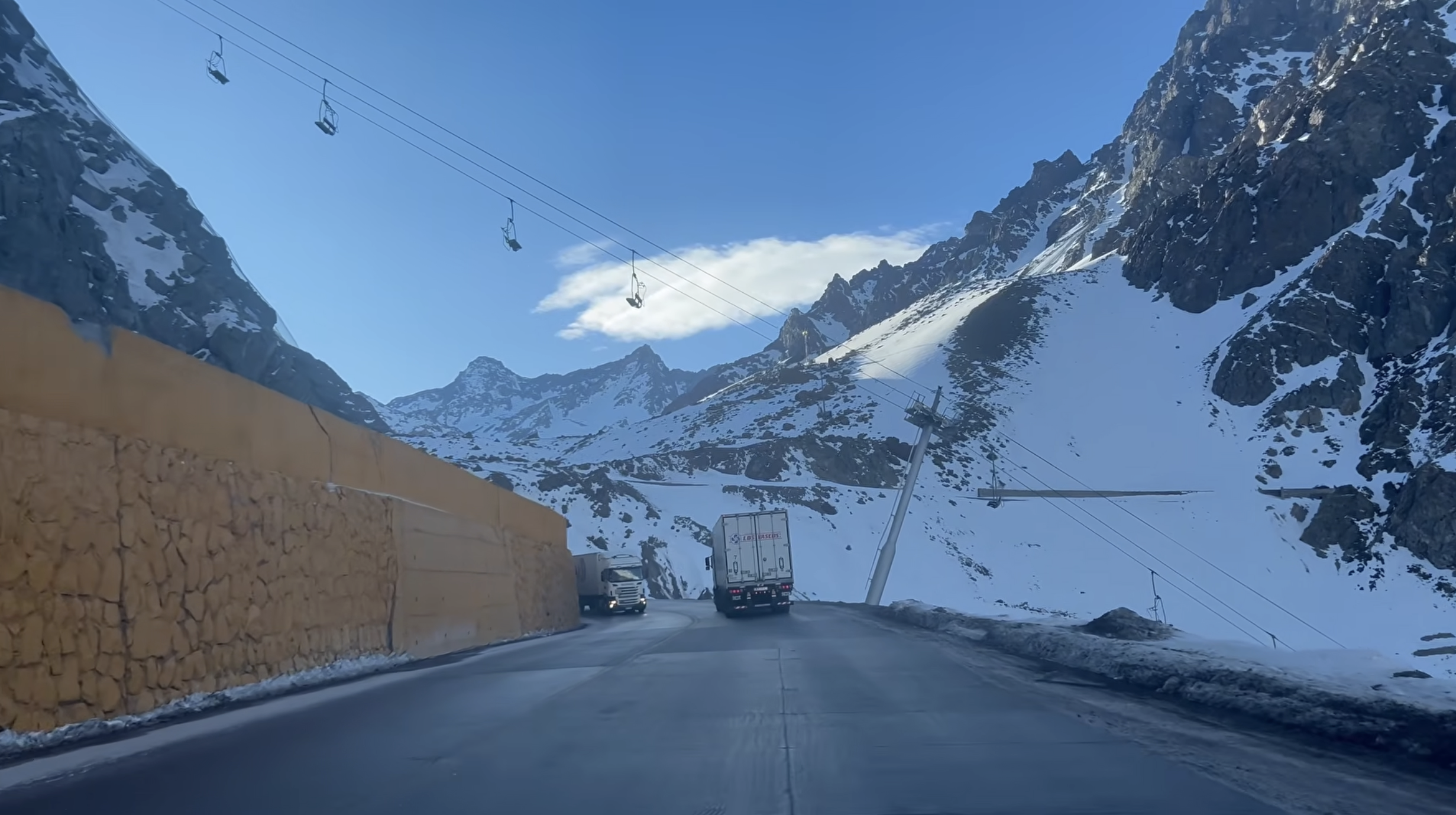
Portillo’s precarious and high-elevation access road.
The Fundamental Problem With the Andes
So what exactly were the factors that made the Andes so brutal and difficult to build ski infrastructure in, and how do we know they weren't just a symptom of South America's poorer economies?
Start with a fact of geography that, in most other cases, would frankly make some of the South American resorts that did materialize physically impossible in most other situations: latitude. Santiago sits at 33 degrees south, which is the same distance from the equator as San Diego. At that latitude, snow typically doesn’t show up at all. But because the Andes are so high, reliable snow actually does come starting at around 7,500 to 9,000 feet. However, this also means the resorts of the central Andes have to sit with base areas far higher than their population centers, with the feasible mountains and the cities separated by roughly 6,000 vertical feet of rapidly-rising, not-insignificant terrain to cross.
And even if the access problem is solvable, the mountains offer little relief higher up, because the Andes overshoot in the other direction as well. As we mentioned earlier, the range is one of the tallest on earth, with a huge share of its terrain rising well past the roughly 13,000-foot ceiling where the lifts of the Rockies and Alps stop, and toward summits above 20,000. At a first glance, this is the type of vertical rise that should make for truly world-class slopes and, in the process, potentially attract enough attention to outweigh the practical constraints of constructing roads.
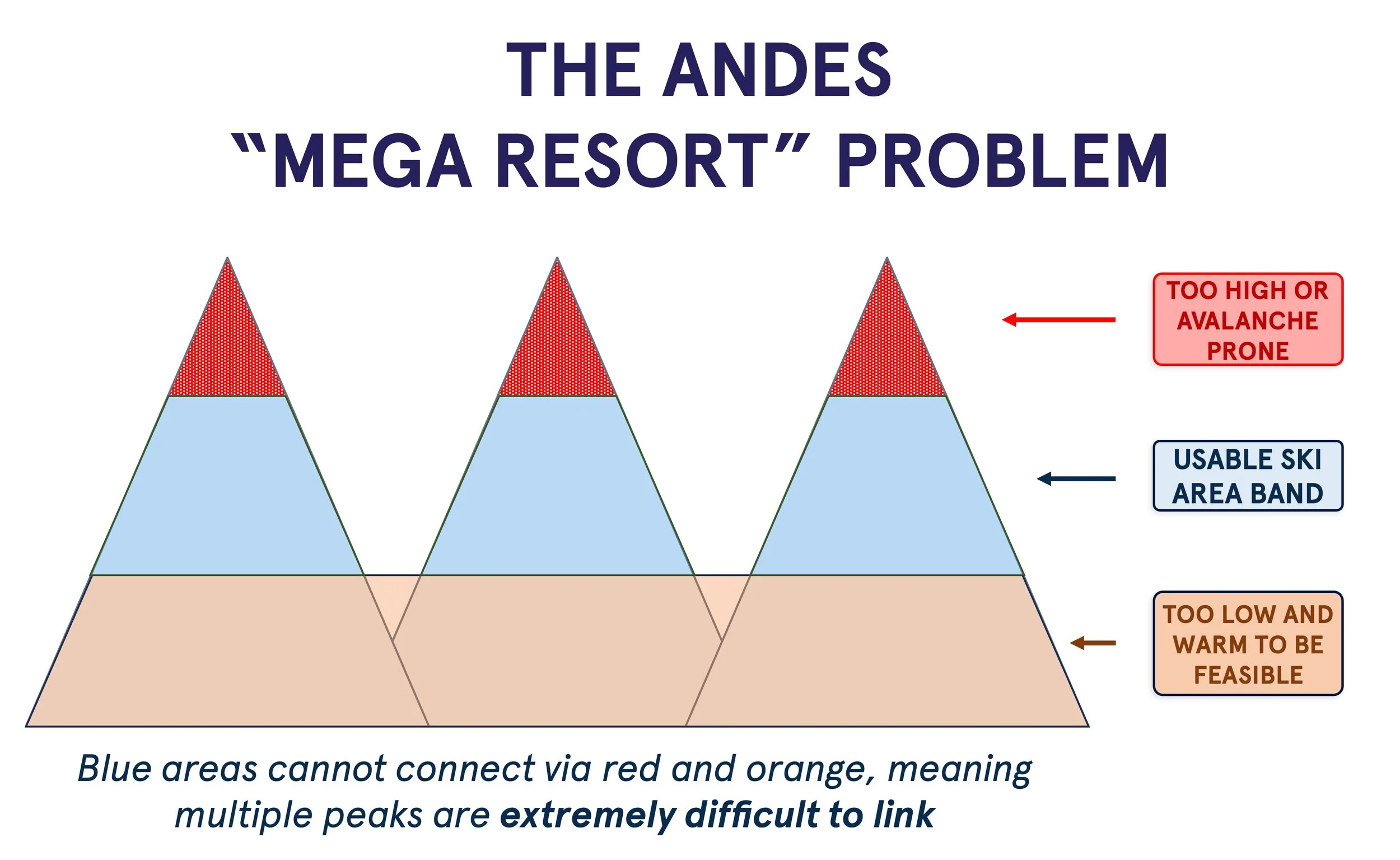
But there’s another reason why virtually every major resort on earth stops its lifts around 13,000 feet: above that, there isn't enough oxygen for the average person to ski comfortably, let alone sleep. So in other words, the Andes get squeezed from both ends. Too warm for snow to reliably accumulate below about 7,500 feet, but too thin-aired above about 13,000. The actual usable band for a ski resort is a narrow shelf partway up a gigantic wall.
And even ignoring the elevation, reaching that shelf is its own nightmare. The Andes are a steep, loose, jagged range that's still tectonically active, making for much more unstable terrain than places like even the Rockies or Alps. Many slopes that would make spectacular ski runs are simply too steep and too avalanche-prone to put a road under or a chairlift on. And even where a road is possible, it might have to climb through passes so high, or so exposed to avalanche terrain, that driving it in winter would be too dangerous in and of itself to make it practical.
1960s: Serious Problems Emerge & Portillo Takes Center Stage
Going into the 1960s, some of these issues started to collapse onto resorts that already existed.
In 1961, the Chilean government had given up on Portillo after more than a decade of losing money on it, and put the whole thing up for auction. Exactly one bid came in, from a pair of New York investors, Bob Purcell and Dick Aldrich. When their manager arrived to take over, he found the hotel all but abandoned. The new owners' plan to turn it around was audacious: put Portillo on the world stage by winning the rights to host the 1966 Alpine World Ski Championships, an event that had never been held anywhere in the Southern Hemisphere. Remarkably, the bid succeeded. However, hurdles stood in the way—some known, others impossible to predict.
At that time, the resort still had no road and remained fully dependent on that narrow-gauge train line. And unfortunately, the rest of its infrastructure was about to be tested in the worst possible way.
Roughly a year before the 1966 World Championships, national teams gathered at Portillo for a pre-championship test event, and tragedy struck the Andes again. A gigantic storm cycle buried Portillo under winds over 100 miles an hour and several feet of snow a day. What followed were a series of catastrophic avalanches that effectively destroyed the resort, ripping out most of the newly installed lifts and flattening part of the staff housing. Sadly, several people among the trapped ski teams were killed. The resort had to rebuild almost its entire lift network in under a year, just to hold the event it had spent years chasing.
But when it came to said event, they actually pulled it off. The 1966 World Championships were held successfully, and still remain the only edition ever hosted in the Southern Hemisphere. For two weeks, a resort that had nearly been abandoned and then nearly been destroyed became the center of the skiing world. It's still the high-water mark of South America’s global relevance to competitive skiing, and nothing on the continent has matched it since.
Also notable was just how Portillo rebuilt its lifts following the 1965 destruction. The resort brought in the strange slingshot lifts it still runs today, va-et-vient systems that fling four or five riders up an avalanche-terrain slope at once while leaving almost nothing standing for the next storm to take down. It was perhaps the clearest example thus far in the 20th century of the Andes’ relentless topography forcing infrastructure innovations.
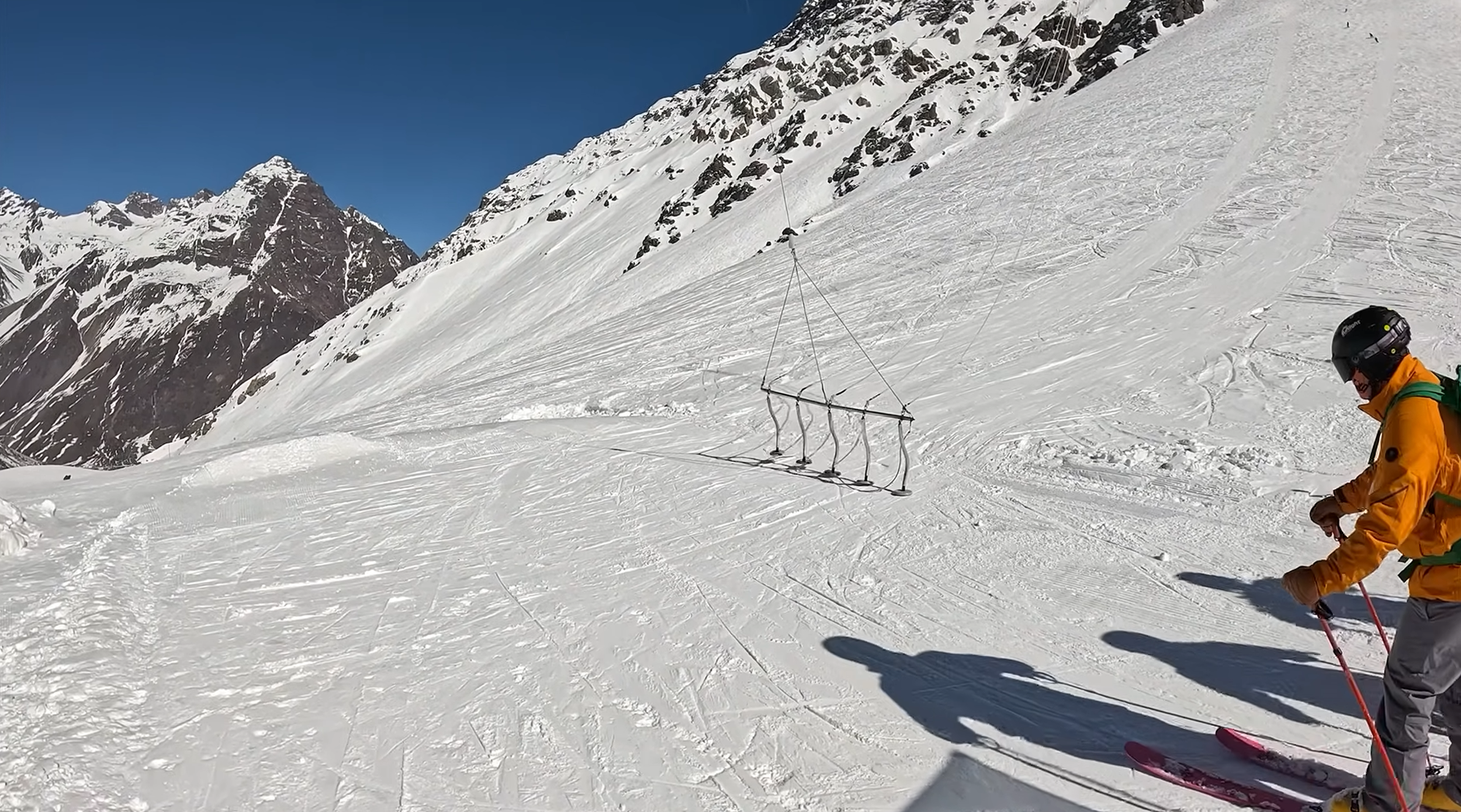
In its effort to rebuild after the 1965 avalanches, Portillo installed the unique and resilient slingshot lifts it still operates on its steepest terrain today.
Everywhere else, the 1960s largely added lifts to resorts that already existed rather than creating new ones. Chapelco finally strung its first chairlift in 1963, more than a decade after volunteers had cleared its runs by hand. Catedral kept growing on the strength of the town beneath it, which was healthily attracting the Argentines the government had intended to with its initial development. The Santiago cluster kept filling in, with La Parva formalizing lifts above the slopes the German club had skied since the thirties, although that was merely elite Santiago money funding chairlifts next to an existing road. Despite these advancements on existing footprints, one could reasonably argue that not one major ground-up destination resort opened anywhere in South America in the entire decade.
1970s & 80s: A New Boom
But that wouldn’t be the end of development in the South American ski scene. No, despite the logistical barriers, a facet would jumpstart development in all the remaining feasible enclaves of the Andes: demand that couldn't be ignored.
By the late 1970s, Argentina's middle class had taken up the sport in numbers, with the sport trickling down from the elites it had been built around in that country. There wasn’t really a Chilean mass-market boom comparable to Argentina’s, but several factors made demand increase anyway; upper-class Brazilians were discovering the Andes, and by extension, skiing and snowboarding, as a novel choice for a winter vacation, and advances in jet travel had put the Southern Hemisphere's winter within reach of the north's summer. Lift lines at the existing resorts, especially in Bariloche, were out of control.
The first harbinger of the demand boom to come showed up on a much smaller scale a decade before the trend truly became clear. La Hoya, above Esquel, finally opened a chairlift in 1974, thirty years after the Army built its first refuges. The provincial government decided to develop the resort as a public works project.
But Argentina at large was so politically chaotic in the 1970s and 80s that the era’s biggest project only happened because one entrepreneur decided to build the roads and the airport himself. The country’s flagship project during this era was Las Leñas, the vision of a burger empire mogulwho reportedly dreamed it up while standing in an endless Catedral lift line. After considering many areas, the remote Las Leñas valley won on terrain and the ability to construct a feasible access road. But while a road was possible to build, it didn’t exist yet, and the Las Leñas developers had to finance 20 kilometers of one with no help from the government. There was no airport, so the developers built the Malargüe airport too, through a scheme that let companies offset taxes with infrastructure works. Construction started in January 1982, but the Falklands War severed the European supply lines within months and nearly killed the project. However, the resort opened anyway in June 1983, with three chairlifts and three hotels, months before Argentina’s military dictatorship collapsed. So thanks to its workable access logistics and the brute force development, Las Leñas still made it despite so many economic factors working against it.
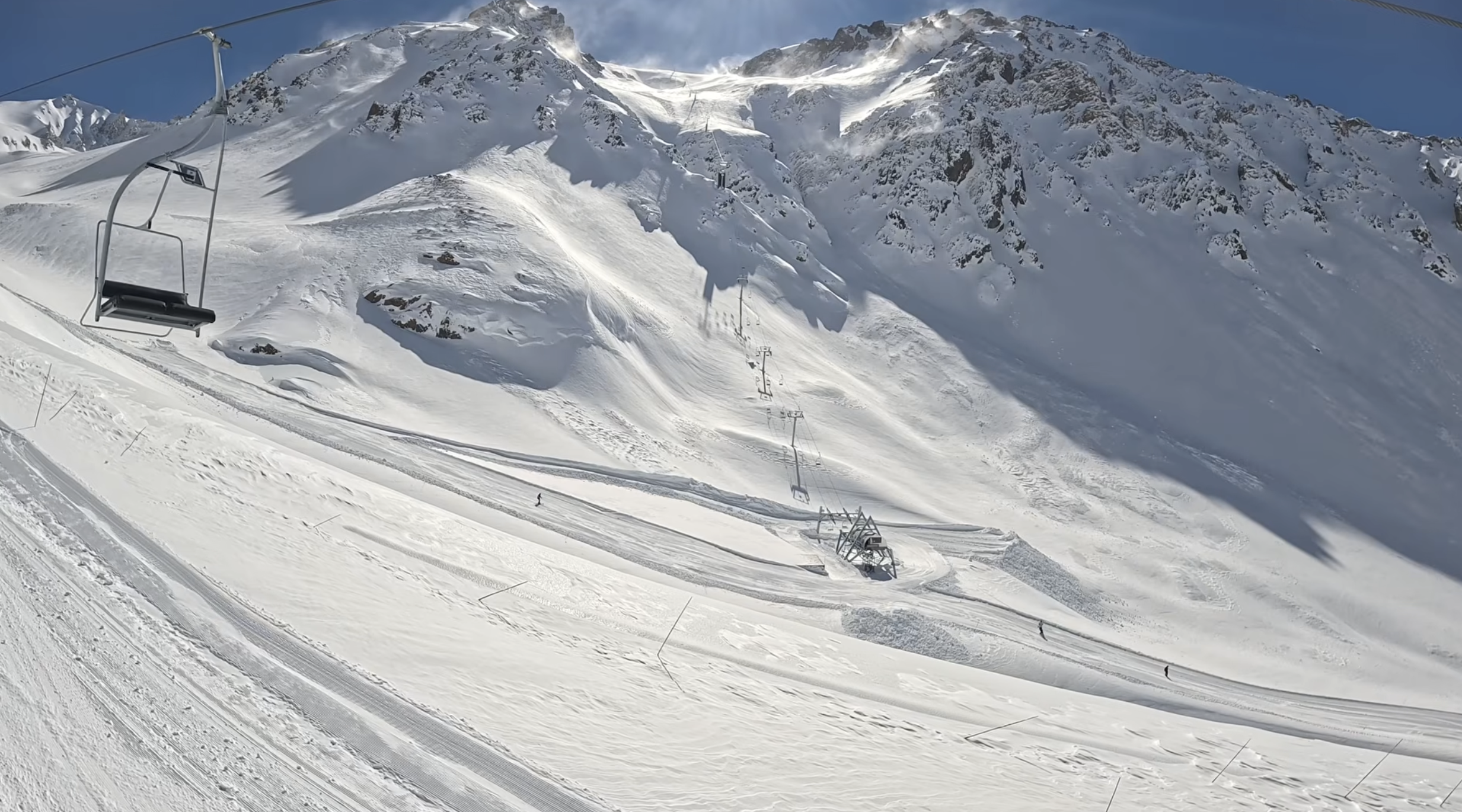
Argentina’s Las Leñas was brute-forced into success during one of the nation’s most tumultuous political eras.
In Chile, a dictatorship built on foreign capital and privatization, despite its horrific atrocities, did end up creating the investment conditions that made an internationally-financed destination ski resort possible. Valle Nevado was conceived and financed by French investors, with the Chilean state pitching in the one piece no private actor was willing to foot the bill for: extending the access road. It only had to be an extension, because the route to Farellones already existed. Valle Nevado opened in 1988, and it went not to a fresh mountain range but to an extension of the one road the central Andes already had. And unlike La Parva and El Colorado, the new resort was built with accommodations that were truly meant to attract hotel guests, rather than the “second home” setups of those already existing resorts.
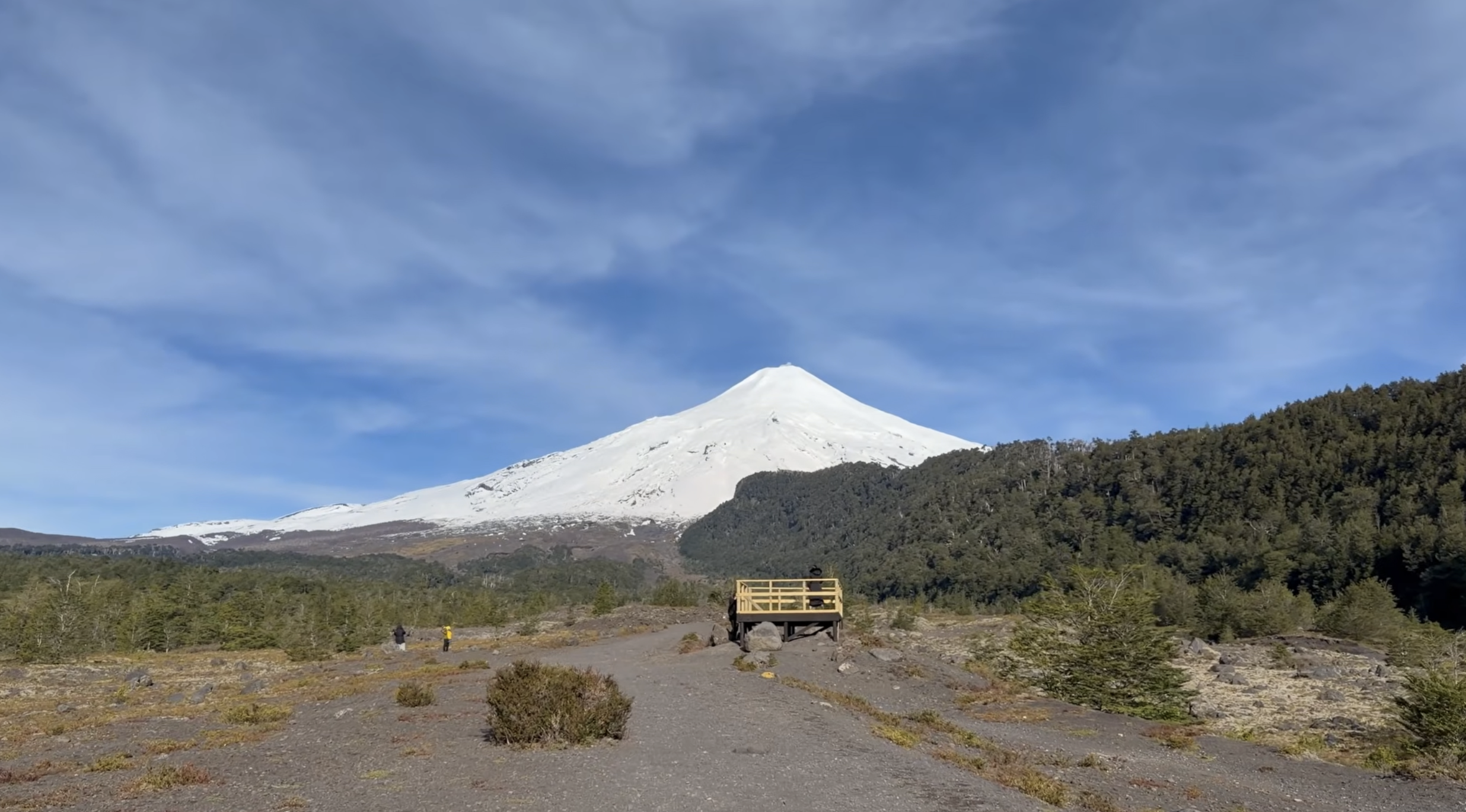
The 1980s saw ski resort development in volcanic and geothermal areas in the Andes due to the gentler access circumstances, such as on the slopes of the Villarrica volcano pictured above.
Then, there were a handful of ski resorts developed out of interest in a completely different winter draw: hot springs. In 1986, back under democracy, the Argentine province of Neuquén founded the town of Caviahue by decree, a planned tourism base pairing skiing and riding on the Copahue volcano with the thermal springs next door. Developing here in the volcano belt was a workaround to many of the structural issues we mentioned earlier: far enough south that the snowline dropped to drivable elevations, with a base around 5,400 feet, gentle cone gradients that were easier to build roads and lifts on, and at least some araucaria forest for wind shelter in the lower mountain. Chile had a much bigger version of this idea executed at Termas de Chillán, a hot-springs resort two centuries old where skiing had been a bathers’ pastime since the 1930s but only got its first real lift in the 1980s. Because the spa’s hotels and road had already been there, investing in a new ski resort in this location, which was later rebranded as Nevados de Chillán, was a lot easier than in many other alpine areas. And finally, lift-served skiing arrived on Villarrica, the volcano that had erased its first ski refuge in the 1948 eruption, in the form of the Pucón ski resort.
1990s & 2000s: Rounding Out the Map
By the 1990s, the South American ski scene as we know it today was rounding out. Two more resorts opened in this era, and both arguably got built during this time period only because it took so long to make the practical realities for them happen.
In 1999, we saw the debut of the world’s southernmost ski resort: Cerro Castor. At 54 degrees south, the same distance from the equator as Moscow, reliable snow falls almost to sea level. As a result, Castor's base sits around 640 feet, thousands of feet lower than every other notable lift-served resort on the continent. But it didn’t have an easy origin story; after being originally proposed in the mid-1980s, the resort’s exceptionally southern and remote location warranted extensive flight studies and meteorological analysis to make it a reality, while political instability in Argentina hurt the timeline as well. But since its inception, the resort has become a critical athlete training ground for its surprising ease of access, being only half an hour from the Ushuaia airport, as well as its consistent snowfall and reliably cold temperatures.
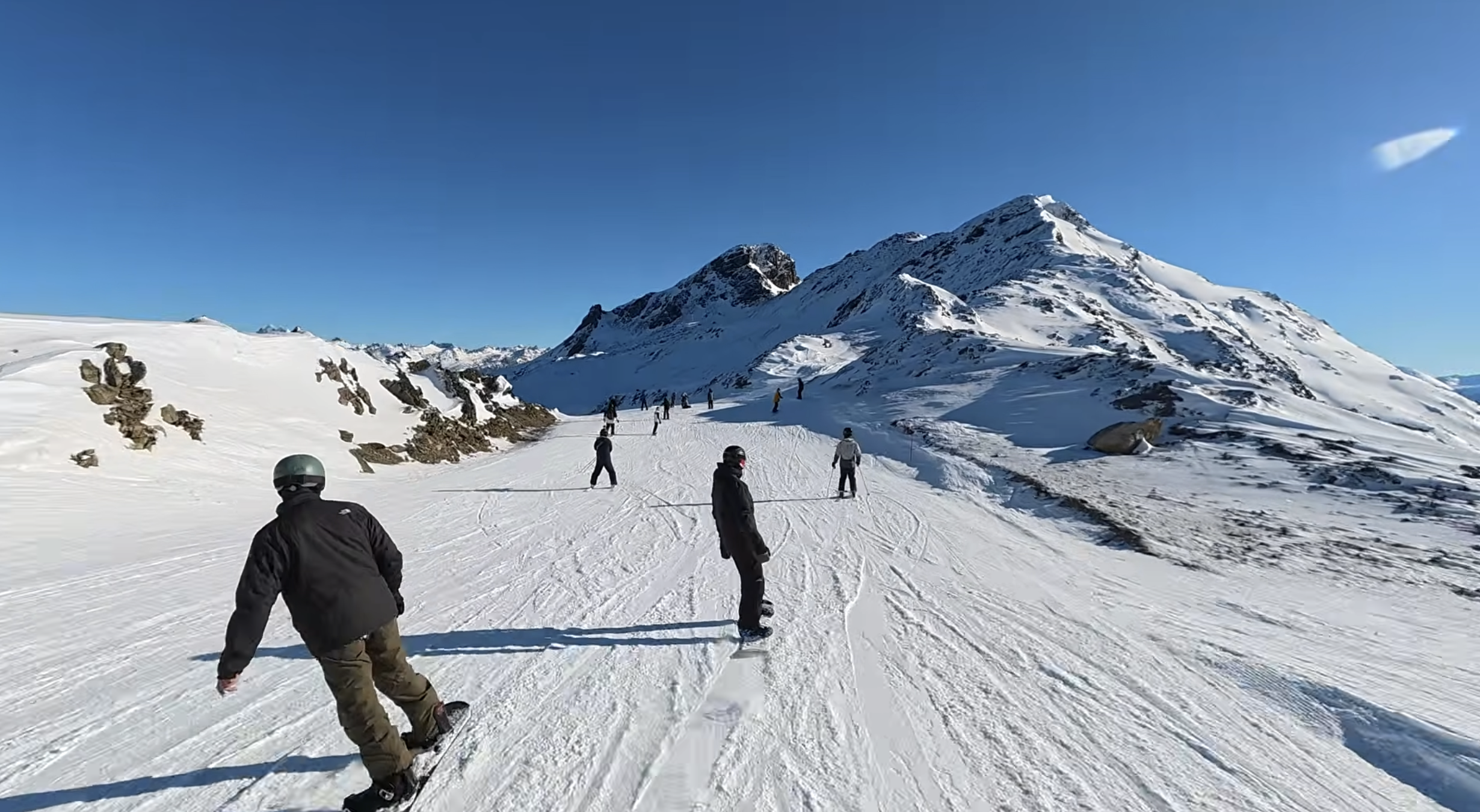
Cerro Castor, sitting at the southern tip of South America, is surprisingly easy to access and popular for its unusual location.
Corralco was the other major resort debut, opening on the flanks of Volcán Lonquimay in Chile in the early 2000s. Like the other volcanic ski areas built in this region, it was far enough south for a drivable base elevation, and on a mountain gentle enough to put in lifts. Corralco faced several constraints in its development, sitting inside a protected national reserve, and strict environmental oversight made for slow on-mountain buildout, with the first on-mountain hotel not arriving until 2013. Even today, the footprint sits only on a fraction of its host volcano, as well as strictly outside the araucaria forests that would make for some incredible tree skiing but are sacred to the region’s indigenous Mapuche-Pehuenche people.
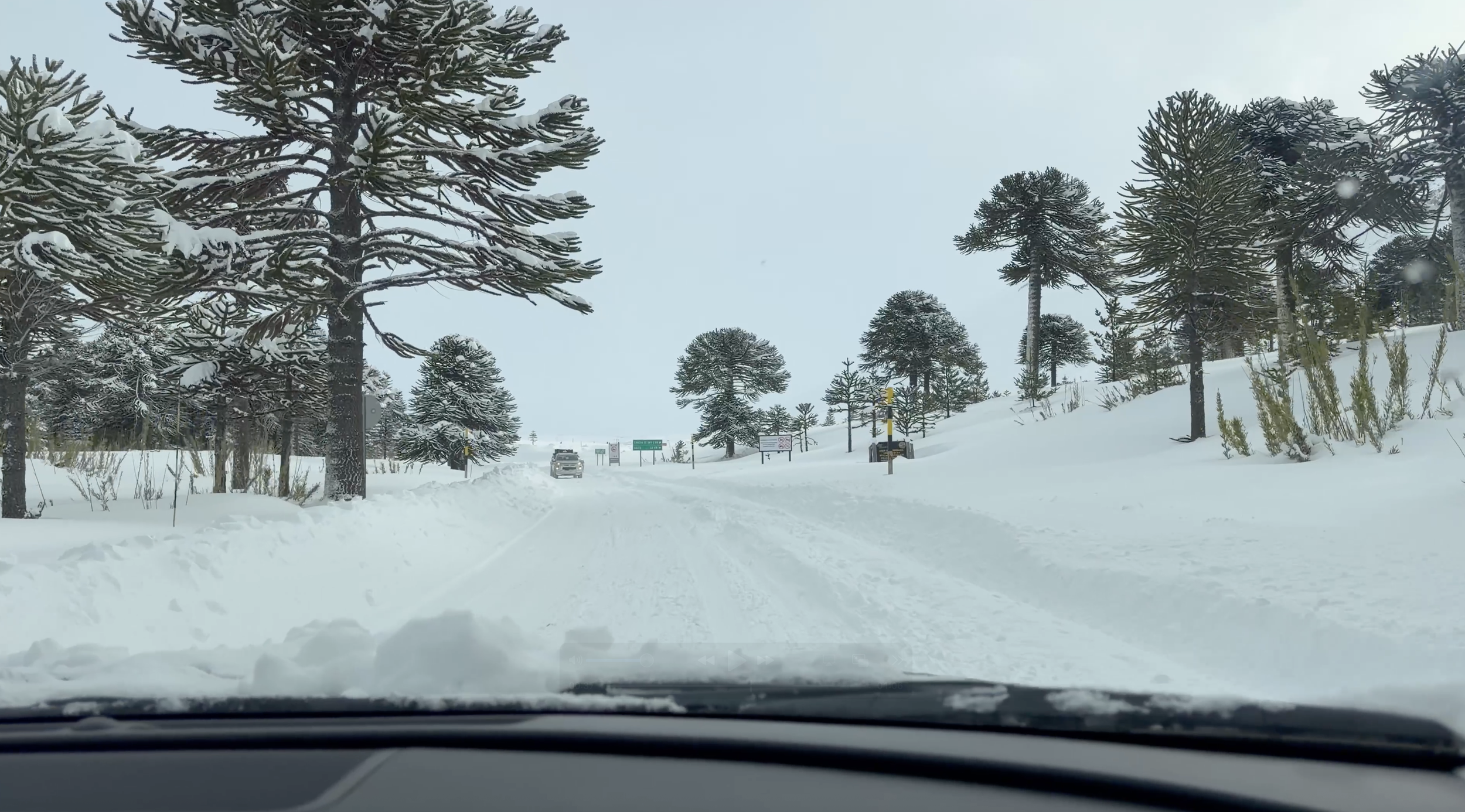
Approaching the base of Corralco through the uppermost bands of the striking araucaria trees.
Why South American Resorts Can’t Expand Any Further
But even aside from the development constraints, this all points at the fundamentals the vast majority of these resorts have in common, old and new alike: they are modest in size. The Andean terrain put severe restrictions on how big any of the resorts could actually get. In the Alps, resorts grew by linking valleys, one lift-served basin connecting to the next, creating huge networks of hundreds of kilometers of terrain and dozens of towns and villages. Even in the Rockies, multiple mountains right next to each other could be skied in their entirety from top-to-bottom and linked together to create giant destination ski resorts. The Andes almost never allow that. The usable band of skiable elevation does not include either the highest or lowest elevations, and the terrain between good zones is usually too steep, too avalanche-exposed, or too high to bridge with lifts. So most ski mountains are effectively “islands” in the sense of connecting to other practical skiable terrain.
There’s pretty much one real exception: the Tres Valles, where Valle Nevado, La Parva, and El Colorado sit on the same broad, forgiving massif above Santiago, physically connected across roughly 4,000 skiable acres. That’s genuinely big, on par with a major North American mountain. It’s arguably the single goldilocks spot on the continent where topography wouldn’t hold a large resort back, and even that’s only because demand from nearby Santiago justified building a road up to it, albeit one that could only be built with thousands of feet of elevation gain, dozens of switchbacks, and a capacity-constraining narrow width that warrants one-way travel restrictions during peak times.
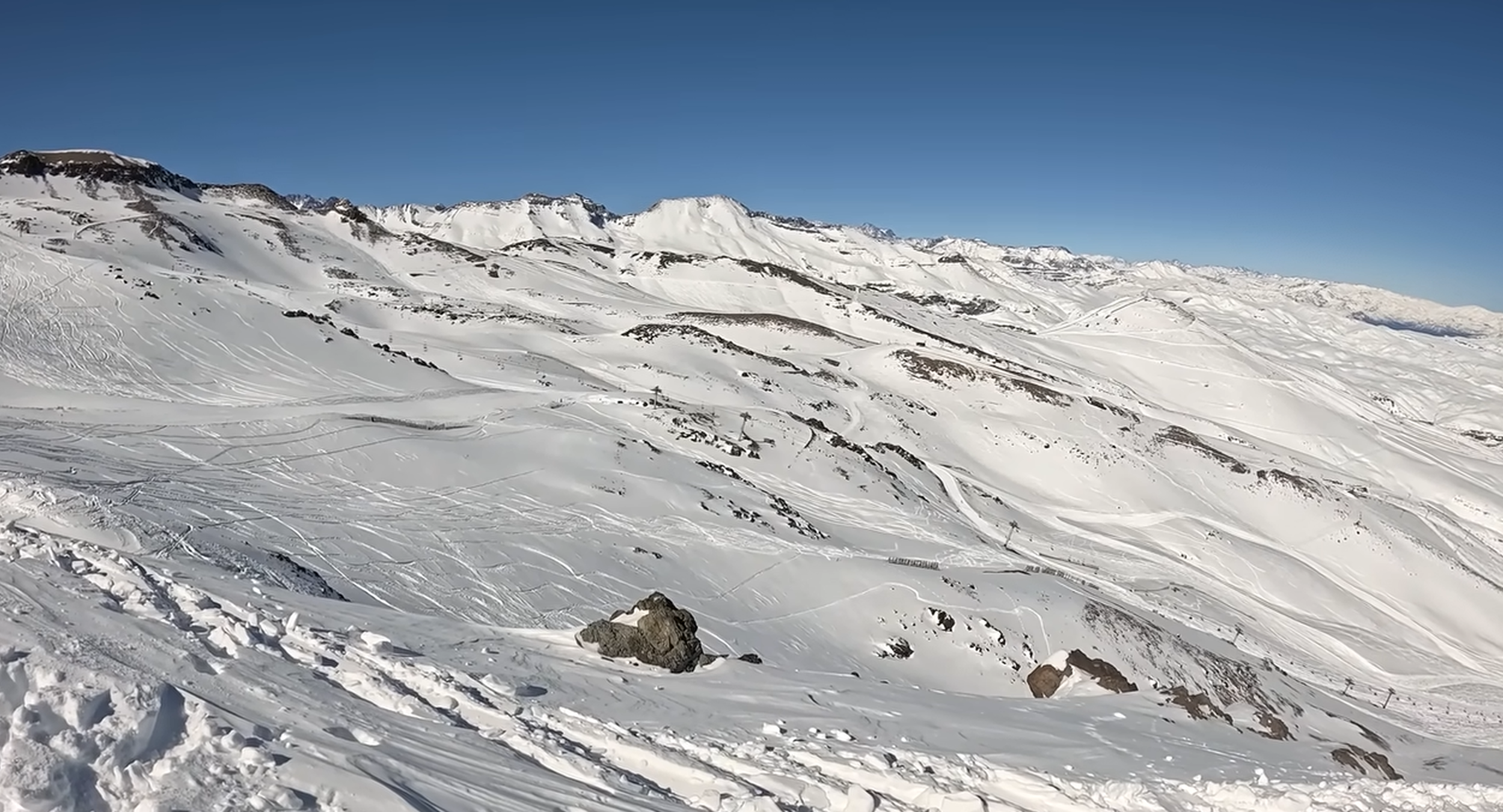
The Tres Valles and its relatively approachable stretch of terrain as seen from the edge of La Parva, one of the three resorts in the area.
And even in some cases, resorts that did successfully get built were eventually ground back down by the mountains themselves. When it debuted in the 1980s, Pucón was built on the volcano's north face, which in the Southern Hemisphere is the sun-facing side during the winter. It was also at a low elevation in a rainy maritime climate with an extraordinarily windy exposure, and the combination slowly ate it alive. Over the following decades the resort shrank in place, with several lifts gradually removed from the map—including, according to an early brochure, a slingshot lift similar to the ones that now only exist at Portillo—and even a large chunk of the lifts that still exist are seldom running today. Unfortunately, some areas that likely could have survived with surface lifts met their demise because the resort made the mistake of installing chairlifts instead. On the same volcano that had erased the area’s first ski refuge in the 1948 eruption, the decline of what is now Pillán sent a warning about Mother Nature a second time, albeit slowly instead of all at once. Although ironically, the resort probably only exists today because of its inopportune exposure, as in 2015, the volcano erupted once again, with the lava flowing down the southeastern flank.
Over in Argentina, Las Leñas found itself unable to maintain its upper mountain Juno chairlift, relocating it to the lower mountain and removing approximately 30% of its lift-served terrain in the process, with the conditions in the area making the lift extremely difficult to operate. Unfortunately, this move effectively took away some of the best advanced and expert-level slopes on the continent.
And then, we have to revisit Bolivia. Chacaltaya had always been the continent's great anomaly, a ski area operating above 17,000 feet, far past the altitude ceiling that stops every other resort on earth, and it got away with it for one reason: La Paz sat just below, one of the highest major cities in the world, supplying a clientele already living and breathing at extreme elevation, up a road that existed because the city did. But the lift sat on a tropical glacier rather than a seasonal snowpack, and when the glacier melted away in its entirety in 2009, the ski slopes went with it.
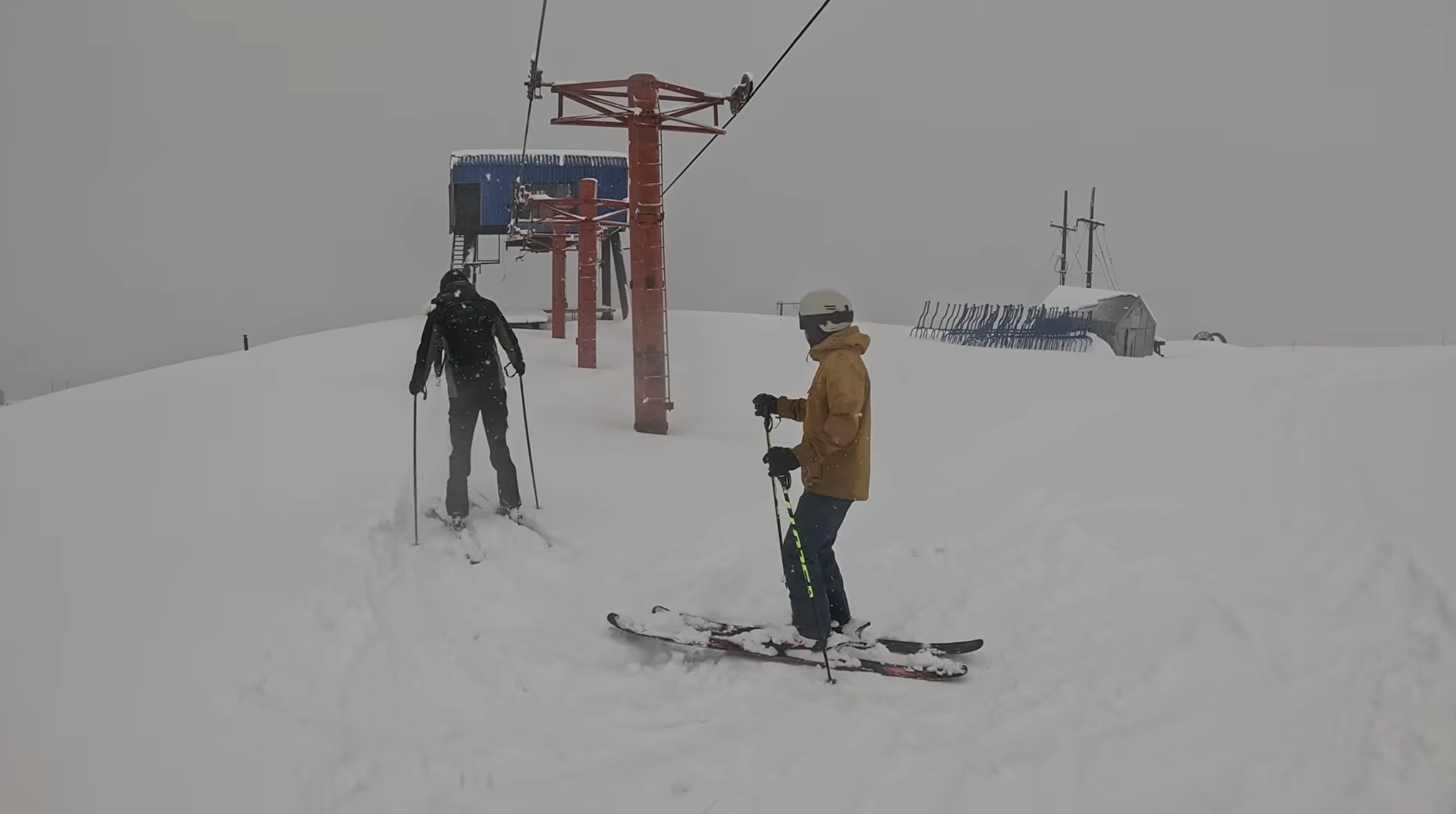
Due to an ongoing struggle against its exposure and volcanic setting, Pillán has slowly abandoned much of its lift infrastructure.
The Economic Question
So with everything we’ve covered so far, there’s one obvious counterargument: couldn’t it just be economics that have put a throttle on South American ski resort development? Yes, governments and economic conditions have not always made building or expanding in Chile and Argentina as easy as it could be.
The most prominent and recent example of this may have to do with the potential of the Tres Valles region. Mountain Capital Partners, an American operator, spent the last three years buying up two of the three Tres Valles resorts, first securing a majority stake in Valle Nevado in 2023,then La Parva in 2024. The company then had a plan to purchase El Colorado as well, connecting all three resorts and eventually building out what was claimed to eventually become the largest ski area in the Western Hemisphere. But in July 2026, the plan reached a fatal hurdle. Chile’s antitrust regulator ruled that letting one company control all three connected areas was too much, and demanded that one be owned by a competitor. As a result, MCP was forced to walk away from the El Colorado deal. So even in the one place on the continent where a truly world-class, interconnected mega-resort is physically possible, it still hasn’t been allowed to happen because of the regulators (although one could plausibly understand why a Chilean government entity might not want a foreign company to own all three of its most prominent resorts).
Also, severely unfavorable long-term financing rates have significantly complicated the ability of resorts to install or replace their lifts. With no lift manufacturers based anywhere on the continent, every chairlift in South America is an imported product, making for extraordinarily high shipping and installation costs. Indeed, lifts are rudimentary by the standards of the regions South America is measured against. While the first high-speed gondola did make its debut at Chapelco in 1983, which was early for this type of investment, the first high-speed detachable chairlift didn't arrive until Cerro Catedral installed one in 1997, decades after they became standard in the Alps and North America. The first Chilean ski resort to get a high-speed lift was Valle Nevado in 2001, and the second, Corralco, didn’t get a detachable until, unbelievably, 2025.
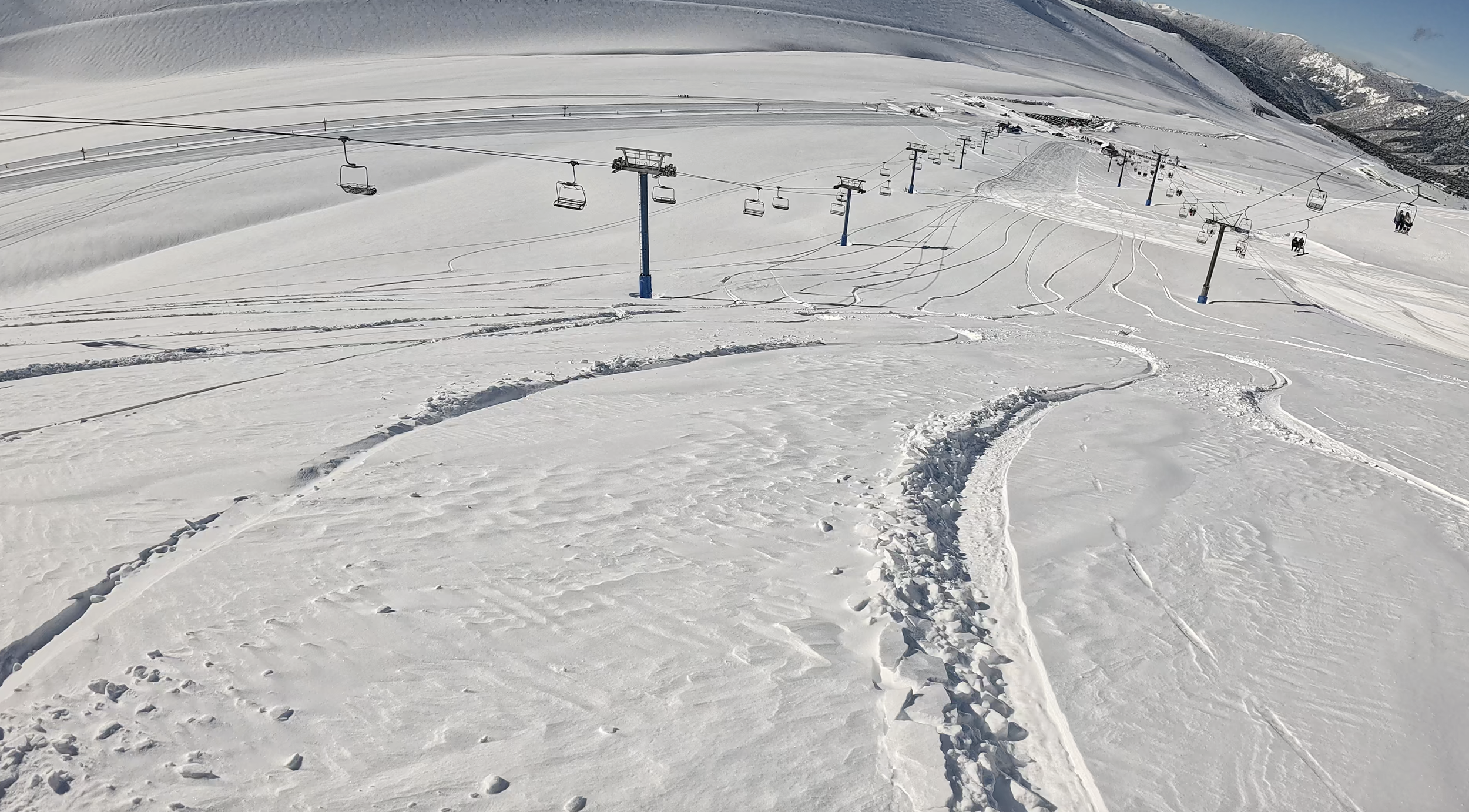
Chile’s newest detachable lift at Corralco, installed last year (and not operating on the day this picture was taken).
However, these factors don’t explain everything. Take surface lifts, which Andean resorts still heavily rely on and are often cited as the clearest evidence of a cash-starved industry. But while this cheap, wind-tolerant, easily repaired hardware is certainly favored by economics, many terrain areas at South American ski resorts are far too wind exposed to run anything else. In fact, several resorts that do have chairlifts often have surface lifts as backups in case of severe wind. And this is a phenomenon that is not unique to South America, with regions like New Zealand, Australia, and the European Alps also relying heavily on surface lifts for their most exposed terrain.
Sure, one could argue that better financing access and friendlier construction policy would have produced more modern packages. But a better economy still wouldn’t have produced—over the significant time window under which the industry has existed—more ski resorts, because nobody has found anywhere new to practically put one, even with far better resources.
The Terrain That Never Became A Resort
But with so much snowy terrain across the continent that would never be practical for ski resort development, is the rest of it simply sitting dormant? Well, it turns out that while a significant portion of the Andes is too compromised for traditional ski resort development, South America is a huge destination for more boutique vacations.
Across both Chile and Argentina, a scattering of heli-ski and snowcat operations work terrain that never got lift service. Valle Nevado runs one of the Southern Hemisphere's premier heli operations from its base, reaching tens of thousands of acres beneath 17,000-foot peaks. Las Leñas runs a similar operation as well. Ski Arpa, in the Aconcagua valley of Chile, is cat-skiing only, with no traditional lifts at all. And further south in Argentina, El Azufre exists solely as a cat and heli operation; while it technically sits along a major border crossing between Argentina and Chile, the pass is closed all winter, and the only way to make it up the final stretch of the pass road is to be snowcatted in. But while these opportunities may look very appealing to those searching for an ultra-luxury vacation, the truth is each of these heli and cat-ski terrain zones arrived there because it was the only way they could feasibly be developed. Skiing or riding above 13,000 feet, dropping into extremely slide-prone terrain, relying on slopes that would go on storm hold at a traditional resort more than half the time, and being off roads that are impassable during the winter would never be practical for a normal ski area, but they can still work in the world of guided snowsports experiences.

Heli-skiing is huge in the Andes; not just for tourism purposes, but also because it’s the only feasible way to ski some of the Andean terrain.
Final Thoughts
So this is the story of how South American skiing arrived, and why it remains so frustratingly stagnant. A scattered handful of desirable ski mountains, each developed in the one narrow window where snow, oxygen, access, and demand happened to overlap, each capped in size by the same topography that made it feasible in the first place.
And to see every one of the region’s problems operating at once, you don’t have to look far. The 2026 season has brought some of the most relentless accumulation of any winter in South American history, which on the surface would suggest an incredible ski season. But in reality, the resorts are struggling to function. Portillo’s access highway was continually shut down due to snow for over a month starting from July 14. The Tres Valles access road closed for nearly a week in July as well, with hours-long backups in the days following. And further south, while the access road conditions have been significantly less of a factor, the prominence of those heavily-volcano-based mountains has brought extraordinary wind and partial or full resort closures, while a non-trivial chunk of the lower-mountain accumulation has fallen as rain.
Sure, it’s easy to blame economics here. But give this same mountain range to the wealthiest country on earth and it still runs into the same fundamental issues. Ultimately, the Andes are quite an exceptional place to ski or ride, but the same can’t be said for building out the infrastructure needed to make that happen.