Mountain Review: June Mountain
MOUNTAIN SCORE

CATEGORY BREAKDOWN
See our criteria
7
Snow:

6
Resiliency:
5
Size:
5
Terrain Diversity:
6
Challenge:
5
Lifts:
6
Crowd Flow:
5
Facilities:
6
Navigation:

8
Mountain Aesthetic:
GOOD TO KNOW
1-Day Ticket: $119-$169
Pass Affiliation: Ikon Pass
On-site Lodging: No
Après-Ski: Limited
Nearest Cities: Mammoth Lakes (30 mins), Reno (2.5 hrs), Los Angeles (6 hrs)
Recommended Ability Level:

+ Pros
Beautiful footprint
Low-traffic mid- and upper-mountain trails
Free tickets for kids 12 and under
– Cons
Woefully outdated out-of-base lift setup
Awkward mountain layout
Limited true beginner terrain
MOUNTAIN STATS
Lifts: 6
Trails: 41
Beginner: 15%
Intermediate: 40%
Advanced/Expert: 45%
VIDEO
Mountain Review
When it comes to skiing and riding in California, there are few resorts that can still make the case for being off the beaten path. June Mountain might be one of the remaining exceptions. With a location about two dozen miles north of Mammoth, modest visitation, and a marketing campaign that leans heavily on family friendliness, the resort might seem like a strong alternative to the bigger destinations for your next peak-time ski trip. However, it turns out there’s a bit more to the family-friendliness story than June Mountain would have you believe. So is June the right pick for your next ski trip? Let’s jump in.
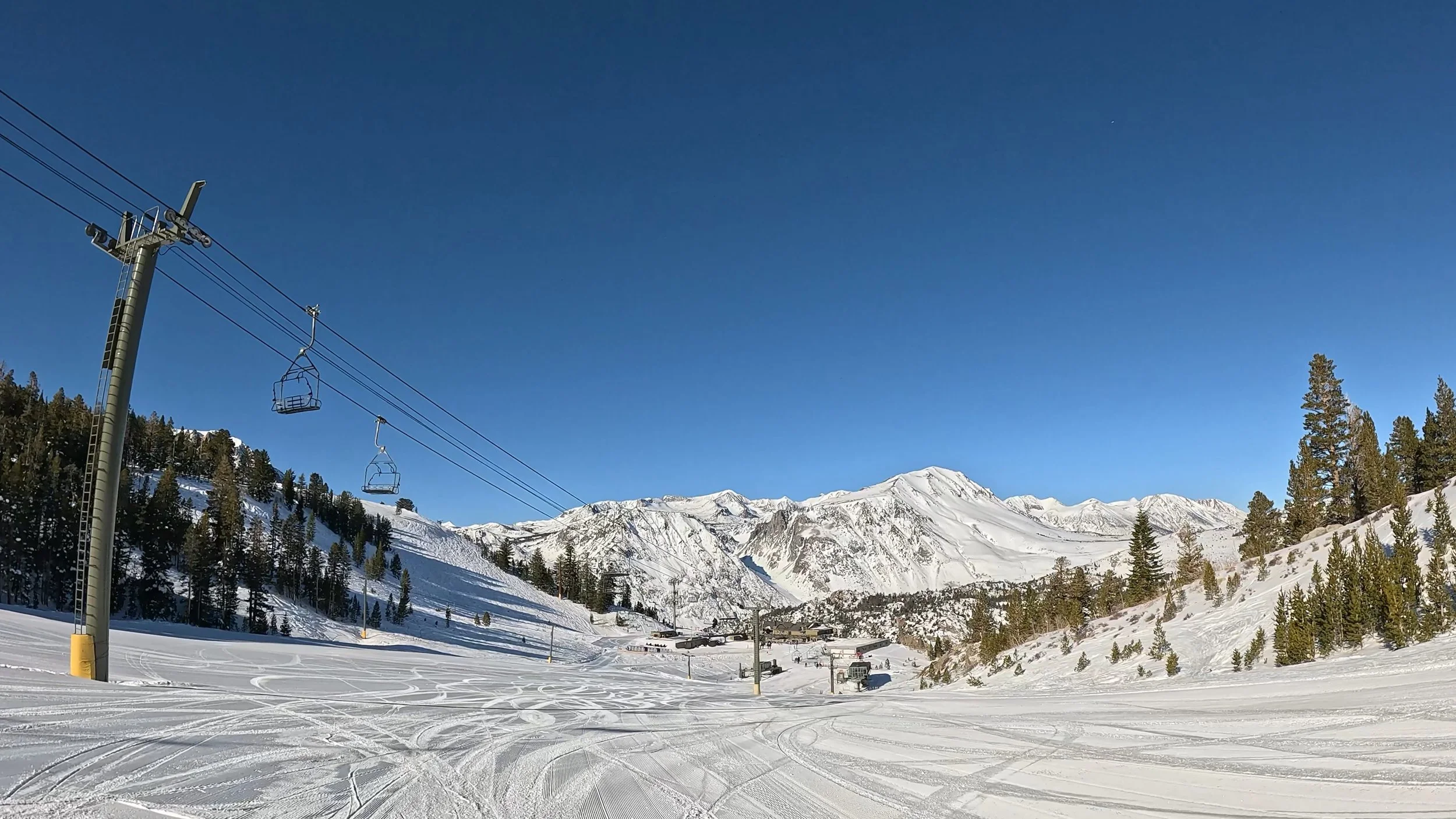
June isn’t the biggest resort in the world, but it boasts incredible views of the Eastern Sierra mountains.
Mountain Layout and Aesthetic
With about 925 skiable acres, June’s terrain footprint as a whole is modest in size. The footprint variety might appear pretty modest too, and none of the inbounds terrain is above treeline. That said, the views of the surrounding Eastern Sierra mountains on clear days make the resort feel bigger and more dramatic than it skis.
Indeed, June’s aesthetic is one of its strongest attributes. There are beautiful views of surrounding mountains and the nearby valley from the slopes, including some views of June Lake itself from mid- and lower-mountain areas. The views include fully above-treeline peaks right in your face, which is very rare in the Sierra and gives the mountain a uniquely striking atmosphere.
Despite not being the biggest in the world, the resort is broken up into several distinct terrain pods, in large part due to a somewhat unorthodox topography.
Beginner Terrain
June Mountain has a good number of things going for it for beginners, but, for such a family-oriented mountain, there are some significant drawbacks as well. Official green terrain is relegated to the small J2 and J3 pods, which effectively function as the resort’s learning areas; all other greens are only accessible by taking a blue run first.
However, trail ratings are often on the easier side, making some of the blues accessible for skiers and riders who would otherwise stick to greens at other mountains. Perhaps the most notable example of this is the Silverado trail, which was actually marked as a green until the early 2010s. The biggest issue for beginners, however, may be that there is no beginner way down from mid-mountain to the base, which creates a more frustrating operational condition than one might expect on paper. Those who can’t ski or ride the blue trail down will need to download the J1 double chairlift to get back to their cars, which involves an awkward, sometimes scary experience given the steep ride down. Not all less-experienced guests will enjoy this, especially when most competing mountains don’t require beginners to do downloading of any kind.
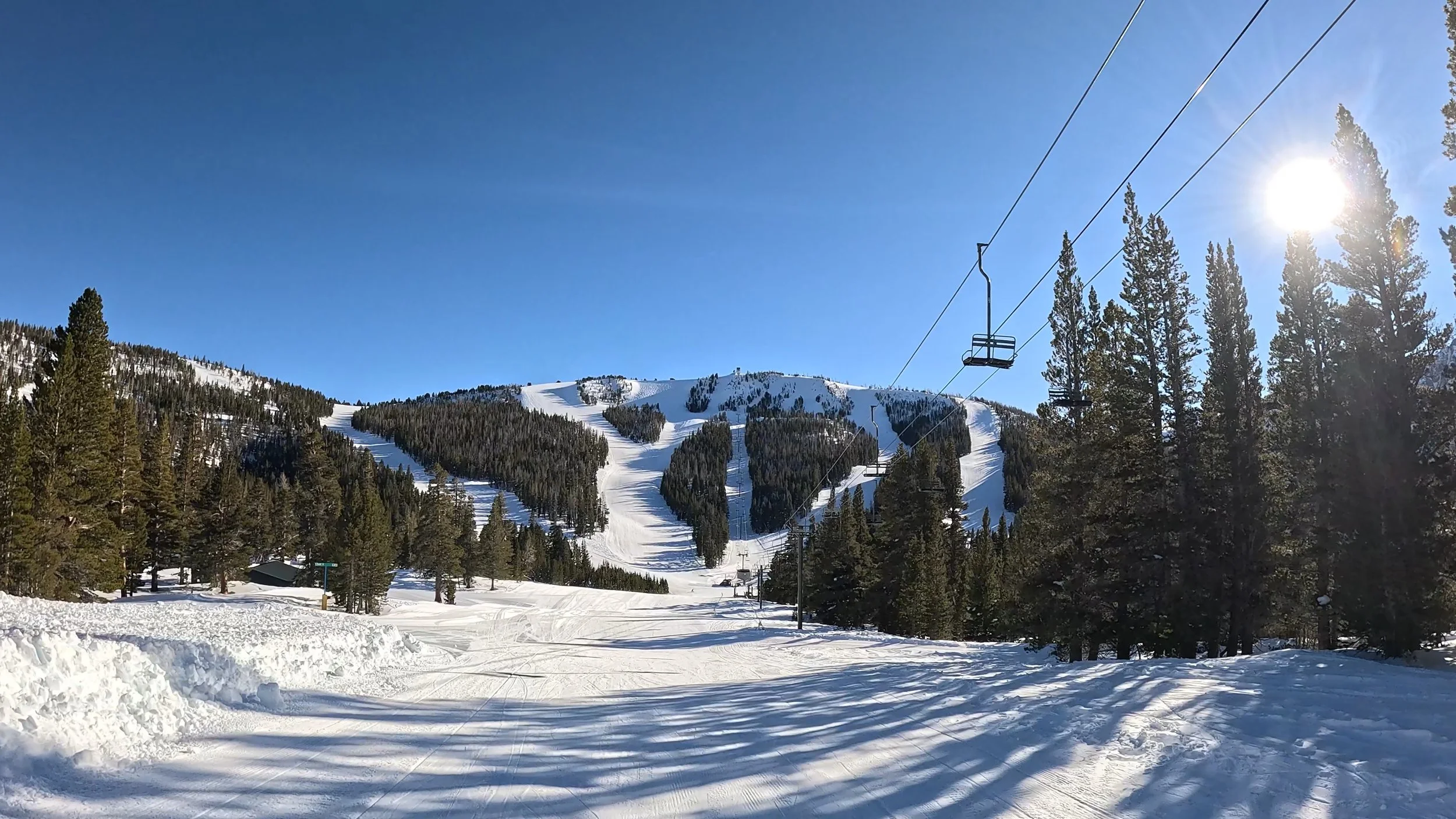
June’s true beginner terrain is fairly limited, but options become more appealing once guests can handle the resort’s blue trails.
Intermediate Terrain
June Mountain has solid terrain for intermediates, but like with the beginner experience, there are a few issues. The main blue pod at the resort is J6, with a good number of low-intermediate cruisers. Some shorter blues off to the skiers’ left side of J6 are more calibrated to the difficulty level at a typical resort. That said, the runs off this lift are bogged down by a lengthy flat spot in the middle of the pod, with the problem getting worse the further to the skier’s left you go. This is frustrating because J6 is the longest and one of the most convenient lift pods at the resort, although most runs can be lapped before the flat spot happens by utilizing the J4 lift (although that lift is pretty slow). The J7 lift has a handful of shorter but enjoyable intermediate cruisers as well, although to get there from J6, you do have to engage in a little bit of, you guessed it, flat terrain. The two blue trails off the J2 terrain pod also involve fairly protracted flat spots at the beginning. One notable positive of the intermediate experience is that the upper mountain is home to solid, moderately-sloped glade terrain when conditions allow.
Terrain Parks
June Mountain offers a few terrain park areas each season, typically centered around the J2 lift. Guests can expect small boxes, rails, jumps, berms, and rollers, but the entire park system is designed to be small and family-friendly, meaning you probably won’t be hucking anything crazy here.
TRAIL MAP

Advanced Terrain
Single black terrain exists only in the J1, J2, and J7 pods, with much of it groomed. Since J1 is not the most reliable and J2 only serves one black trail, J7 stands out as arguably the best part of the resort to lap for people who don’t want to spend time on mellow terrain. It is shorter than the J6 pod we covered earlier, but it offers sustained vertical with no flat spots. The majority of the single-blacks off J7 are groomed, allowing for serious speed runs, although they are still easier than blacks at many destination resorts. The ungroomed Wall trail off J2 offers a strong mogul challenge, offering a fantastic view of the mid-mountain complex and nearby June Lake, and the small amount of single-black terrain served by J1 offers a decently challenging descent back to the base when conditions allow.
Expert Terrain
Despite the fairly mellow terrain across most of June Mountain, there is a substantial step up in difficulty when moving into double-black terrain at the resort. June’s hardest marked trails are very steep and ungroomed, with even some cornice drops depending on where you look. J1 has the most sustained and largest quantity of steeps at the resort, making it a solid option if you are looking for expert terrain. However, the lower elevation means variable conditions and inconsistent openings. Some J1 double-blacks can only be accessed by riding to the top of J2 first, making them kind of hard to find but offering slightly better snow retention and more vertical than the ones directly down from the mid-mountain lodge. Like with single-black runs, J7’s expert terrain is by far the most reliable at the resort. And while the J7 double-blacks are shorter than those off J1, they offer very steep pitches and a handful of surprisingly technical sections as well.
Backcountry
June Mountain also offers surprisingly strong access to backcountry terrain, with a gate at the top of J7. That said, this terrain doesn’t filter back into the resort and is best explored with a guide and life-saving equipment like a beacon, shovel, and probe.
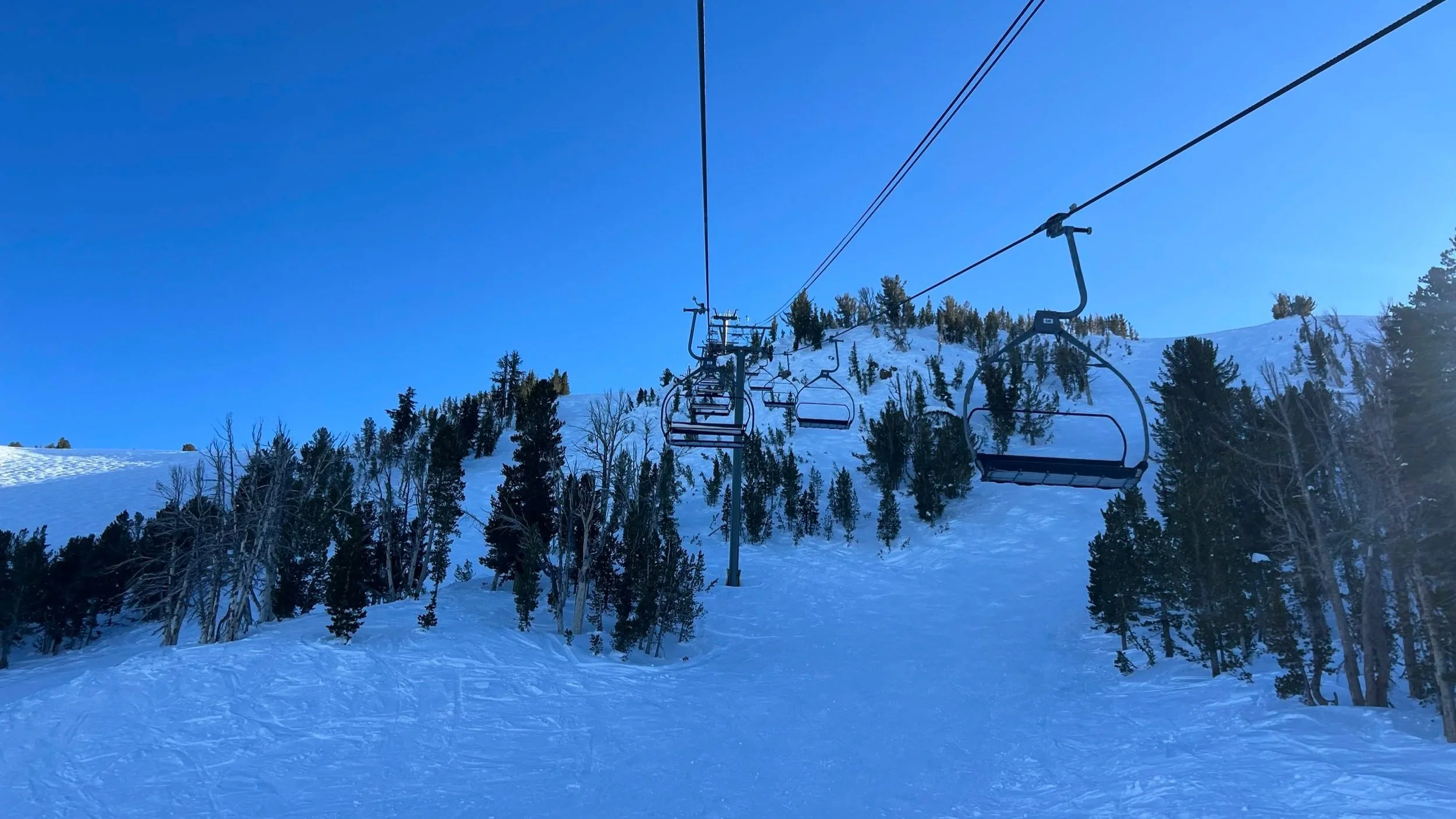
Despite its family-friendly reputation, June Mountain has some notably technical terrain if you know where to look.
Snow Quality and Resiliency
Thanks to its eastern Sierra location, June Mountain typically sees decent snowfall totals each winter and a secure base in upper-mountain areas. However, the resort doesn’t benefit from as favorable accumulation totals as nearby Mammoth, which sits at a largely higher elevation and catches storms more consistently.
That said, June’s more sheltered footprint provides resilient operations during storm days, and the entire mountain will often still be operating when many of Mammoth’s lifts are on wind hold. However, conditions on June’s lower-mountain J1 pod are more variable than the rest of the mountain because of the lower elevation. The terrain here can sometimes be partially or fully unskiable, requiring guests to download the J1 chairlift to leave the resort.
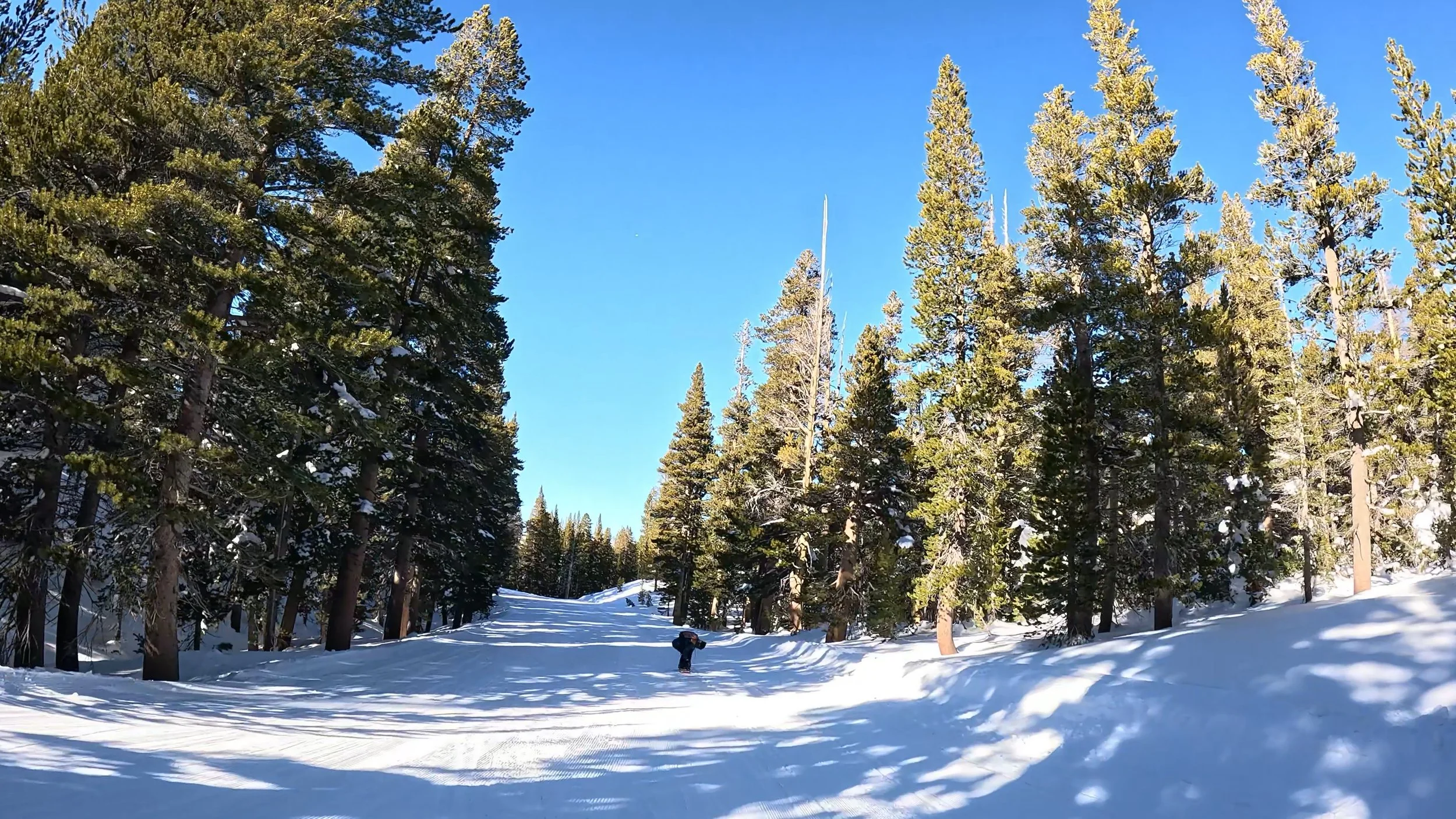
Dealing with flat terrain is a frequent drawback to the June Mountain experience.
Navigation
As a relatively small resort, getting truly lost at June won’t be a serious concern. But as we alluded to earlier, the bigger navigational problem comes with the resort’s awkward layout. When descending from the top back to mid-mountain, it’s hard to avoid at least some flavor of flat terrain, with the problem getting worse as you make your way further to the skiers’ left. By the time you get to the green run out from the bottom of J4, it is essentially just a catwalk. Once you get far enough left to the point that’s you’re ending up at the bottom of J7, there is no trail back to the lodge at all; instead, you have to take the slow but short J3 chair to get back. While this complaint may sound specific, it impacts nearly every part of the resort outside directly lapping some short beginner and expert-oriented terrain pods.
In general, trail signs at June are well placed with good lift and facilities markings, but there could be more trail maps placed around the resort. In addition, some signs are now slightly inaccurate, with the Rainbow Ridge trail, which was remarked as a blue a few years ago, still signed as a green on the mountain. At least the bottom of the chairlift that accesses it, J6, does have signage saying there’s no beginner terrain up there.
RECOMMENDED SKIS FOR JUNE MOUNTAIN
NOTE: We may receive a small affiliate commission if you click on the below links. All products listed below are unisex.

Recommended all-mountain ski

Recommended carving ski

Recommended glade ski

Recommended expert/touring ski
Lifts and Crowd Flow
On paper, June Mountain’s lift setup isn’t the worst in the world. The upper mountain lapping pods are held down by two high-speed quads, J6 and J7, with the former serving intermediate terrain and the latter serving more advanced runs. Some other mid-mountain lifts are old and slow, but they’re short and often avoidable, albeit with some of that avoidance requiring slogging through flat terrain.
But the Achilles’ heel of June Mountain’s lift system—and one that ultimately cascades into numerous broader problems with the resort’s overall experience—is the slow, fixed-grip J1 lift providing the only access out of the main base. J1 is an ancient center-pole double chair that is over six decades old. To the resort’s credit, it is one of the only center-pole doubles out west with a safety bar, although the safety bar is an odd sideways folding contraption. But this lift is a major chokepoint.
Even though June does not get anywhere near the traffic of Mammoth, J1’s combination of low capacity and non-existent redundancy creates significant lift lines. On peak weekends or holidays, waits at the bottom often range from 30 minutes to an hour, and in the worst-case scenario, they can even stretch to an hour or longer, with lines extending all the way out of the parking lot and into town. Lines are typically worst from around 9 to 11; if you get there early and ride when it starts spinning around 8, you can avoid the worst of it.

The ancient, low-capacity J1 double chair provides the only out-of-base access at June and sees significant lift lines during peak times.
The situation is made worse by the mix of users funneled onto the lift. Because so many beginners ride J1, there are lots of misloads, which slows things down even more. As we mentioned earlier, J1 offers downloading from the mid-mountain—but when lower-mountain conditions aren’t ideal, all guests will need to download J1 to leave the resort, not just beginners. This creates even more delays and can often result in significant lines simply to leave the resort, most often during the beginning or end of the season. On center pole lifts, solo riders must load on the inner side, and they enforce this strictly. If you load on the outer side, they will stop the lift and make you reload.
J1 would be a much better lift if it were just for lapping expert terrain, but because it is also used by literally everyone to get up the mountain and for downloading, it becomes far less practical to take advantage of the resort’s natural steeps in this area on busy days, even if conditions are prime for it.
This all being said, other lifts basically never have lines.
It is worth noting that June’s lower-mountain lift issues didn’t always exist. From the mid-1980s to the mid-1990s, the resort operated a flagship funitel known as the QMC. It ran parallel to J1, which was at the time effectively a backup lift, but it was ultimately removed due to design flaws. Remnants of that lift still exist, including a large bridge near the mid-mountain lodge from the former top terminal, and the old lift line remains visible to the looker’s right of J1.

The most popular place to stop in for a break is June’s mid-mountain lodge complex, although it does get packed during peak times.
On-Mountain Facilities
June Mountain’s capacity issues, exacerbated by the reluctance of most of its guests to drop below mid-mountain before the end of the day, extend to its on-mountain facility setup. The mid-mountain June Meadows Chalet lodge is not big enough for the holidays, and there is often a rush to get a table, with lots of people standing up eating. Food is decidedly overpriced, although it is understandable given that people are willing to pay a premium to avoid going back down and dealing with the J1 experience again.
To give the resort some credit, there are a few alternative options open on weekends and holidays. There’s a to-go shack outside the mid-mountain lodge if you don’t want to deal with the crowds inside, and the resort does have another upper-mountain lodge near the bases of the J3 and J7 lifts called Slim’s Cantina, although it’s pretty small and short on space as well.
RECOMMENDED SNOWBOARDS FOR JUNE MOUNTAIN
NOTE: We may receive a small affiliate commission if you click on the below links. All products listed below are unisex.

Recommended intermediate board

Recommended advanced board

Recommended expert board

Recommended touring board
Getting There and Parking
June Mountain is not particularly easy to access, and its location creates some unusual tradeoffs depending on where you’re coming from. From Los Angeles, the drive is roughly 5.5 to 6 hours in good conditions. But from Southern California, the resort is actually further north than Mammoth, meaning you have to drive past Mammoth Lakes—already a larger, more developed destination—to get there. That alone makes June a tough sell as a primary destination for most Los Angeles-based skiers and riders.
From the north, June is about 2.5 to 3 hours from Reno. While that’s closer than Mammoth, it puts June in direct competition with the Tahoe resorts, which are significantly closer, easier to reach, and generally offer larger footprints and more developed infrastructure.
The final approach into June Mountain can also be a concern. The access road is known to be sketchy and isn’t always well-plowed, which can make the last stretch of the drive more challenging in winter conditions. Ultimately, while June is not remote in an absolute sense, its location relative to stronger nearby options—and the quirks of actually getting there—make it harder to justify from a logistics standpoint.
On the plus side, parking at June is free. That said, the main base area lot is relatively limited in size, and on busier days it can fill up quickly, with no great overflow options. When that happens, some visitors may attempt to park along the road closer to June Lake, but law enforcement is strict and will ticket cars. At least the limited parking puts a hard cap on how truly bad the J1 lift lines can get.
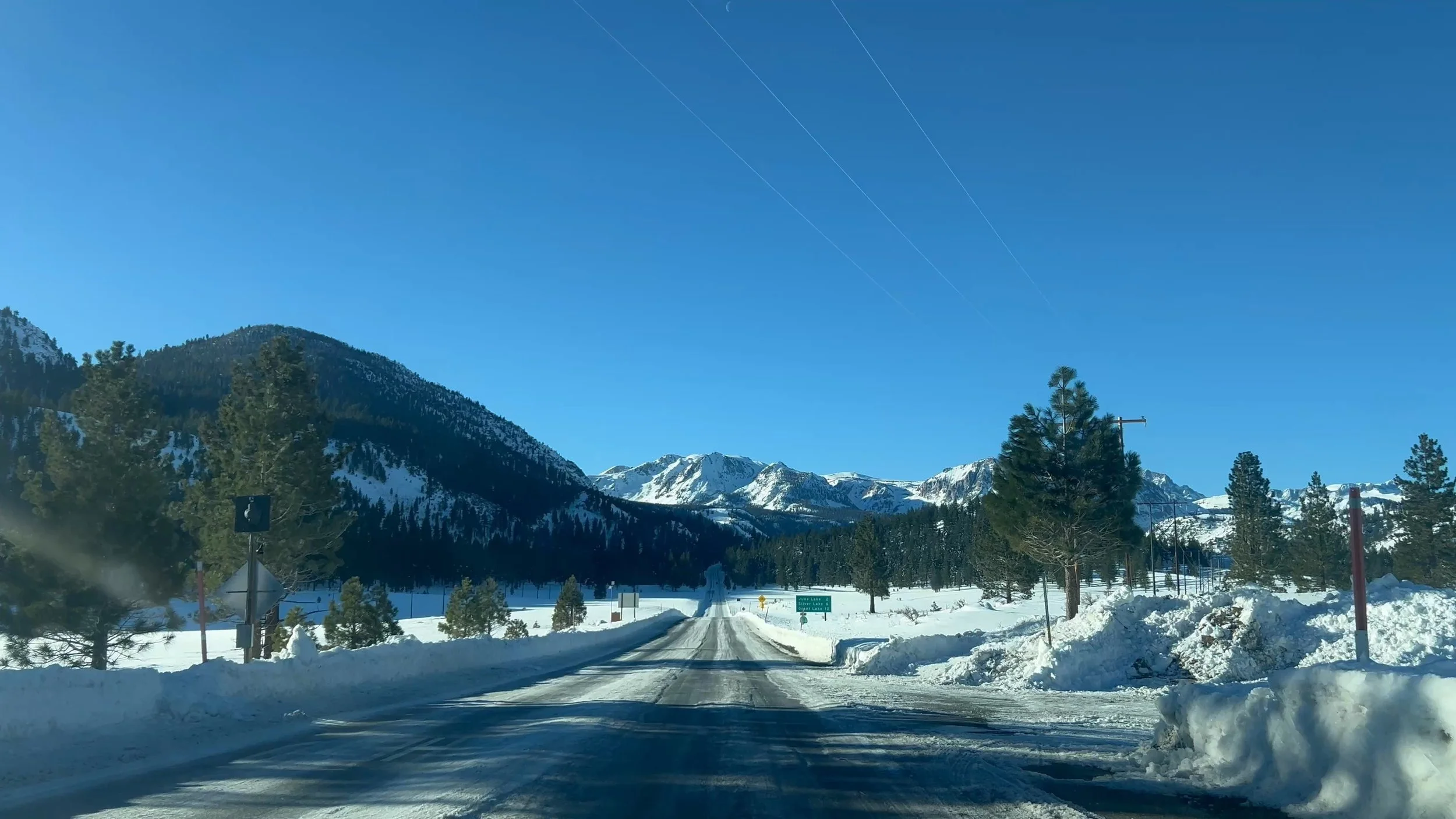
The final access road drive to June Mountain can be difficult in the winter.
Lodging and Après-Ski
While June Mountain doesn’t have any on-site lodging, the town of June Lake offers a small selection of hotels, motels, cabins, and vacation rentals just a few minutes from the base. However, the overall lodging selection there is limited, with the options that do exist generally being more rustic with fewer amenities.
As a result, many visitors choose to stay in Mammoth Lakes, about 25-30 minutes south, where there is a much wider range of lodging and much more to do.
Speaking of things to do, the town of June Lake isn’t all that strong for après either. Those looking for nightlife will once again be better off basing themselves in Mammoth Lakes.
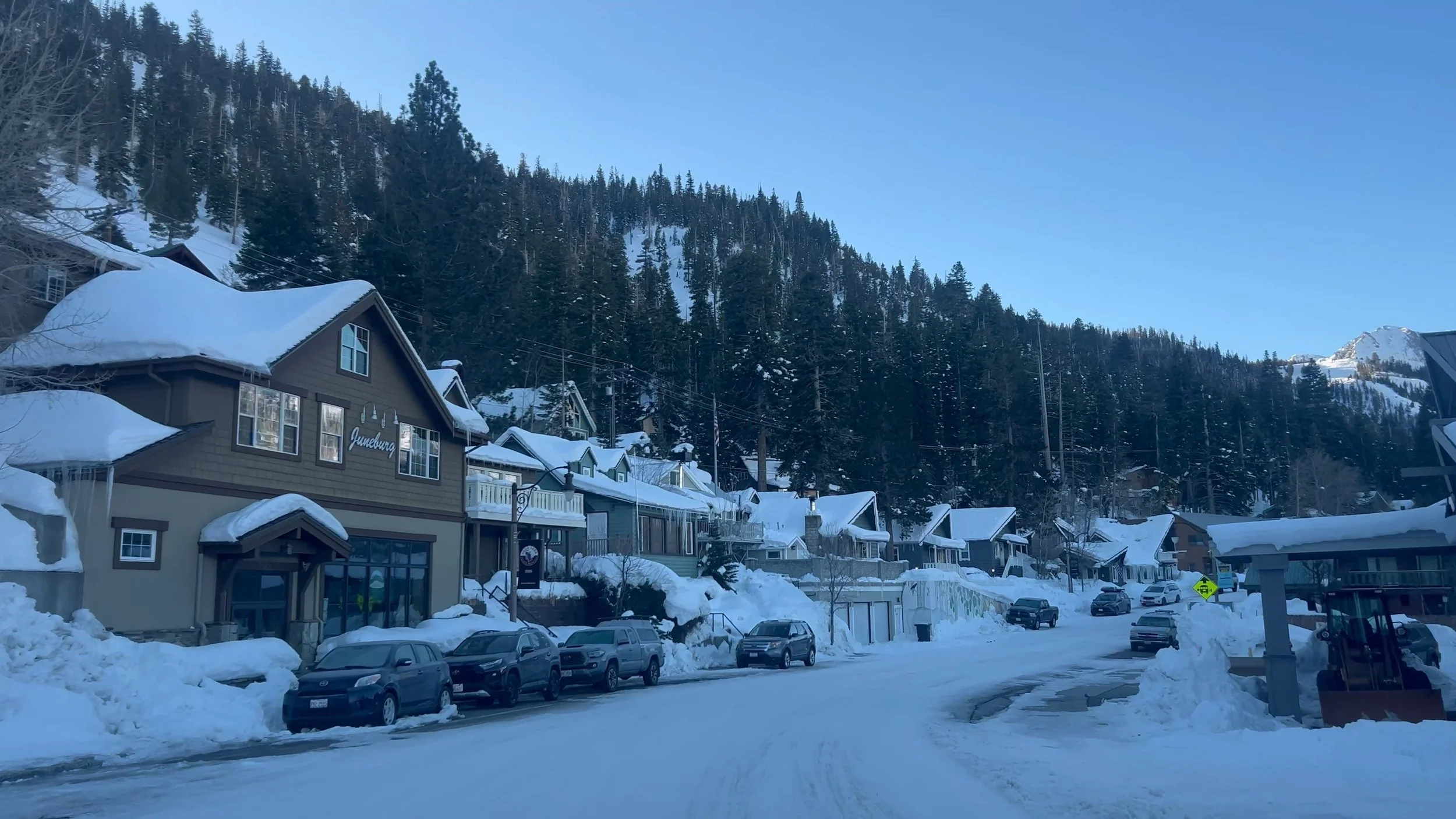
The town of June Lake is sleepier than nearby Mammoth Lakes.
Verdict
June Mountain’s unusual circumstances get at the heart of its broader reality: it’s probably not closing in the near future, but in many ways, it makes very little sense for most skiers and riders. It’s not as crowded as most other California resorts, but it can experience horrific lift lines due to the inadequate lower-mountain lift setup. It has a more family-friendly atmosphere than Mammoth, but the ride up and down the J1 chair will be downright scary for some kids. It’s further away from Los Angeles than Mammoth, and while it’s closer from Reno, it’s then competing with the Tahoe-area resorts, which are a lot closer and often times bigger.
Pricing
June’s biggest benefit may be that in terms of family friendliness, it puts its money where its mouth is. Kids 12 and under ski or ride the resort free, and it is the only ski resort in the state of California to offer such a benefit. However, if you are an adult, despite the resort being an unlimited member of the Ikon Pass and home to some early-season Quad Pack deals, lift tickets still top out at an outrageous $169.